• Skip to primary navigation
  • Skip to main content
  • Skip to primary sidebar
  • Skip to footer
Next Stage – Social Impact Services

Next Stage - Social Impact Services

Social good strategy to amplify your impact

  • Who we are
  • What we do
  • Who we serve
  • Resources
    • Impact Stories
    • News & Insights
  • Contact
  • Newsletter
  • fb
  • in
  • ins

Nonprofit Leadership

Why Strategic Planning Can’t Wait: Preparing for Social Good’s Greatest Challenge

January 5, 2026 by joshjacobson

It is now 2026. A new year. And with it comes no shortage of uncertainty about how social good will fare in the months and years ahead.

With so many variables at play, you may be asking yourself: Is now really the time to embark on a strategic planning effort?

Pardon the colorful language, but hell yes.

Organizations that elect to take a “wait-and-see” approach — or focus only on the next calendar year without considering what comes after — are likely to be unprepared when the worst of the disruption arrives in early 2027.


Revisiting the One Big Beautiful Bill

I hate to do this so early in the new year, but some may need a reminder: a tsunami of epic proportions is approaching. Federal policy change in the form of the One Big Beautiful Bill (OBBB) will disrupt everyone. It feels like watching a car wreck in slow motion. We know the outcome, and yet there is very little we can do to stop it.

But maybe your area of human services wasn’t mentioned in the bill. Maybe you think this doesn’t apply to you. Maybe you believe you’re the one organization that can rest easy.

Think again.

While the impact of the bill to date has been largely administrative, in early 2027, people will roll off Medicaid in large numbers — and they will lose much more than just access to healthcare.

Medicaid is one of the largest funding mechanisms for addressing the social drivers of health, which include food access, housing stability, and transportation. And when people lose Medicaid coverage, the burden for meeting those needs will not disappear. Instead, it will shift to state governments, local municipalities, nonprofits, and philanthropy, and the challenge that creates is sobering. In our home state of North Carolina, NC DHHS estimates that nearly $50 billion in federal Medicaid funding will be lost over the next decade. No state can absorb that level of loss and continue operating as before. Simply put, there is no realistic way for the gap created by federal spending cuts to be made up elsewhere. It is too large a shortfall to backfill. 

At Next Stage, we believe this represents the single greatest challenge to social good in our lifetimes — one that will manifest in predictable ways:

  • Increased competition for resources. Everyone will be competing for a much smaller pie, forcing painful decisions for boards, executives, and funders alike. The desperation this creates will likely produce false choices about what matters most in sustaining healthy, safe, and affordable communities.
  • Surging need as services shrink. As resources contract, need will continue to grow. When people experience unmet needs — food insecurity, housing instability, untreated health conditions — those pressures do not stay contained. They ripple outward. Families across income levels will feel the consequences of communities under strain, and the calls for solutions will intensify even as capacity declines.
  • Continued politicization of settled assumptions. All this is unfolding in a moment when there is deep disagreement about what it means to be an American. Ideas that once felt broadly shared — that people deserve access to health, opportunity, and dignity — are increasingly contested. Addressing barriers to access becomes more difficult when the language of equity itself is under attack.

That’s why the work in front of us should not focus on overcoming this disruption — that is not where we are. Going forward, the social good sector must work to minimize harm, manage contraction, and make hard choices as thoughtfully as possible.

But without a shared internal framework to create alignment, clarity, and discipline in decision-making, institutions may risk their own sustainability moving forward.

So what does this mean for your nonprofit, government agency, or philanthropic organization? Strategic planning.


A Passionate Argument for Strategic Planning

Strategic planning differs from annual planning or budgeting exercises. And especially in uncertain times, it can be a powerful way to help your organization make intentional operational choices.

The most effective versions of strategic planning include:

  • A focus on external data. Strategic planning forces organizations to look outward — at policy shifts, demographic trends, funding trajectories, and community needs — rather than relying solely on internal performance or historical success. In moments like this, intuition and gut feelings are not enough.
  • Greater clarity on perception and reality. Many organizations believe they understand their position in the ecosystem. Strategic planning creates space to test those assumptions. What role do you truly play? Where are you indispensable? Where are you replaceable? These are uncomfortable, yet necessary, questions.
  • A multiyear horizon. Annual planning keeps the lights on. Strategic planning prepares you for what’s coming. A multiyear horizon allows organizations to scenario-plan, sequence decisions, and avoid reactive whiplash as conditions change.

Strategic planning matters in moments like this because it creates shared discipline when instinct pulls leaders in different directions. It gives boards, executives, and staff a common set of assumptions to work from, a clear understanding of tradeoffs, and an agreed-upon rationale for difficult decisions. Without that alignment, organizations drift into reactive mode — chasing funding, protecting legacy programs, and deferring hard conversations until options narrow. 

A strong strategic plan does not eliminate uncertainty, but it does provide a stable platform for making choices grounded in reality as conditions continue to change.


Our Commitment to You

While we will continue to track and share updates on the impacts of federal spending cuts throughout the year, our central focus will be on supporting you, your organizations, and the communities you serve by highlighting tangible ways social good leaders like you can get actionable.

Because we believe informed, intentional efforts are the best — and only — way forward.

Our collective legacy, as organizations, as communities, and as people, will be defined by how we respond to this moment. This is an eyes-wide-open period. The decisions made now will shape what survives, what adapts, and what is lost.

We stand ready to support you as you navigate the future. Reach out to set up a call today. 


Want the latest social good trends, insights, and inspiration delivered straight to your inbox? Subscribe to the Impact Insider today!

Filed Under: Nonprofit Leadership, Planning & Implementation, Thought Leadership, Uncategorized

10 Trends That Will Shape Social Good in 2026

December 5, 2025 by joshjacobson

Every December, the Next Stage team looks back across the year’s retreats, board meetings, listening sessions, late-night conversations, and messy whiteboards. That’s where the real story lives — in the patterns that start to emerge from the lived experiences of leaders trying to navigate an increasingly complex landscape. You can feel when something in the ecosystem shifts, even before the headlines catch up.

2026 won’t be gentle. It will be a year defined by adaptation, creativity, and a reckoning with systems that are stretched thin. Yet I’m encouraged, because our sector has always shown its best instincts when we stop waiting for ease and start building for what’s next.

Here are six trends I believe will shape social good in the coming year:


 1. Innovation Becomes a Requirement

Innovation is one of those things that tends to thrive when times are tough. When the world of social good feels relatively stable, there may be more financial resources available for testing new approaches, but institutions often lack the urgency and appetite for the change management needed to see them through.

But when the pressure is on, “doing things the way we’ve always done it” stops being an option.

The challenge, of course, is that innovating on the fly can feel risky and chaotic. That’s why the best time to test new methodologies is before the crisis hits, when the stakes are lower and teams have more capacity to experiment.

Still, we’ve seen this sector make some of its most meaningful advancements under duress — most recently during the pandemic, when necessity forced creativity at a scale no one expected. If 2026 continues its current trajectory, we’ll need that spirit again. Innovation isn’t a luxury anymore. It’s infrastructure.


 2. Rebuilding Trust Will Be Difficult — But Essential

We’ve talked a lot about trust this year, and for good reason. Communities are waking up each morning to a landscape that feels less stable and less safe than it did just a few years ago.

BIPOC residents have watched the progress made under diversity, equity, and inclusion efforts be rolled back — in many cases literally deleted from nonprofit websites. Families in our own city of Charlotte hesitated to leave their homes after recent actions by Customs and Border Protection. The trauma of these moments is real, layered on top of the lingering disruption of the COVID-19 pandemic.

Service providers are carrying that weight. Communities are carrying it.

Rebuilding trust won’t happen through a new program or a sharper tagline. It will take sustained, visible investment in relationships and transparency — at both the organizational and community-wide level. “Who are we?” is a question every community leader should be asking as the new year crests. The answers won’t come quickly, but they matter more than ever.


 3. AI’s Move From Experiment to Infrastructure

Artificial intelligence is changing the way work gets done, and nonprofits — long understaffed and overstretched — are feeling its impact quickly.

Executives now have something they’ve never had before: a powerful productivity partner sitting on their desktop. A grant application due tomorrow? No problem. Need to untangle an HR issue? AI can surface options in seconds. Administrative teams that have been underwater for years finally have a lever that helps them breathe.

The next frontier is shifting from staff experimenting with AI in isolation to the development of organizational adoption strategies — policies, workflows, expectations, and guardrails.

We predict that 2026 is the year nonprofits begin institutionalizing AI. It will reshape job descriptions, performance expectations, documentation practices, and capacity models across the sector.


 4. A Deepening of AI’s Impact on Social Good Mission Delivery

If AI is transforming nonprofit operations, its effect on mission delivery may be even more profound.

Next Stage works with many organizations focused on workforce development, and the landscape is shifting quickly. For years, STEM training was held up as the ticket to economic mobility — “learn to code” was the refrain. But as developers face layoffs due to AI automation, that assumption is shifting.

Trades educators from carpentry to HVAC repair are positioning their fields as “AI-resistant,” and they’re not wrong. The promise of technology as a universal upward-mobility path needs a fresh look.

Beyond workforce development, AI is reshaping healthcare, human services, climate resilience, and philanthropy. It brings incredible potential, but also new questions about equity, ethics, and long-term opportunity.

We expect 2026 to be the year AI takes center stage in the larger fight for social and economic mobility, and every mission-driven organization will feel its ripple effects.


5. A Renewed Focus on Individual Philanthropy 

Organizations overly dependent on institutional support — foundations, corporations, or government agencies — are heading into choppy waters.

As the most consequential elements of the One Big Beautiful Bill Act begin to take hold at the end of 2026, federal funding shifts will act as a force multiplier. The domino effect threatens the sustainability of countless programs and institutions.

This is the moment when individual donors step forward. What we call “elective taxation” — individuals voluntarily fueling causes they care about — is poised to become a defining factor in who survives and who struggles.

We’ve talked about this trend throughout the year, and all signs suggest it will accelerate in 2026. Organizations with clear messaging, strong stewardship, and genuine community alignment will be the ones positioned for stability.


 6. Gen X Steps Up

The times, they are a’changing. As a member of Gen X myself, I’ve long wondered what it would look like when the Baby Boomer generation began handing the torch to us. We’re now seeing it happen.

The oldest Gen Xers turned 60 this year. Many are still in the workforce, at the height of their earning potential, and stepping into leadership roles across sectors. Our hopes for increased philanthropy need them — especially as Boomers shift into more fixed-income mindsets around giving.

But Gen X is not a monolith. If organizations want to engage this cohort effectively, segmentation, persona-building, and the adoption of an acquisition mindset are essential.

This is a year tailor-made for new approaches to brand marketing, with institutions examining who they’re speaking to and why it matters. At Next Stage, we’re gearing up for a big year in 2026 because we believe Gen X will shape the next chapter of social good.


 What Our Team Is Watching 

One of the advantages of working at Next Stage is that our team views the sector through many different lenses — workforce development, health equity, philanthropy, community engagement, culture-building, and data and evaluation. We are in rooms with people solving very different problems, and we see the through-lines that connect them.

So after reflecting on my own predictions, I asked my colleagues to share the trends they’re watching as we head into 2026. Their insights add important texture to the picture and underscore how interconnected these shifts truly are.


 7. A Push for Partnerships to Address Public Health Infrastructure Gaps 

—Jalah Blackmon, Director of Impact for Health

One concerning trend I’m watching is the quiet erosion of our public health infrastructure. We’re seeing holes left by job turnover in government agencies, and with that, a real fragility in the systems we rely on. As a new parent, I was alarmed to learn during my child’s early doctor visits that the CDC’s vaccine schedule was temporarily unavailable online. Key datasets and alerts are becoming inconsistent or disappearing altogether, creating a dangerous void that challenges public trust and health equity.


Yet, I’m optimistic. Health-focused nonprofits and community-based organizations are stepping into the gap as temporary librarians and translators of essential information. The increased focus on the social drivers of health and lessons from the pandemic have equipped them to provide trusted, hyper-local outreach. It’s a powerful testament to the sector’s agility.


This interim work is crucial, but underscores an urgent call to action. We must come together across sectors to defend and restore a public health system that doesn’t leave anyone behind. Protecting our most vulnerable isn’t just a healthcare issue; it’s a test of our collective commitment to a healthy society.


8. A Shift in Strategy Horizons 

—Caylin Haldeman, Director of Strategy

Across my work with Next Stage clients and leading internal strategy, one pattern is showing up again and again: the speed at which the world is changing and communities are organizing far outpaces the speed at which institutions and organizations are planning. The three-to-five-year strategic plan — once a reliable anchor — feels increasingly misaligned with a world shaped by policy volatility, funding whiplash, and localized crises that unfold on weeks-, not years-long, timelines. Meanwhile, grassroots groups and informal networks are adapting in near real time, guided by proximity, trust, and an ability to move without bureaucratic drag.

In 2026, I believe the most resilient and impactful organizations will rethink not just what they plan, but how far out they plan. Strategy will need shorter horizons, lighter structures, and stronger feedback loops — designed for calibration, not prediction. Long-term vision still matters. What’s changing is the operating posture required to sustain it: governance models that absorb uncertainty, funder relationships that allow for course correction, and measurement systems that surface signals early rather than reporting outcomes too late.

The organizations that thrive won’t be the ones with the most polished plans. They’ll be the ones that treat strategy as a living practice — and build the muscle to respond as conditions, and communities, change.


 9. An Increased Need to Meet Donors Where They Are Scroll

—Nora Hines, Marketing Manager

Vertical video content will only become more essential in 2026. With 41% of Gen Z and 24% of Millennials being motivated to support causes based on what appears on their social media, and short-form video content consistently performing better on TikTok and Instagram, social good organizations that fail to prioritize video-first storytelling risk missing out on significant swaths of the younger generations. Posts with images already see 650% more engagement than text-only posts, and video only further amplifies this effect.

And the good news is, you don’t have to have an in-house TikTok expert on your team to pull this off. In 2026, nonprofits can (and should!) tap into their existing community for content creation. Organizations can reshare videos from volunteers on the ground, ask donors to explain why they give, and turn testimonials into Instagram Reels. Successful nonprofits will crowdsource their video content, giving beneficiaries, volunteers, and young supporters simple prompts to create authentic 15-30 second stories about their experiences with the organization. This user-generated approach solves both the expertise and authenticity gaps, as peer-created content resonates far more with younger audiences than polished organizational messaging ever could.


 10. A Renewed Demand for Authentically Human Visual Designs

—Wendy Orrego, Visual Design Manager

As audiences face information fatigue, fractured attention spans, and growing distrust in institutions, the role of design will shift from decoration to translation, turning complex data, community insights, and impact stories into visuals that people can immediately understand and emotionally connect with.

While AI will continue transforming how creative work gets produced, I predict a strong counter-trend: a renewed demand for authentic, human-centered visuals and storytelling. In a world where almost anything can be generated instantly, audiences will value what feels real — original photography, genuine community representation, and narrative and design choices rooted in lived experience rather than automated templates.


Want the latest social good trends, insights, and inspiration delivered straight to your inbox? Subscribe to the Impact Insider today!

Filed Under: Nonprofit Leadership, Planning & Implementation, Thought Leadership

Getting Your Nonprofit Ready for 2026: An End-of-Year Checklist

November 7, 2025 by joshjacobson

The season of end-of-year leadership retreats are upon us. Next Stage is supporting a number of organizations as they prepare for an unprecedented set of circumstances in 2026, and one thing is certain:

It’s difficult to plan when the ground feels like it’s shifting beneath your feet. 

The ongoing federal government shutdown has created real consequences across the social good sector — for nonprofits, local governments, and even private companies like ours at Next Stage. Many organizations are seeing ripple effects from delayed contracts, paused grants, and reduced cash flow. The reality is that this moment of instability is not isolated, but rather a part of a larger wave of change resulting from ongoing policy shifts and legislative stalemates.

So yes: things feel uncertain. But “wait and see” is not a strategy. Sitting on the fence until the dust settles is the surest way to get left behind. Because what distinguishes resilient organizations isn’t an innate ability to predict the future, but a willingness to prepare for it (uncertain as it might be).

If you’re heading into your end-of-year retreat or annual planning process, here’s a simple checklist to help get your nonprofit ready for 2026.


:ballot_box_with_check: 1. Conduct a Risk Assessment

Federal policy impacts won’t disappear when the shutdown ends. Many analysts predict 2026 will be a staging year for broader spending shifts in 2027, which makes now an essential time to examine your organization’s exposure.

  • Where are you reliant on government contracts or federal programs?
  • How might indirect impacts, like delayed reimbursements, declining consumer confidence, or disruptions to partner agencies, affect your work?

To get started, gather a small cross-functional team, including finance, operations, and program leaders, and spend a few hours mapping your dependencies. Identify all major revenue streams, partnerships, and contracts, then rate each by both likelihood and impact of disruption. Explore: What might happen if this funding source pauses for three months? If this vendor can’t deliver? If this partner downsizes? Document your findings in a simple risk matrix and note which exposures can be mitigated now versus monitored later. 

The Bottom Line: Performing a proactive risk audit can help you identify your exposure before gaps become crises. Use this process to strengthen your balance sheet and clarify your strategy.


:ballot_box_with_check: 2. Gather Metrics and Know Thy Databases

If 2025 has taught us anything, it’s that data clarity equals decision clarity. On the revenue side, review your fundraising or new business data to pinpoint trends:

  • Which funders or customers are dependable?
  • Where are you seeing growth?
  • Where are you overexposed?

On the operations side, consider how your organizational structure supports (or hinders) agility.

Activate these efforts by pulling a year-over-year comparison from your CRM or accounting system. Look beyond totals to instead segment your data by source, type, and relationship length to see what’s really driving results. Then, bring that same discipline to internal metrics: staff capacity, program utilization, and expense categories. Schedule a short data review session with your leadership team to translate those numbers into insights, identifying where to double down and where to pivot.

The Bottom Line: You can’t build resilience on gut instinct alone. Use your databases to guide resource allocation, performance targets, and scenario planning. Numbers tell stories; make sure you’re listening to them.


:ballot_box_with_check: 3. Check In With Peers

You’re not alone in this uncertainty. Every nonprofit executive, municipal leader, and small-business owner is navigating similar headwinds. Rather than making decisions in isolation, use this moment to engage your peers and compare notes on what’s changing.

Create a top-20 outreach list by identifying the leaders and partner organizations whose perspectives you trust the most. Schedule brief, focused conversations – even 20-30 minutes can reveal valuable insights about funding pipelines, staffing shifts, and community demand. Consider hosting a small roundtable or virtual session to surface shared challenges and spark new ideas, and commit to at least one peer discussion each week through February 2026. 

The Bottom Line: Shared learning uncovers blind spots and builds a sense of solidarity across the sector. In volatile times, collaboration becomes a risk-mitigation strategy.


:ballot_box_with_check: 4. What Can We Do About It? An Advocacy Toolkit

Uncertainty is unsettling, but ignoring it doesn’t make it go away. 

Build your framework by outlining three plausible futures for your organization over the next 18 months: best case, middle ground, and worst case. In each, map your financial position, staffing levels, and program adjustments. Assign clear decision triggers: at what point would you pause hiring, cut expenses, or shift priorities? Involve both leadership and frontline staff so plans are realistic and account for downsides that are not readily apparent.

Keep these scenarios handy and revisit them quarterly. Doing so turns preparation into a habit rather than a reaction.

The Bottom Line: Scenario planning is less about accurately predicting disruption and more about building the muscle to adapt when it happens. The goal of this exercise is steady footing, no matter how unpredictable the future may appear.


An Ounce of Prevention 

We often tell clients that the work of planning is the work of hope. It’s an act of optimism to prepare for a future you can’t yet see

The coming year will test many institutions, but those who make time to plan now — with clarity, courage, and a willingness to adapt — will enter the new year from a position of strength.

If your organization is ready to take a proactive approach, we’d welcome a conversation about how our team can help facilitate a risk assessment, scenario planning process, or end-of-year strategy retreat to help get your nonprofit ready for 2026.


An ad for the Impact Insider newsletter.

 Want the latest social good trends, insights, and inspiration delivered straight to your inbox? Subscribe to the Impact Insider today!

Filed Under: Nonprofit Leadership, Planning & Implementation, Thought Leadership

Establishing an Advocacy Strategy for Your Social Good Institution

September 30, 2025 by joshjacobson

Earlier this summer, we examined how organizations can move beyond crisis messaging and shift toward approaches that center community strength and invite genuine participation. We then explored how to create compelling call-to-action campaigns and the concept of boundary spanning to expand supporter pools.

Then, in September, Next Stage’s Helen Hope Kimbrough hosted a powerful discussion with Angela Woods, COO of Crossnore Communities for Children, about embedding advocacy in daily operations.

These are conversations framed against a very real backdrop: the looming disruption caused by federal policy change. The passing of the One Big Beautiful Bill Act (OBBBA) in July 2025 set into motion a series of reductions to social safety-net programs that will ripple out across the country. Medicaid alone will see a $900 billion reduction over the next decade, forcing states to make hard trade-offs. SNAP benefits are being reduced, and new requirements will make it harder for vulnerable families to access food support. 

These sizable funding cuts will force state and local governments to reallocate resources from other core community supports. So even if your workforce development organization or arts institution isn’t directly impacted, the funding you’ve relied on could be realigned.

Unlike the pandemic’s overnight transformation, this is a slow-moving crisis. The practical effects may take 18–24 months to reach local communities, but the trajectory is clear. The silver lining? This delay offers something unusual: time to prepare, mobilize, and have honest conversations about advocacy.

To Advocate or Not to Advocate?

Many service providers see themselves as apolitical, leaving advocacy to mission-focused organizations. This creates a real quandary (one that should be added as an agenda item to your next leadership team meeting and/or end-of-year board retreat).

Because organizations are facing competing pressures: preserving relationships with policymakers and some donors by steering clear of politics versus responding to supporters who expect them to be vocal champions for change. And in today’s polarized environment, sometimes even stating facts can feel like picking sides.

Facing an Uncomfortable Truth

The nonprofit sector has long been split between service providers delivering programming and advocacy institutions focused on changing systems through coalition-building. 

But here’s the uncomfortable truth: the services you provide are often only needed because of upstream policy failures. While you try to remain neutral, you’re most affected when policy shifts undercut your work. 

And the reality is, neutrality isn’t cost-free. It leaves communities unprepared when cuts hit, alienates passionate supporters, and normalizes policies that damage the most vulnerable.

Because the real question isn’t whether advocacy is political — it always is — but whether silence actually serves your mission. Instead of debating whether to advocate, organizational leaders should focus on developing effective strategies to lead decisively in this unprecedented moment.

What Are the Options?

There’s not a single “right” answer. Advocacy exists along a spectrum, and each organization must decide where it feels comfortable. Here are three broad approaches:

  • Invite Individual Action. The least controversial form of advocacy is empowering individuals to make change in their personal lives. When you send a fundraising appeal that explains how policy cuts threaten your budget and asks donors to help close the gap, you’re already engaging in advocacy, connecting policy to personal action. The same applies programmatically. At Carolina Raptor Center, where I’ve been serving in an interim leadership role this past year, visitors are encouraged to think about how their daily choices — from recycling to protecting habitats — can improve outcomes for birds of prey. Equipping individuals to act in mission-aligned ways can create a powerful ripple effect.

  • Oppose a Damaging Policy. The next level is taking a stand on a specific policy. This doesn’t mean endorsing candidates or parties — it means naming the harm that a particular decision will cause and speaking publicly about it. Consider ourBRIDGE for Kids, which earlier this year lost federally derived after-school funding without warning. The organization didn’t stay quiet. Staff and board members went to the media, explained how the cuts would harm local children, and urged the state Attorney General to intervene. These advocacy efforts ultimately resulted in funding being restored. Without clear public advocacy, those dollars likely would have been lost.

  • Galvanize Your Constituency. The boldest approach is to mobilize your base: ask constituents to call legislators, sign petitions, attend rallies, or submit public comments. For many service providers, this feels like unfamiliar territory. But as policy changes mount, it may become necessary. After all, who better to tell your impact story than the people you serve and the supporters who believe in your mission?

Each approach along this spectrum comes with trade-offs. Individual action is safe but limited. Policy opposition is riskier but potentially powerful. And mobilizing constituents can transform systems but requires courage and resources. The key is to decide where your organization will stand.

What Can We Do About It? An Advocacy Toolkit

If your leadership decides the time has come to engage in advocacy, here are four foundational steps to guide the work:

  1. Define clear goals. Advocacy without a clear objective becomes noise. Whether you aim to restore funding, change eligibility rules, or build awareness of an issue, having clarity will keep your efforts focused and prevent message drift.
  2. Identify your target audience. Focus on those with the power to influence the outcome, whether they’re state legislators, local agency heads, school boards, or corporate partners. But equally prioritize who your messengers will be, recognizing that the most credible advocates are often constituents, volunteers, or community allies rather than staff or board members.
  3. Craft your message and call-to-action. Craft your communications with simplicity in mind: focus on one problem, one solution, and one clear action for supporters to take. Avoid jargon and link the issue directly to your mission and the lives of those you serve. Make the call-to-action specific and easy to follow to ensure strong engagement and impact.
  4. Implement and monitor. Advocacy requires persistence. It’s essential to roll out your campaign methodically, track engagement carefully, evaluate results regularly, and make adjustments as needed. Celebrate small wins along the way to help maintain momentum and keep supporters motivated for the long haul.

These steps may seem basic, but they’re effective. Advocacy need not feel overwhelming. It can be seamlessly integrated into your existing communications and aligned with your broader strategy. By weaving advocacy messages into regular outreach channels and coordinating with overall organizational goals, social good institutions can amplify their impact while maintaining consistency and clarity in their messaging.

What Do Your Values Tell You? 

True advocacy transcends tactics and campaigns; it’s a profound commitment to standing alongside those most affected by injustice and amplifying their voices. It challenges organizations to expand their own understanding, confront uncomfortable realities, and embrace the courage that sustained social change demands. 

In this way, advocacy isn’t just a strategy concept but an essential expression of the values and vision at the heart of every social good institution.

If you’d like some help navigating these topics, reach out for a free consultation. We’re here to help.


An ad for the Impact Insider newsletter.

 Want the latest social good trends, insights, and inspiration delivered straight to your inbox? Subscribe to the Impact Insider today!

Filed Under: Nonprofit Leadership, Thought Leadership

Beyond Crisis Messaging: How Nonprofits Can Cut Through the Noise

July 7, 2025 by joshjacobson

When everyone is asking for help, lasting impact comes from inviting participation rather than requesting rescue.


A wave of financial instability is building across the nonprofit sector. Policy changes are threatening major funding streams, and health and human services organizations are bracing for the ripple effects of government contraction that could have long-term implications on their operations, staffing, and programmatic impact.

In response, many organizations are preparing to shift their focus to private philanthropy. The hope is to “close the gap” before budgets go underwater, but there’s a real risk this strategy could backfire.

As many local nonprofits activate crisis messaging at once, the volume of appeal communications will reach levels that are hard to process. Because although each organization will tell its story with clarity and conviction, with urgent messaging that highlights clear consequences should support fall short, the reality is, there are only so many donors.

And perhaps more concerning in the current climate, there’s only so much attention and emotional energy available.

A recent system leader put it bluntly: Fundraising in this environment is like trying to fill an empty swimming pool with a Dixie cup. Point blank, there’s simply insufficient capacity in the private sector to make up for public sector shortfalls. 

While the instinct to sound the alarm is understandable, organizations that lean too heavily into crisis messaging may inadvertently push away the very people they’re trying to reach. 

So what if there was a different way?

Read on to learn how nonprofits can “cut through the noise” by centering community strength and inviting genuine partnership — even in the most challenging times.


When Crisis Messaging Becomes the Default

In times of uncertainty, organizations often fall back on communicating urgent need. Appeals become centered on organizational survival, painting a picture of programs at risk and community members who could go unserved.

However, need-based, organization-centric appeals are often not fully effective. While they may generate a short-term giving boost, messaging that frames a nonprofit as a central character needing the public to come to its aid changes the dynamics of relationship-building. Constituents must become saviors. Donors simply become a means to an end.

Over time, this approach can fatigue even the most loyal supporters. 

And we’re already seeing signs of community disengagement. Across the board, people are pulling back from civic involvement. Because when people feel overwhelmed by societal pressures, they seek distance and distraction. That’s why a steady stream of crisis communications, no matter how well-intended, can increase that desire to retreat.

The good news is that nonprofits have something commercial brands spend millions trying to create: authentic purpose that naturally brings people together. So by making small shifts in how you talk about your work — focusing on possibility rather than peril — organizations like yours can build deeper, more sustainable relationships with your supporters. 


Centering People, Not Programs

Next Stage’s approach to brand marketing is rooted in the belief that nonprofits are uniquely positioned to foster connection, belonging, and shared purpose. The challenge is to ensure marketing efforts reflect that dynamic.

We’ve adapted Donald Miller’s StoryBrand framework for social good institutions in a service line we call Movement-Building Brand Marketing. This approach uses the “hero’s journey” narrative structure to position the person hearing the message as the protagonist in their own story.

Movement-building brand marketing assumes that the people you serve, and those who support your work, are already on their own unique paths to creating change. Your organization becomes the “hero’s guide” who helps them stay on course — introducing them to others on the journey, creating opportunities for collective action, and reminding them they’re not alone.

When organizations market through this lens, stories highlight resilience rather than scarcity. Campaigns focus on what’s possible rather than what may be lost. And people receiving the message are treated as active participants rather than sideline observers.


What to Do Now: A Practical Starting Point

Here are three simple shifts you can make in your nonprofit’s communication strategy to help cut through the noise and make a positive first impression with new constituents and donors:

1. Affirm community strength in your messaging. Start with what’s already working. Shine a light on the grit, creativity, and determination of the people you serve. Let your storytelling reflect forward motion, even in the face of difficulty. Crisis communication tends to highlight need rather than showcase a can-do attitude in the face of adversity. Find ways to be strengths-based rather than deficit-based in your communication.

Instead of: Food insecurity is at an all-time high, and we’re struggling to keep up with demand. Without your help, families will go hungry this winter.

Try: Local families are finding creative ways to stretch their budgets and support each other through these tough times. Your partnership helps us amplify their resourcefulness by connecting them with fresh produce and cooking classes that build long-term food security.


2. Invite participation rather than transactions. Campaigns rooted in shared values tend to be more sustainable than those focused on crisis response. Consider the long-term relationship you want to build with your audience and develop messaging that invites them to join you (and others) in advancing a cause rather than solving a funding problem. Being part of a growing movement of caring people fosters a greater sense of purpose than having a one-to-one relationship built on the need for a financial contribution. 

Instead of: We need $50,000 by December 31 or we’ll have to cut our after-school program. Can you help us reach our goal?

Try: Join hundreds of neighbors who believe every child deserves a safe place to learn and grow after school. Together, we’re building a community where working parents can thrive knowing their kids are supported, engaged, and developing skills for their future.


3. Focus on alignment, not comparison. Acknowledge the larger ecosystem in which you operate. Instead of arguing for your organization’s singular importance, emphasize the role you play within a broader community of partners. By lifting up your role in collaboration, you position the donor or funder in a role of catalytic action.

Instead of: As the only organization providing mental health services to teens in our region, we’re uniquely positioned to address the youth mental health crisis. Without us, these kids have nowhere else to turn.

Try: Your support helps us collaborate with schools, healthcare providers, and peer organizations to create a comprehensive network of mental health support for teens. Together with our partners, we’re ensuring young people have multiple pathways to healing and resilience.


Preparing for the Surge

If early indicators hold true, the back half of 2025 will bring a surge of appeals from nonprofits, particularly in health, housing, food access, and other safety net sectors. 

As we enter this time of intense competition for attention, the instinct will be to lean into that urgency. But without thoughtful framing, your marketing’s call to actions may blend into the crowd or unintentionally contribute to a sense of futility — another wave of worthy causes crashing into supporters’ minds already awash with overwhelm.

So we encourage you to pause and consider your marketing approach. Ask yourself what story you’re telling and who you’re centering in that story. Ground your communication in belonging, community, and possibility.

The needs are real, but so is the strength of the people you serve. Let your brand reflect that. And let us know if we can help.


:mega: Help Shape the Future of Nonprofit Communications

We’re continuing our 2025 nonprofit leadership survey series to better understand how social good organizations are navigating today’s uncertain operating climate.

Join your fellow nonprofit colleagues and make your voice heard by taking a brief survey on the current state of fundraising communications. Your input will help inform strategies for digital engagement and donor activation, and we look forward to sharing those insights with you and the broader nonprofit community soon.


An ad for the Impact Insider newsletter.

 Want the latest social good trends, insights, and inspiration delivered straight to your inbox? Subscribe to the Impact Insider today!

Filed Under: Communications, Nonprofit Leadership, Thought Leadership

Bridging the Gap: How Nonprofit Executives and Boards Perceive Governance Engagement in 2025

June 26, 2025 by Caylin

In recent years, the governance landscape for nonprofits has become increasingly complex. Between political turmoil and policy change, economic uncertainty, shifting funding patterns, and evolving community needs, nonprofit boards and executive teams are navigating unprecedented challenges together. But are they truly on the same page?

To explore this dynamic, we launched a brief survey to explore how the nonprofit board-executive relationship is evolving in real time. Survey responses reveal some surprising disconnects in how leadership teams perceive their own effectiveness and engagement levels.


:busts_in_silhouette: Who We Heard From

Our survey gathered responses from 45 individuals, representing organizations ranging from small community-based nonprofits to larger regional organizations:

  • 20 nonprofit executives or senior staff leaders
  • 25 current nonprofit board members

This dual perspective offered a valuable opportunity to compare how both sides of the table are experiencing board engagement, where they align, and where gaps are emerging.

A note on methodology: While this exploratory study provides valuable preliminary findings, organizations should view these insights as conversation starters rather than definitive conclusions. The response rate imbalance (more board members than nonprofit executives) and potential self-selection bias should be considered when interpreting results. Organizations might also consider supplementing these findings with their own assessment processes.


:mag_right: A Perception Gap on Engagement

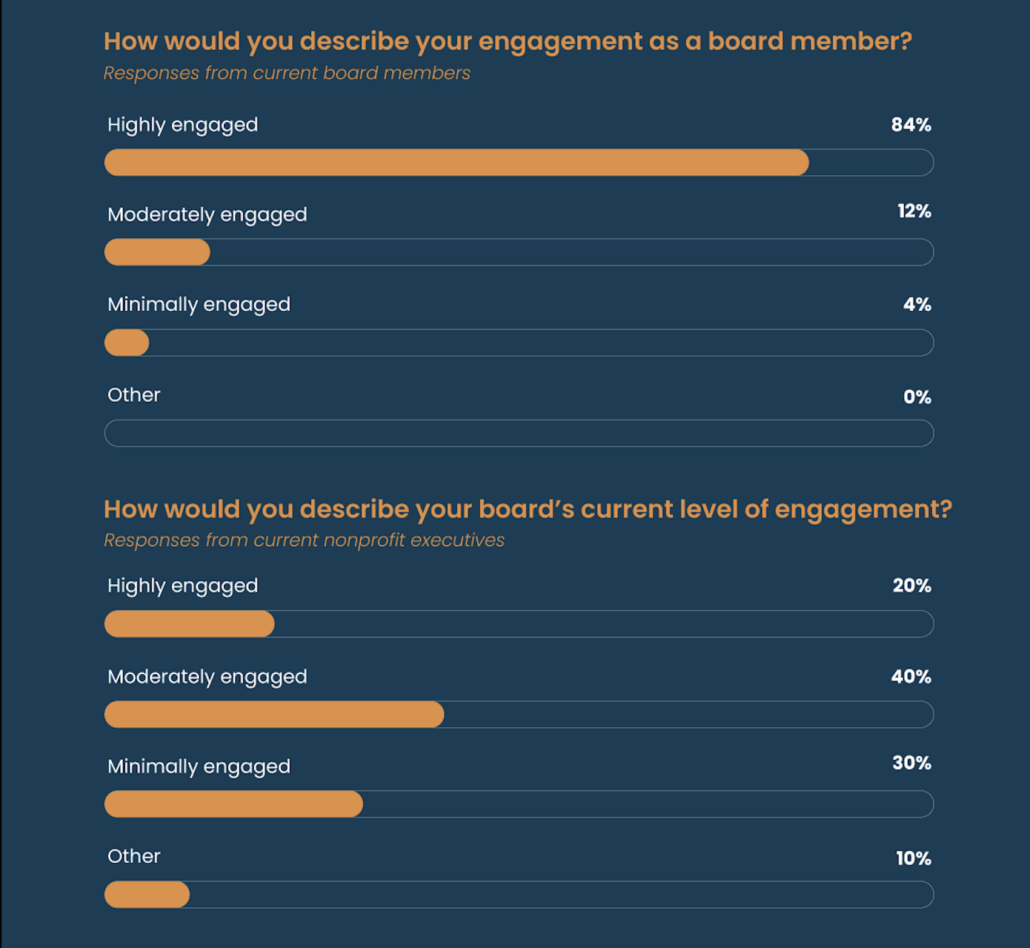
The most striking finding? A clear disconnect in how board engagement is perceived.

A chart that shows the findings described in the text.

84% of board members described themselves as “highly engaged” — proactive, responsive, and deeply involved in strategic issues. Yet, only 20% of nonprofit executives described their boards the same way.

Conversely, 30% of nonprofit executives said their boards were “minimally engaged” — attending meetings but offering limited involvement otherwise.

We believe this isn’t just a difference in experience, but it points to a larger, more systemic opportunity: a difference in how we define and measure board engagement. What does “engagement” really mean? Is it attending meetings? Providing strategic guidance? Fundraising? Something else entirely? For many organizations, that answer is still evolving.


:arrow_right: What’s Changing — and What’s Not

When asked how board engagement has shifted in the past six months:

  • 45% of executives reported no major change.
  • 40% saw engagement increase somewhat or significantly.
  • 15% experienced a slight decline.

Contrary to what we might expect in today’s volatile environment, nearly half of nonprofit executives reported no major change in board engagement due to external factors over the past six months. However, among those who have seen changes, increases in engagement outpaced decreases significantly.

:chart_with_upwards_trend: The organizations experiencing increased engagement often cited heightened urgency around their mission as a driving factor, suggesting that crisis can indeed catalyze commitment, but it’s not universal. When asked how board engagement has changed, one executive said: “We’re watching the macroeconomic conditions that would impact inflation, employment, and discretionary giving.” Others shared their boards are “being proactive” and “very supportive.” 

:chart_with_downwards_trend: Those experiencing decreased engagement shared a nuanced reality about the volunteer nature of board roles: “There are fewer people willing to take on voluntary roles,” while another noted: “Some of them own and run their own businesses, so they’ve had to step away from our board so they can concentrate more on keeping their businesses thriving.”

Many comments related to decreased engagement focused on a reluctance around fundraising: 

“I feel like my board members have a lot more on their plates personally and professionally, giving little to no time for board engagement, especially in fundraising areas.”

“They continue to remain interested in operations with the external pressures, but aren’t willing to be the solution in raising funds.”


:blue_car: What’s Driving (or Draining) Board Engagement?

Board members, on the other hand, shared what’s helping and hindering their ability to stay engaged. The top positive driver? Increased urgency or relevance of the organization’s work (15 responses).

Top challenges:

  • Competing personal or professional demands (15 responses)
  • Frustration or lack of clarity around strategic priorities (6 responses)
  • Uncertainty about role expectations (4 responses)

Taken together, these responses paint a picture of well-intentioned leaders navigating time constraints and a desire for clearer direction.

When asked what would increase their engagement, board members requested:

  • Peer relationships and mentorship opportunities (15 responses)
  • More context about external challenges (10 responses)
  • Clearer strategic direction and priorities (9 responses)
  • Better communication timing and structure (9 responses)

:building_construction: Building Empathy

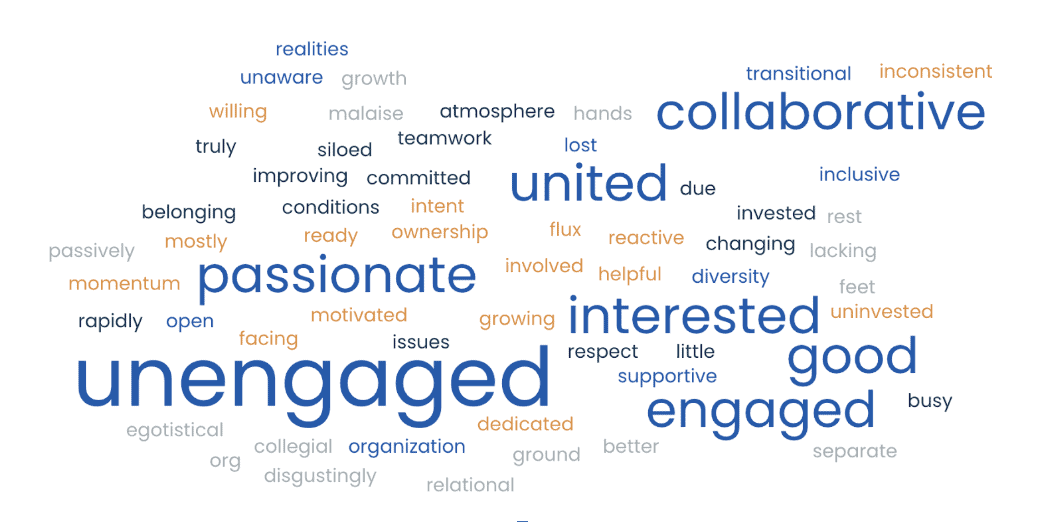
In closing, we asked survey participants to respond to optional qualitative questions exploring what they wished their counterparts understood about their roles, as well as a single word or phrase that described their current board culture. Here’s a sample of their responses.

What nonprofit executives wish they could tell their board members:

“How hard it is to manage everything as the only full-time employee. How much I need their help in fundraising.”

“That I wear many hats, from trash collector to Major Donor ‘Friend’, and I have very little staff capacity to assist in the needed work.”

“I wish they’d see the amount of time spent on administrative tasks, such as scheduling meetings, taking notes, handling ALL the logistics of events, meetings, and programs, in addition to my key roles of fundraising, leading the organization, etc.”

“I wish the board realized that this isn’t a small business that I own. It’s a shared partnership.”

“The impact it has on our team and mission when board members don’t follow through on their commitments.”

What board members wish their nonprofit executive peers understood:

“Sometimes I feel used and not like a partner.”

“I feel like we have important needs to fulfill as a board (stronger governance, structure, nominating), but they aren’t “assigned” to anyone on the board to execute or follow up. We often talk about the importance of these things, but it’s just talk.

“I think it’s critical for everyone employed at the nonprofit to understand that this is a volunteer role, and it can often be challenging to juggle our full-time work commitments and the demands of the board.”

“We’re not full-time employees; keep in mind this is a volunteer role; need to be reminded often & at board meetings why we are doing the work-don’t forget the mission’s moment.”

“The lull in between meetings can be challenging to re-engage where we left off.”

What’s one word or phrase that best describes your board’s current culture?A word cloud.


:motorway: The Path Forward: Three Recommendations

This survey comes just weeks after our team explored another facet of governance: the growing difficulty of recruiting and retaining board members. Overreliance on the same small pool of leaders is creating burnout, redundancy, and a lack of fresh perspectives.

The findings from this engagement survey reinforce that challenge (and expand on it). It’s not just about getting the right people on the board. It’s about making sure they understand their role, feel equipped to engage fully, and are meaningfully connected to the mission. 

For nonprofit leadership teams looking for ways to build a stronger board culture and cultivate deeper engagement, here are three areas to explore:

  1. :heavy_equals_sign: Expectation Alignment on “Engagement”: The perception gap suggests boards and executives are operating with different definitions of “engagement.” While board members may view strategic oversight and governance as high engagement, executives need more tactical partnership. Organizations need to have explicit conversations about what meaningful board involvement actually looks like in today’s resource-constrained environment.

  2. :bulb: Fundraising Skill Development: Fundraising remains one of the greatest pressure points in board-executive dynamics. While many board members express discomfort or uncertainty around donor engagement, nonprofit leaders are looking for more hands-on support. Closing this gap means moving beyond expectations to skill-building — equipping board members with the tools, language, and confidence to engage authentically in resource development.

  3. :busts_in_silhouette: Partnership Mindset Shift: Many of the most engaged boards operate from a place of true partnership, not just oversight. This means cultivating a culture where board members feel both responsibility and agency, understanding that their leadership extends beyond bimonthly meetings. Building that mindset starts with clearer role design, better communication, and an emphasis on shared outcomes over formal titles.

:compass: What’s Next?

The governance challenges facing nonprofits aren’t going away (if anything, they’re intensifying). But organizations that invest in bridging the executive-board engagement gap will be better positioned to navigate whatever comes next.

The question isn’t whether your board is “good” or “bad” — it’s whether your leadership team is aligned around shared expectations, clear roles, and genuine partnership in service of your mission.

What resonates most with your experience? We’d love to hear how your organization is navigating these governance dynamics.


Stay tuned for the next survey in our 2025 nonprofit leadership series by subscribing to our monthly newsletter, and thank you for being part of this work!

:bar_chart: Want help translating insight into strategy? Next Stage helps nonprofits and other social good organizations with organizational strengthening and team building. Let’s talk today.

Filed Under: Nonprofit Leadership, Thought Leadership

  • Page 1
  • Page 2
  • Page 3
  • Interim pages omitted …
  • Page 6
  • Go to Next Page »

Primary Sidebar

Footer

Subscribe to the Impact Insider

Your monthly roundup of social good news and trends

only_email

Who we are

What we do

Who we serve

resources

Newsletter

Careers

Let’s work together!

Contact Us

fb
in
ins

© 2026 Next Stage Consulting | All rights reserved | Privacy Policy