• Skip to primary navigation
  • Skip to main content
  • Skip to primary sidebar
  • Skip to footer
Next Stage – Social Impact Services

Next Stage - Social Impact Services

Social good strategy to amplify your impact

  • Who we are
  • What we do
  • Who we serve
  • Resources
    • Impact Stories
    • News & Insights
  • Contact
  • Newsletter
  • fb
  • in
  • ins

Planning & Implementation

Why Strategic Planning Can’t Wait: Preparing for Social Good’s Greatest Challenge

January 5, 2026 by joshjacobson

It is now 2026. A new year. And with it comes no shortage of uncertainty about how social good will fare in the months and years ahead.

With so many variables at play, you may be asking yourself: Is now really the time to embark on a strategic planning effort?

Pardon the colorful language, but hell yes.

Organizations that elect to take a “wait-and-see” approach — or focus only on the next calendar year without considering what comes after — are likely to be unprepared when the worst of the disruption arrives in early 2027.


Revisiting the One Big Beautiful Bill

I hate to do this so early in the new year, but some may need a reminder: a tsunami of epic proportions is approaching. Federal policy change in the form of the One Big Beautiful Bill (OBBB) will disrupt everyone. It feels like watching a car wreck in slow motion. We know the outcome, and yet there is very little we can do to stop it.

But maybe your area of human services wasn’t mentioned in the bill. Maybe you think this doesn’t apply to you. Maybe you believe you’re the one organization that can rest easy.

Think again.

While the impact of the bill to date has been largely administrative, in early 2027, people will roll off Medicaid in large numbers — and they will lose much more than just access to healthcare.

Medicaid is one of the largest funding mechanisms for addressing the social drivers of health, which include food access, housing stability, and transportation. And when people lose Medicaid coverage, the burden for meeting those needs will not disappear. Instead, it will shift to state governments, local municipalities, nonprofits, and philanthropy, and the challenge that creates is sobering. In our home state of North Carolina, NC DHHS estimates that nearly $50 billion in federal Medicaid funding will be lost over the next decade. No state can absorb that level of loss and continue operating as before. Simply put, there is no realistic way for the gap created by federal spending cuts to be made up elsewhere. It is too large a shortfall to backfill. 

At Next Stage, we believe this represents the single greatest challenge to social good in our lifetimes — one that will manifest in predictable ways:

  • Increased competition for resources. Everyone will be competing for a much smaller pie, forcing painful decisions for boards, executives, and funders alike. The desperation this creates will likely produce false choices about what matters most in sustaining healthy, safe, and affordable communities.
  • Surging need as services shrink. As resources contract, need will continue to grow. When people experience unmet needs — food insecurity, housing instability, untreated health conditions — those pressures do not stay contained. They ripple outward. Families across income levels will feel the consequences of communities under strain, and the calls for solutions will intensify even as capacity declines.
  • Continued politicization of settled assumptions. All this is unfolding in a moment when there is deep disagreement about what it means to be an American. Ideas that once felt broadly shared — that people deserve access to health, opportunity, and dignity — are increasingly contested. Addressing barriers to access becomes more difficult when the language of equity itself is under attack.

That’s why the work in front of us should not focus on overcoming this disruption — that is not where we are. Going forward, the social good sector must work to minimize harm, manage contraction, and make hard choices as thoughtfully as possible.

But without a shared internal framework to create alignment, clarity, and discipline in decision-making, institutions may risk their own sustainability moving forward.

So what does this mean for your nonprofit, government agency, or philanthropic organization? Strategic planning.


A Passionate Argument for Strategic Planning

Strategic planning differs from annual planning or budgeting exercises. And especially in uncertain times, it can be a powerful way to help your organization make intentional operational choices.

The most effective versions of strategic planning include:

  • A focus on external data. Strategic planning forces organizations to look outward — at policy shifts, demographic trends, funding trajectories, and community needs — rather than relying solely on internal performance or historical success. In moments like this, intuition and gut feelings are not enough.
  • Greater clarity on perception and reality. Many organizations believe they understand their position in the ecosystem. Strategic planning creates space to test those assumptions. What role do you truly play? Where are you indispensable? Where are you replaceable? These are uncomfortable, yet necessary, questions.
  • A multiyear horizon. Annual planning keeps the lights on. Strategic planning prepares you for what’s coming. A multiyear horizon allows organizations to scenario-plan, sequence decisions, and avoid reactive whiplash as conditions change.

Strategic planning matters in moments like this because it creates shared discipline when instinct pulls leaders in different directions. It gives boards, executives, and staff a common set of assumptions to work from, a clear understanding of tradeoffs, and an agreed-upon rationale for difficult decisions. Without that alignment, organizations drift into reactive mode — chasing funding, protecting legacy programs, and deferring hard conversations until options narrow. 

A strong strategic plan does not eliminate uncertainty, but it does provide a stable platform for making choices grounded in reality as conditions continue to change.


Our Commitment to You

While we will continue to track and share updates on the impacts of federal spending cuts throughout the year, our central focus will be on supporting you, your organizations, and the communities you serve by highlighting tangible ways social good leaders like you can get actionable.

Because we believe informed, intentional efforts are the best — and only — way forward.

Our collective legacy, as organizations, as communities, and as people, will be defined by how we respond to this moment. This is an eyes-wide-open period. The decisions made now will shape what survives, what adapts, and what is lost.

We stand ready to support you as you navigate the future. Reach out to set up a call today. 


Want the latest social good trends, insights, and inspiration delivered straight to your inbox? Subscribe to the Impact Insider today!

Filed Under: Nonprofit Leadership, Planning & Implementation, Thought Leadership, Uncategorized

10 Trends That Will Shape Social Good in 2026

December 5, 2025 by joshjacobson

Every December, the Next Stage team looks back across the year’s retreats, board meetings, listening sessions, late-night conversations, and messy whiteboards. That’s where the real story lives — in the patterns that start to emerge from the lived experiences of leaders trying to navigate an increasingly complex landscape. You can feel when something in the ecosystem shifts, even before the headlines catch up.

2026 won’t be gentle. It will be a year defined by adaptation, creativity, and a reckoning with systems that are stretched thin. Yet I’m encouraged, because our sector has always shown its best instincts when we stop waiting for ease and start building for what’s next.

Here are six trends I believe will shape social good in the coming year:


 1. Innovation Becomes a Requirement

Innovation is one of those things that tends to thrive when times are tough. When the world of social good feels relatively stable, there may be more financial resources available for testing new approaches, but institutions often lack the urgency and appetite for the change management needed to see them through.

But when the pressure is on, “doing things the way we’ve always done it” stops being an option.

The challenge, of course, is that innovating on the fly can feel risky and chaotic. That’s why the best time to test new methodologies is before the crisis hits, when the stakes are lower and teams have more capacity to experiment.

Still, we’ve seen this sector make some of its most meaningful advancements under duress — most recently during the pandemic, when necessity forced creativity at a scale no one expected. If 2026 continues its current trajectory, we’ll need that spirit again. Innovation isn’t a luxury anymore. It’s infrastructure.


 2. Rebuilding Trust Will Be Difficult — But Essential

We’ve talked a lot about trust this year, and for good reason. Communities are waking up each morning to a landscape that feels less stable and less safe than it did just a few years ago.

BIPOC residents have watched the progress made under diversity, equity, and inclusion efforts be rolled back — in many cases literally deleted from nonprofit websites. Families in our own city of Charlotte hesitated to leave their homes after recent actions by Customs and Border Protection. The trauma of these moments is real, layered on top of the lingering disruption of the COVID-19 pandemic.

Service providers are carrying that weight. Communities are carrying it.

Rebuilding trust won’t happen through a new program or a sharper tagline. It will take sustained, visible investment in relationships and transparency — at both the organizational and community-wide level. “Who are we?” is a question every community leader should be asking as the new year crests. The answers won’t come quickly, but they matter more than ever.


 3. AI’s Move From Experiment to Infrastructure

Artificial intelligence is changing the way work gets done, and nonprofits — long understaffed and overstretched — are feeling its impact quickly.

Executives now have something they’ve never had before: a powerful productivity partner sitting on their desktop. A grant application due tomorrow? No problem. Need to untangle an HR issue? AI can surface options in seconds. Administrative teams that have been underwater for years finally have a lever that helps them breathe.

The next frontier is shifting from staff experimenting with AI in isolation to the development of organizational adoption strategies — policies, workflows, expectations, and guardrails.

We predict that 2026 is the year nonprofits begin institutionalizing AI. It will reshape job descriptions, performance expectations, documentation practices, and capacity models across the sector.


 4. A Deepening of AI’s Impact on Social Good Mission Delivery

If AI is transforming nonprofit operations, its effect on mission delivery may be even more profound.

Next Stage works with many organizations focused on workforce development, and the landscape is shifting quickly. For years, STEM training was held up as the ticket to economic mobility — “learn to code” was the refrain. But as developers face layoffs due to AI automation, that assumption is shifting.

Trades educators from carpentry to HVAC repair are positioning their fields as “AI-resistant,” and they’re not wrong. The promise of technology as a universal upward-mobility path needs a fresh look.

Beyond workforce development, AI is reshaping healthcare, human services, climate resilience, and philanthropy. It brings incredible potential, but also new questions about equity, ethics, and long-term opportunity.

We expect 2026 to be the year AI takes center stage in the larger fight for social and economic mobility, and every mission-driven organization will feel its ripple effects.


5. A Renewed Focus on Individual Philanthropy 

Organizations overly dependent on institutional support — foundations, corporations, or government agencies — are heading into choppy waters.

As the most consequential elements of the One Big Beautiful Bill Act begin to take hold at the end of 2026, federal funding shifts will act as a force multiplier. The domino effect threatens the sustainability of countless programs and institutions.

This is the moment when individual donors step forward. What we call “elective taxation” — individuals voluntarily fueling causes they care about — is poised to become a defining factor in who survives and who struggles.

We’ve talked about this trend throughout the year, and all signs suggest it will accelerate in 2026. Organizations with clear messaging, strong stewardship, and genuine community alignment will be the ones positioned for stability.


 6. Gen X Steps Up

The times, they are a’changing. As a member of Gen X myself, I’ve long wondered what it would look like when the Baby Boomer generation began handing the torch to us. We’re now seeing it happen.

The oldest Gen Xers turned 60 this year. Many are still in the workforce, at the height of their earning potential, and stepping into leadership roles across sectors. Our hopes for increased philanthropy need them — especially as Boomers shift into more fixed-income mindsets around giving.

But Gen X is not a monolith. If organizations want to engage this cohort effectively, segmentation, persona-building, and the adoption of an acquisition mindset are essential.

This is a year tailor-made for new approaches to brand marketing, with institutions examining who they’re speaking to and why it matters. At Next Stage, we’re gearing up for a big year in 2026 because we believe Gen X will shape the next chapter of social good.


 What Our Team Is Watching 

One of the advantages of working at Next Stage is that our team views the sector through many different lenses — workforce development, health equity, philanthropy, community engagement, culture-building, and data and evaluation. We are in rooms with people solving very different problems, and we see the through-lines that connect them.

So after reflecting on my own predictions, I asked my colleagues to share the trends they’re watching as we head into 2026. Their insights add important texture to the picture and underscore how interconnected these shifts truly are.


 7. A Push for Partnerships to Address Public Health Infrastructure Gaps 

—Jalah Blackmon, Director of Impact for Health

One concerning trend I’m watching is the quiet erosion of our public health infrastructure. We’re seeing holes left by job turnover in government agencies, and with that, a real fragility in the systems we rely on. As a new parent, I was alarmed to learn during my child’s early doctor visits that the CDC’s vaccine schedule was temporarily unavailable online. Key datasets and alerts are becoming inconsistent or disappearing altogether, creating a dangerous void that challenges public trust and health equity.


Yet, I’m optimistic. Health-focused nonprofits and community-based organizations are stepping into the gap as temporary librarians and translators of essential information. The increased focus on the social drivers of health and lessons from the pandemic have equipped them to provide trusted, hyper-local outreach. It’s a powerful testament to the sector’s agility.


This interim work is crucial, but underscores an urgent call to action. We must come together across sectors to defend and restore a public health system that doesn’t leave anyone behind. Protecting our most vulnerable isn’t just a healthcare issue; it’s a test of our collective commitment to a healthy society.


8. A Shift in Strategy Horizons 

—Caylin Haldeman, Director of Strategy

Across my work with Next Stage clients and leading internal strategy, one pattern is showing up again and again: the speed at which the world is changing and communities are organizing far outpaces the speed at which institutions and organizations are planning. The three-to-five-year strategic plan — once a reliable anchor — feels increasingly misaligned with a world shaped by policy volatility, funding whiplash, and localized crises that unfold on weeks-, not years-long, timelines. Meanwhile, grassroots groups and informal networks are adapting in near real time, guided by proximity, trust, and an ability to move without bureaucratic drag.

In 2026, I believe the most resilient and impactful organizations will rethink not just what they plan, but how far out they plan. Strategy will need shorter horizons, lighter structures, and stronger feedback loops — designed for calibration, not prediction. Long-term vision still matters. What’s changing is the operating posture required to sustain it: governance models that absorb uncertainty, funder relationships that allow for course correction, and measurement systems that surface signals early rather than reporting outcomes too late.

The organizations that thrive won’t be the ones with the most polished plans. They’ll be the ones that treat strategy as a living practice — and build the muscle to respond as conditions, and communities, change.


 9. An Increased Need to Meet Donors Where They Are Scroll

—Nora Hines, Marketing Manager

Vertical video content will only become more essential in 2026. With 41% of Gen Z and 24% of Millennials being motivated to support causes based on what appears on their social media, and short-form video content consistently performing better on TikTok and Instagram, social good organizations that fail to prioritize video-first storytelling risk missing out on significant swaths of the younger generations. Posts with images already see 650% more engagement than text-only posts, and video only further amplifies this effect.

And the good news is, you don’t have to have an in-house TikTok expert on your team to pull this off. In 2026, nonprofits can (and should!) tap into their existing community for content creation. Organizations can reshare videos from volunteers on the ground, ask donors to explain why they give, and turn testimonials into Instagram Reels. Successful nonprofits will crowdsource their video content, giving beneficiaries, volunteers, and young supporters simple prompts to create authentic 15-30 second stories about their experiences with the organization. This user-generated approach solves both the expertise and authenticity gaps, as peer-created content resonates far more with younger audiences than polished organizational messaging ever could.


 10. A Renewed Demand for Authentically Human Visual Designs

—Wendy Orrego, Visual Design Manager

As audiences face information fatigue, fractured attention spans, and growing distrust in institutions, the role of design will shift from decoration to translation, turning complex data, community insights, and impact stories into visuals that people can immediately understand and emotionally connect with.

While AI will continue transforming how creative work gets produced, I predict a strong counter-trend: a renewed demand for authentic, human-centered visuals and storytelling. In a world where almost anything can be generated instantly, audiences will value what feels real — original photography, genuine community representation, and narrative and design choices rooted in lived experience rather than automated templates.


Want the latest social good trends, insights, and inspiration delivered straight to your inbox? Subscribe to the Impact Insider today!

Filed Under: Nonprofit Leadership, Planning & Implementation, Thought Leadership

Getting Your Nonprofit Ready for 2026: An End-of-Year Checklist

November 7, 2025 by joshjacobson

The season of end-of-year leadership retreats are upon us. Next Stage is supporting a number of organizations as they prepare for an unprecedented set of circumstances in 2026, and one thing is certain:

It’s difficult to plan when the ground feels like it’s shifting beneath your feet. 

The ongoing federal government shutdown has created real consequences across the social good sector — for nonprofits, local governments, and even private companies like ours at Next Stage. Many organizations are seeing ripple effects from delayed contracts, paused grants, and reduced cash flow. The reality is that this moment of instability is not isolated, but rather a part of a larger wave of change resulting from ongoing policy shifts and legislative stalemates.

So yes: things feel uncertain. But “wait and see” is not a strategy. Sitting on the fence until the dust settles is the surest way to get left behind. Because what distinguishes resilient organizations isn’t an innate ability to predict the future, but a willingness to prepare for it (uncertain as it might be).

If you’re heading into your end-of-year retreat or annual planning process, here’s a simple checklist to help get your nonprofit ready for 2026.


:ballot_box_with_check: 1. Conduct a Risk Assessment

Federal policy impacts won’t disappear when the shutdown ends. Many analysts predict 2026 will be a staging year for broader spending shifts in 2027, which makes now an essential time to examine your organization’s exposure.

  • Where are you reliant on government contracts or federal programs?
  • How might indirect impacts, like delayed reimbursements, declining consumer confidence, or disruptions to partner agencies, affect your work?

To get started, gather a small cross-functional team, including finance, operations, and program leaders, and spend a few hours mapping your dependencies. Identify all major revenue streams, partnerships, and contracts, then rate each by both likelihood and impact of disruption. Explore: What might happen if this funding source pauses for three months? If this vendor can’t deliver? If this partner downsizes? Document your findings in a simple risk matrix and note which exposures can be mitigated now versus monitored later. 

The Bottom Line: Performing a proactive risk audit can help you identify your exposure before gaps become crises. Use this process to strengthen your balance sheet and clarify your strategy.


:ballot_box_with_check: 2. Gather Metrics and Know Thy Databases

If 2025 has taught us anything, it’s that data clarity equals decision clarity. On the revenue side, review your fundraising or new business data to pinpoint trends:

  • Which funders or customers are dependable?
  • Where are you seeing growth?
  • Where are you overexposed?

On the operations side, consider how your organizational structure supports (or hinders) agility.

Activate these efforts by pulling a year-over-year comparison from your CRM or accounting system. Look beyond totals to instead segment your data by source, type, and relationship length to see what’s really driving results. Then, bring that same discipline to internal metrics: staff capacity, program utilization, and expense categories. Schedule a short data review session with your leadership team to translate those numbers into insights, identifying where to double down and where to pivot.

The Bottom Line: You can’t build resilience on gut instinct alone. Use your databases to guide resource allocation, performance targets, and scenario planning. Numbers tell stories; make sure you’re listening to them.


:ballot_box_with_check: 3. Check In With Peers

You’re not alone in this uncertainty. Every nonprofit executive, municipal leader, and small-business owner is navigating similar headwinds. Rather than making decisions in isolation, use this moment to engage your peers and compare notes on what’s changing.

Create a top-20 outreach list by identifying the leaders and partner organizations whose perspectives you trust the most. Schedule brief, focused conversations – even 20-30 minutes can reveal valuable insights about funding pipelines, staffing shifts, and community demand. Consider hosting a small roundtable or virtual session to surface shared challenges and spark new ideas, and commit to at least one peer discussion each week through February 2026. 

The Bottom Line: Shared learning uncovers blind spots and builds a sense of solidarity across the sector. In volatile times, collaboration becomes a risk-mitigation strategy.


:ballot_box_with_check: 4. What Can We Do About It? An Advocacy Toolkit

Uncertainty is unsettling, but ignoring it doesn’t make it go away. 

Build your framework by outlining three plausible futures for your organization over the next 18 months: best case, middle ground, and worst case. In each, map your financial position, staffing levels, and program adjustments. Assign clear decision triggers: at what point would you pause hiring, cut expenses, or shift priorities? Involve both leadership and frontline staff so plans are realistic and account for downsides that are not readily apparent.

Keep these scenarios handy and revisit them quarterly. Doing so turns preparation into a habit rather than a reaction.

The Bottom Line: Scenario planning is less about accurately predicting disruption and more about building the muscle to adapt when it happens. The goal of this exercise is steady footing, no matter how unpredictable the future may appear.


An Ounce of Prevention 

We often tell clients that the work of planning is the work of hope. It’s an act of optimism to prepare for a future you can’t yet see

The coming year will test many institutions, but those who make time to plan now — with clarity, courage, and a willingness to adapt — will enter the new year from a position of strength.

If your organization is ready to take a proactive approach, we’d welcome a conversation about how our team can help facilitate a risk assessment, scenario planning process, or end-of-year strategy retreat to help get your nonprofit ready for 2026.


An ad for the Impact Insider newsletter.

 Want the latest social good trends, insights, and inspiration delivered straight to your inbox? Subscribe to the Impact Insider today!

Filed Under: Nonprofit Leadership, Planning & Implementation, Thought Leadership

4 Essential Best Practices for Strategic Planning in 2025

January 13, 2025 by joshjacobson

It’s a new year, and that means new opportunities for your organization to build a strategic roadmap.

Strategic planning is Next Stage’s cornerstone service line. It’s a process we’ve guided more than 100 organizations through—from nonprofits and community-based organizations to health care groups and government agencies. We understand the words “strategic planning” can elicit very different reactions: for some, the process is exciting and full of possibility, while for others, it’s a daunting or even cringe-worthy task.

In recent years, strategic planning in the social good sector has faced significant disruption. The lingering effects of the COVID-19 pandemic, combined with an uncertain political environment and the looming threat of economic recession, caused many organizations to shift to a “wait-and-see” mindset, opting to rely on short-term annual plans rather than committing to multiyear strategic roadmaps. According to one recent study, up to 49% of nonprofits lack a strategic plan.

However, as we enter 2025, the external landscape has begun to stabilize. We’re operating under a new federal administration, the economy has achieved relative stability, and advancements in technology are firmly taking hold. While challenges remain for institutions working to advance social good, we’re no longer navigating in the fog of ambiguity. The near-term future has become clearer—and with that clarity comes opportunity.

So, what now? The time has come to get proactive because developing a multiyear strategy has wide-ranging benefits. One study found that 86% of nonprofit respondents believed their strategic plan positively impacted revenue generation through grants, donors, events, and other avenues.

So whether you’re contemplating your first strategic plan or looking to refresh your approach, we’ve prepared a list of four best practices for strategic planning to help your organization create a roadmap that drives real impact.


1. Listen to Your Constituents

A microphone in front of an audience.

Market research is big business—a $150 billion global industry according to ESOMAR’s Global Market Research report. And with more sources of data than ever before thanks to advancements in technology and AI, there are seemingly endless opportunities to secure key constituent insights. 

That’s welcome news because regularly listening to your constituents is essential. Don’t make the all-too-common mistake of believing you already know what your key stakeholders are thinking, feeling, and experiencing. Conditions change over time, and so too do the needs and opportunities faced by the people critical to your institution’s success.

That’s why we always encourage our clients to use learnings gained by listening to their constituents to inform their operational direction. It’s more than worth the time investment because truly effective strategic planning must begin with robust primary research. This includes interviews, focus groups, surveys, and observational studies that gather diverse perspectives and insights.

And listening to your constituents shouldn’t just be a one-time thing. By regularly engaging in such activities, your organization will gain a pulse on changing needs, opportunities, and challenges. This ongoing process not only informs your strategy but also keeps it grounded in reality, making it more adaptive and actionable.


2. Include Stakeholders in Planning

A diverse group of people stand and sit around a planning table.

As we’ve shared before, Americans have a deepening mistrust of most institutions. According to Pew Charitable Trust’s 2024 report, confidence levels across sectors remain at or near historic lows, with only modest recovery since the pandemic’s onset.

​​Many organizational leaders mistakenly believe their organization is immune to this trend. But the reality is, even the most trusted institutions are feeling the impact of this broader erosion of public faith.

The good news is your organization’s strategic planning efforts present a key opportunity to reverse this trend. By making the process genuinely inclusive, you can build stronger strategies while fostering authentic stakeholder buy-in. When you bring together diverse voices—staff, board members, beneficiaries, and community partners—on your strategic planning task force, the resulting roadmap better reflects the full spectrum of perspectives and voices that matter to your organization’s success.

This sense of inclusion also fosters a sense of ownership among stakeholders, which is essential for successful implementation down the road.

The 2024 whitepaper “Nothing About Us Without Us,” which examines disability representation in media and branding, powerfully illustrates this concept. While focused on the disability community, the report’s central message resonates broadly: sustainable solutions emerge only when the communities we serve are active participants in designing their future.

Because true stakeholder inclusion isn’t just about gathering input—it’s about sharing power in the planning process itself.


3. Build Belonging Through Engagement

A group of people high-fiving.

Strategic planning is more than just charting a course—it’s an opportunity to deepen stakeholder investment in your institution’s future. When done well, it creates a compelling roadmap that inspires diverse groups to unite around shared goals and outcomes.

This has become particularly crucial amid what experts call a “crisis of belonging.” As highlighted in a 2024 Chronicle of Philanthropy article: “It’s not just marginalized populations and marginalized communities that feel a sense of not belonging; it’s also those who traditionally have been higher up in the societal hierarchy who feel they don’t belong.”

Your strategic planning process can help address this crisis by fostering genuine connection and shared purpose. But the work doesn’t end when the plan is complete. To build lasting bonds between your organization and its constituents, it’s essential to close the communication loop with everyone who contributed to the process.

Clearly communicate to stakeholders exactly how their input shaped the final plan. Make their impact visible. By acknowledging their role in shaping your organization’s future, you do more than just build transparency—you cultivate the trust and enthusiasm needed to turn strategic vision into reality.


4. Create a Launch Campaign

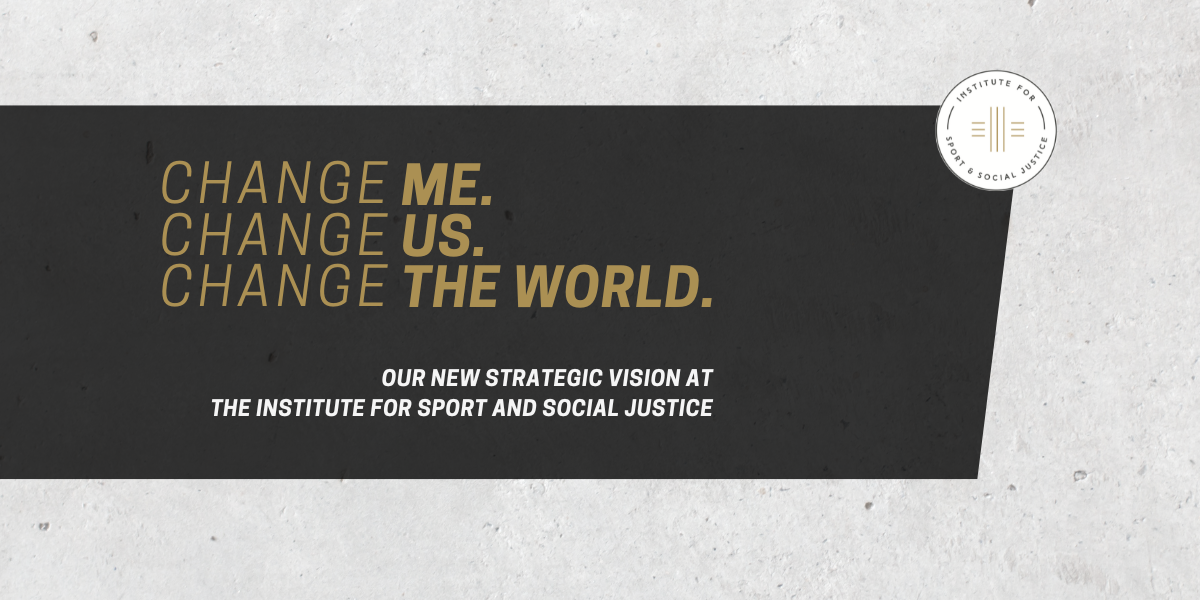
The image contains the text Change Me. Change Us. Change the World.

A strategic plan is only as powerful as its implementation. And all too often, this is where organizations stumble. In fact, according to an organizational diagnostic survey by BridgeSpan Group, staff members at more than 120 nonprofits rated their employers’ capacity to implement their strategies 10% below their average rating for all other organizational capability areas. Respondents gave their organizations especially low marks on their abilities to break down their strategies into actionable steps, communicate their vision effectively, allocate resources appropriately, and adapt to change.

To ensure successful implementation, launch your strategic plan with the energy and intentionality of a campaign. The Institute for Sport and Social Justice offers an inspiring example of this approach. Despite having a clear mission of advancing social justice through sport, they needed to unite their diverse programs under a cohesive narrative. Through Next Stage-facilitated strategic planning sessions, they developed the powerful campaign theme “Change Me. Change Us. Change the World.” This framework elegantly connected their four pillars of impact (Training & Education, Community & Youth, Global Engagement, and Knowledge Creation) into a compelling narrative that resonated with stakeholders at every level.

This campaign-style approach transforms strategic plans from static documents into dynamic forces for organizational change. When you develop a unifying theme that speaks to your stakeholders’ aspirations, your strategy becomes more than a roadmap—it becomes a rallying cry that energizes staff, inspires donors, and activates allies in pursuit of shared goals.


The time for strategic planning is now. As the external landscape stabilizes and new opportunities emerge, organizations need robust, multiyear strategies more than ever. And if the past few years have taught us anything, it’s that strategic planning should no longer be treated as a one-off exercise that happens every few years. Instead, it must become a core capability embedded into your organization’s adaptive DNA.

Is your organization looking to develop or amend its strategic plan in 2025?

Reach out today—we’d love to partner with you!


Want the latest social good trends, insights, and inspiration delivered straight to your inbox? Subscribe to the Impact Insider today!

Filed Under: Nonprofit Leadership, Planning & Implementation, Thought Leadership

Championing Change: Next Stage’s Strategic Planning Project with the Institute for Sport and Social Justice

October 16, 2024 by nextstage

Last year, Next Stage proudly partnered with the Institute for Sport and Social Justice (‘the Institute’) on an expansive strategic planning engagement. The project ranked among Next Stage’s most visionary planning efforts, with the Institute’s leaders staking out a globally focused horizon for its social impact programming.

About the Institute for Sport and Social Justice

The Institute’s mission is to harness the power of sport to educate and empower leaders to create a safer, more equitable, and inclusive world. Founded by civil rights icon Dr. Richard Lapchick in 1985, the Institute has long been an innovative leader in leveraging sport as a platform for social change.

The Institute is perhaps best known for its Huddle Up program, working with university programs, professional sports teams, and leagues to deliver training on a continuum of topics including the following:

  • Diversity, Equity, Inclusion, and Belonging (DEIB)
  • Eradicating gender-based violence
  • The power of transformational leadership
  • Critical decision-making skills

Additional programs include the management of National Student-Athlete Day, PlayMakers of the Month, and Invisible Women in Sport. Signature events include the Giant Steps Awards Gala and the Hall of Fame Induction Ceremony.

The Need

Sporting events often serve as a platform for protest and social justice demonstrations. And, in today’s divisive and highly politicized climate, the Institute’s guiding principles and mission have never been more vital.

The Institute appointed Dr. Jeffrey O’Brien as its new CEO in 2022, transitioning leadership from its founder ahead of the organization’s 40th anniversary in 2025. With a staff and contractor team new to the organization, the time had come to engage in a multi-year strategic planning process to establish a roadmap ahead of the upcoming anniversary.

The Approach

Based in Central Florida, the Institute wasn’t familiar with Charlotte-based Next Stage. The organization reached out following a referral to learn more about the social innovation company’s strategic planning services. Next Stage was proud to step into the facilitator role for the Institute’s strategic planning process. The effort was led by CEO Josh Jacobson and Senior Director, Community Voice Helen Hope Kimbrough.

Jacobson and Kimbrough conducted a wide-ranging discovery process that included virtual planning sessions with a national task force and an in-person, multi-day retreat in Detroit and Ann Arbor, Michigan. These phases of work built buy-in with the Institute’s leadership and created a platform for creating a game-changing strategic plan.

According to Dr. O’Brien, this reimagining of the Institute’s pathway forward came at a critical time for the organization and its staff and board leadership.

“Over several decades, the Institute had led the way in creating human-centered standards within the sports industry,” O’Brien said. “To move forward, we needed to take stock of our history while carefully plotting a course for our future. Thanks to the work of Next Stage, we now have the renewed clarity and defined roadmap we need to put our new pillars into practice.”

The Impact

The Institute’s various programs and service lines all focus on the same central value proposition: advancing social justice through sport. But to bring current and future programs into cohesion, the Institute needed to develop a theory of change to help tell the story of how the individual programs work together to create impact.

Through Next Stage–facilitated planning sessions, the Institute originated the concept “Change Me. Change Us. Change the World.”

  • Change Me: We believe impact starts at the individual level. We educate and empower individuals to realize how they can make a positive difference.
  • Change Us: We aim to build a movement of individuals who take what they have learned to inspire and transform their local communities.
  • Change the World: We work with global partners to lift up and support their change-making efforts and advance equity, safety, and inclusion. The movement we envision emanates from individual and community-based action that, ultimately, will change the world.

This conceptualization helped to bring the Institute’s four pillars of impact (Training & Education; Community & Youth; Global Engagement; Knowledge Creation) into a connected framework, which set the stage for planning and ambition setting.

The result was a highly detailed strategic roadmap and implementation plan outlining a 3-year horizon toward a newly defined approach to the Institute’s work.

For Jacobson, Next Stage’s engagement with the Institute was a thrilling demonstration of the company’s capacity for supporting far-ranging impact.

“The Institute’s strategic plan is global in scope, placing the organization on the path to being a worldwide leader in creating a safer, more equitable, and inclusive world,” Jacobson said.

—

To learn more about the Institute for Sport and Social Justice and its impact, visit www.sportandsocialjustice.org.

To learn more about Next Stage’s strategic planning services, visit our website or reach out to Josh Jacobson at ceo@nextstage-consulting.com.

Filed Under: Nonprofit Leadership, Planning & Implementation

Navigating the New Realities of Corporate Social Responsibility

July 18, 2024 by joshjacobson

On August 22, I will present a session at the AFP NC Philanthropy Conference on one of my favorite topics: corporate social responsibility. The session will continue a decade-long series of talks I’ve given at this annual conference.

Our company has done a significant amount of research on this topic, which informed the launch of our corporate impact services line. Now, Next Stage works with multiple private-sector companies to realize compelling public-private partnerships. It’s some of the most innovative and game-changing work our company has done.

Helping nonprofit organizations understand what has changed about corporate social responsibility requires near-constant updating because so much has changed — and continues to change — so quickly, which is why we’ve found it important to share our latest findings regularly.

Alignment to Materiality

As we previously shared in our 2023 report, Profit & Purpose: The ESG Addendum, the speed with which corporate social responsibility has been evolving has accelerated in recent years. A more sophisticated methodology for social impact efforts has replaced the shotgun approach of previous decades. “Spreading it around” has given way to something more strategic. 

That approach is part of what I’ll unpack in greater depth at the conference next month. Companies are focusing their impact efforts on areas of greater alignment to their work, often to mitigate unintended negative consequences of their operations. This concept, for companies to choose social issues aligned to their business processes, is called materiality. For example, a residential home builder is likely to focus on social impact efforts related to affordable housing, while a lending institution may work to create more racially equitable access to capital. 

If you’re curious about what a company considers its materiality, take a look at its ESG report. Delta Airlines’ report, for example, suggests that climate change is an area of particular focus — not surprising given that the aviation industry is responsible for 2–3% of total carbon emissions annually. A deeper dive into the report reveals that education and equity are also key areas of focus, with the need for a future STEM-based workforce critical to the company’s future success. 

Metric-Based Goal-Setting

One way the private sector and nonprofits have come closer together in recent years is how they are evaluated. Like the nonprofits they have granted funding to for years, companies are now compiling their impact data and making it available to third-party reviewers for assessment. Why? Because future backing from socially conscious investors hinges on how those outcomes stack up against others in their industry. 

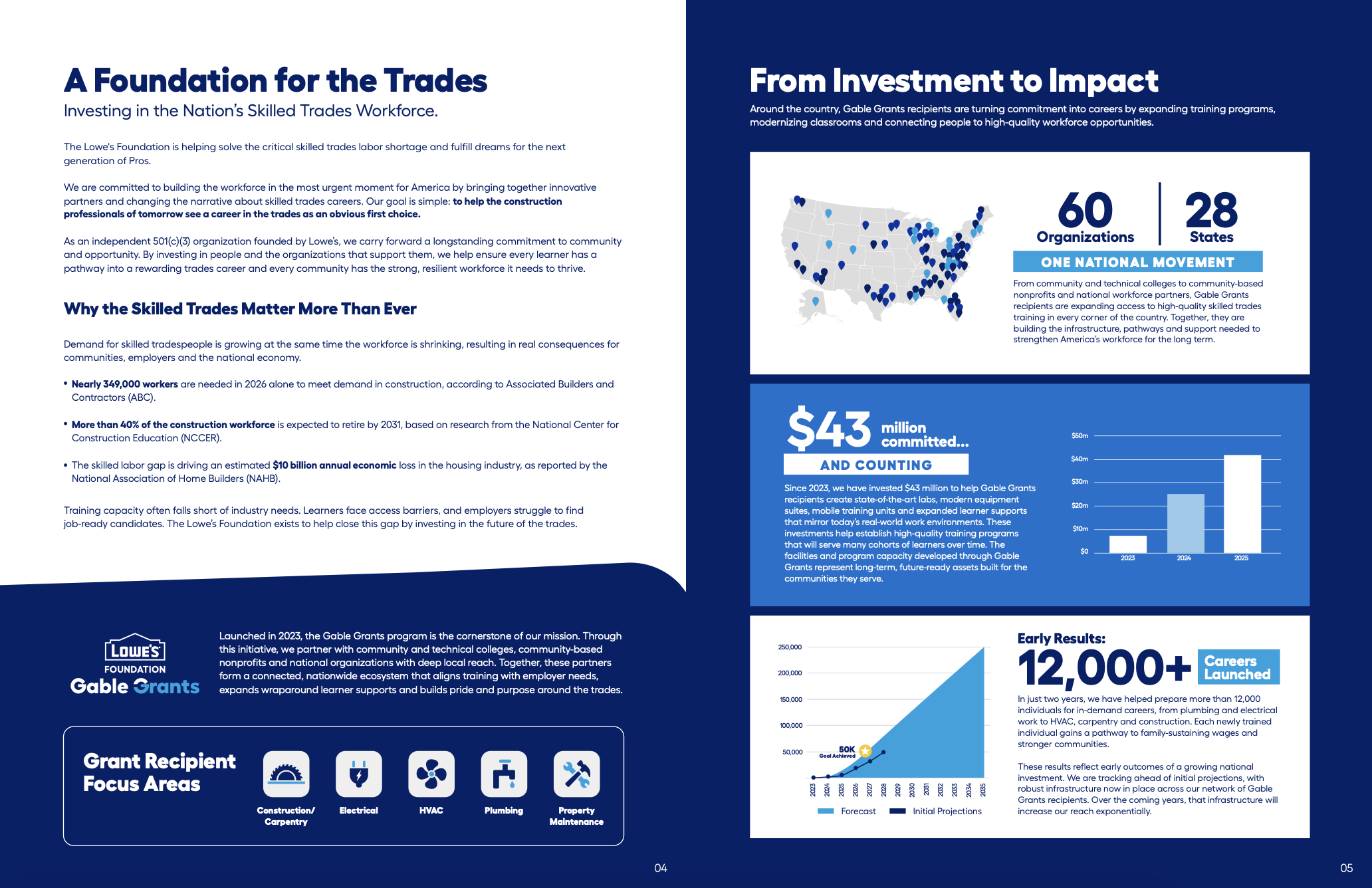
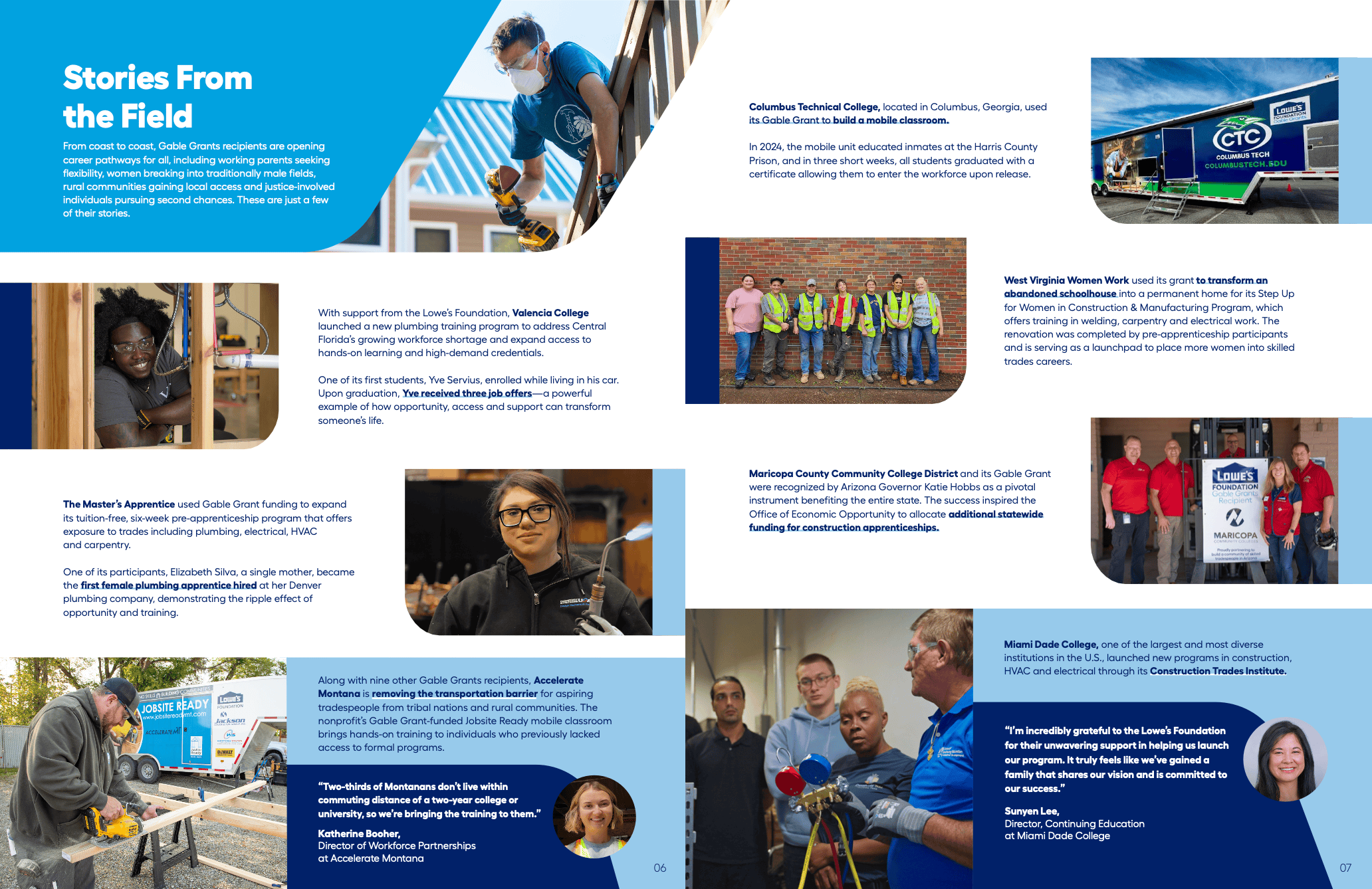
The Lowe’s Foundation Gable Grant program is a $50 million, 5-year program to train 50,000 job-ready skilled tradespeople. Beyond the stated financial commitment and multiyear design, the effort is also carving out a specific and measurable goal of 50,000 people served. The grantmaking strategy includes investing in national-level nonprofits, technical and community colleges, and community-based organizations nationwide, recognizing the importance of working at macro and micro levels to affect change. It’s an advanced approach to grantmaking that was not very common in the past. (Disclosure: Next Stage is helping the Lowe’s Foundation to implement this innovative initiative).

Commitment to Research

The history of corporate social responsibility is one without much grounding in research. Companies often decided to support issue areas based on internal decision-making, and organizations were selected as much on their social capital (e.g., board connections to corporate executives) as on the merits of their programming. That framework has largely disappeared, with far more evidence-based approaches to grantmaking becoming more of the norm. 

The PNC Foundation was ahead of the curve when it launched its Grow Up Great initiative — an effort to prepare children from birth through age 5 for success in school and life — in 2004. As the PNC Foundation celebrates its 20th anniversary this year, it’s positioning its grantmaking against the backdrop of research that indicates an area where its impact can be particularly effective. PNC-funded research, in partnership with the National Institute for Early Education Research, is helping to reframe the need for more nature-based play and learning environments.

Leveraging Grantee Connectivity

One area where Next Stage has been pioneering new social impact efforts is in the development of digital communities of practice for corporate foundations seeking to better harness their portfolios of investees. Companies have changed how they treat the nonprofits and agencies they support, from seeing them as charitable investments to vendors of corporate-aligned social impact. As such, realizing stronger outcomes collectively is a top priority.

Next Stage has developed an approach to building social cohesion among grantee organizations that increases the potential for collaboration. Working together, grantees convened by a single corporate grantmaker may be able to realize more impact than when working in isolation. 

Next Stage uses a digital collaboration management platform called Cultivate Impact ® to unite grantee organizations, often through the lens of professional development and organizational strengthening. We have built a curriculum to support grantee learning communities that leads to stronger relationships, deeper trust and increased impact.

Want to learn more? Feel free to get in touch! We’d welcome the opportunity to discuss our approach further.

Filed Under: Communications, Community Voice, Nonprofit Leadership, Planning & Implementation, Thought Leadership

  • Page 1
  • Page 2
  • Page 3
  • Go to Next Page »

Primary Sidebar

Footer

Subscribe to the Impact Insider

Your monthly roundup of social good news and trends

only_email

Who we are

What we do

Who we serve

resources

Newsletter

Careers

Let’s work together!

Contact Us

fb
in
ins

© 2026 Next Stage Consulting | All rights reserved | Privacy Policy