• Skip to primary navigation
  • Skip to main content
  • Skip to primary sidebar
  • Skip to footer
Next Stage – Social Impact Services

Next Stage - Social Impact Services

Social good strategy to amplify your impact

  • Who we are
  • What we do
  • Who we serve
  • Resources
    • Impact Stories
    • News & Insights
  • Contact
  • Newsletter
  • fb
  • in
  • ins

Nonprofit Leadership

Dipping from the Same Well: Why Finding and Retaining Board Members Is Getting Harder

June 10, 2025 by joshjacobson

For many nonprofits, June brings the end of the organization’s fiscal year. It’s a time when organizational leaders are deep in the process of approving budgets, planning summer retreats, and preparing for a new set of challenges in the year to come. 

This season also serves to activate the annual reset of board rosters and committee assignments. For nonprofits that follow a calendar-year nomination process, summer is the time to assess who will be leaving and what gaps will need to be filled. And that task seems to be getting more difficult.

At Next Stage, we’re digging into this governance challenge as part of our broader nonprofit leader listening series. Our current survey focuses on board engagement, and we’re eager to hear from both executive teams and board leaders. Please consider sharing your perspective and forwarding the survey to your governance committee or board chair to help ensure the findings are grounded in a diversity of voices.

But before diving into the data, it’s important to set the stage. Because we’re observing how leadership is evolving in real time, shaped by growing uncertainty and mounting pressure on the systems designed to support sound decision-making.

The Challenge of Recruitment

Serving on a nonprofit board has never been an easy ask. It requires a commitment of time, energy, and personal capital; the kind of service that doesn’t always show up on a résumé or come with applause. And yet, it’s long been a vital part of the social contract for those in positions of influence and capacity. It’s a way to contribute to the greater good by providing oversight and strategic guidance to institutions that serve the public.

Lately, though, the pool of people willing to take on that responsibility seems to be shrinking. Nominating committees are spending more time recruiting. Executive directors are voicing concern about lagging engagement and unclear expectations. And in some cases, boards are operating well below their full complement; not by choice, but by default.

What’s driving this shift? Part of it may simply be math. Each year, thousands of new nonprofits are launched across the country, and each one requires at least a handful of board members to satisfy basic IRS requirements. Add to that the growing number of advisory councils, task forces, homeowner associations, PTAs, and professional associations — each with its own board, its own meetings, its own call for service — and you begin to understand the larger context. We’re drawing from the same well of talent, but more buckets are being dipped.

At the same time, people are recalibrating how and where they spend their time. The post-pandemic world has prompted a new clarity around bandwidth. A growing number of would-be board members are either stretched too thin or opting out altogether, choosing more flexible forms of volunteerism or simply declining the request when it comes. 

This has also gotten worse in recent months, as people who would normally lean into community needs are instead sitting this moment out. The politicized environment, coupled with real concerns for the economy, is having a chilling effect on civic engagement. It’s reflected in diminished audiences for cultural institutions, lower-than-expected attendance at fundraising events, and sluggish response rates to digital calls-to-action. A general malaise has settled into social good, and it spells trouble given the enormity of the task ahead.

What’s at Stake

This would all be less concerning if boards were being asked to do less. But in fact, the opposite is true. The road ahead for nonprofit organizations is full of complexity, and boards will play a central role in navigating it.

We believe three key issues will dominate nonprofit boardrooms in the months ahead:

  • Budget Shortfalls. First and foremost, revenue uncertainty is real. While it may still feel like the early click-clack of a wooden roller coaster climbing the first hill, the signals of an impending plunge are hard to ignore. Pandemic-era funding is drying up. Major donors are re-evaluating their portfolios. State and local governments are signaling pullbacks and reprioritization as a result of federal policy changes. For many nonprofits, this will be the first real budget reckoning in years, and boards will be tasked with making sense of it all. That includes recalibrating fundraising strategies, reviewing reserve policies, and approving cuts that will impact the communities they serve.
  • Leadership Transitions. Executive turnover is an inevitable part of organizational life, but it can feel more disruptive when layered on top of other changes. The executive turnover that was predicted five years ago is beginning to show up in practice. Executive directors and CEOs who led organizations through the pandemic are stepping away. Burnout is real, and for some, the time has come to pass the baton. In those moments, the board must be ready to not only hire a new leader but to stabilize the organization during a period of change, reassure staff and donors, and provide vision and clarity amid transition.
  • Strategic Integrations. We’re hearing more and more interest in integration, including collaborative ventures, shared back-office services, co-location strategies, and full-on mergers. These ideas require careful consideration, risk assessment, and a vision for what could be gained or lost. Board members will be asked to engage in that ambiguity, serving on working groups that require extra meetings and reflective critical thinking. That’s a tall order for even the most committed volunteers, especially while their own sectors and industries wrestle with the impact of tariffs and policy change.

The Skills That Matter Now

Board service has always called for dedication. But what’s needed now is something more. We need board members who have the time to meaningfully engage, who bring expertise in finance, strategy, fundraising, and organizational health. We need board members who lead with empathy, who understand the real impact of their decisions, and who are willing to show up during difficult seasons.

Above all, we need board members who care. 

These skills are available. The people who can lead nonprofits through these challenges are out there, but they must be cultivated, invited, supported, and equipped. This work takes time and requires a strong board culture, clear expectations, and a governance committee that takes its charge seriously.

What Comes Next

If this all sounds like a big ask, that’s because it is. But the alternative is to let boards drift toward ineffectiveness at a time when organizations need them most.

Next month, we’ll publish the findings from our current survey on board engagement, along with actionable recommendations for strengthening your own board.

Please consider completing the survey if you haven’t already. Your experience matters, and your response will help shape the future of nonprofit governance.

Take the 2-minute survey now.


Next Stage CEO Josh Jacobson launched Next Stage as a social enterprise in 2014, bridging his professional experiences as a nonprofit practitioner with his consulting expertise. He has led Next Stage’s work with 225+ clients, including nonprofits, private-sector companies, municipalities, faith institutions, philanthropies, and community-based organizations. Josh’s skills in strategic positioning and tactical design help clients achieve their goals. He guides Next Stage’s work in strategic planning and collaboration management and is a major contributor to the company’s thought leadership efforts.


See a comprehensive report of our previous nonprofit leader survey results here, and follow us on social media to stay in the loop on future findings.


:inbox_tray: Want the latest social good trends, insights, and inspiration delivered straight to your inbox? Subscribe to the Impact Insider today!

Filed Under: Nonprofit Leadership, Talent, Thought Leadership

5 Ways Your Nonprofit Can Recruit and Retain Top Talent in 2025

May 12, 2025 by joshjacobson

Filed Under: Nonprofit Leadership

What’s Fueling (and Fraying) Nonprofit Morale? Insights from Our Latest Workplace Culture Survey

May 12, 2025 by Caylin

At a moment when social good work feels more critical than ever, many leaders are wrestling with an increasingly urgent question: How do we keep our teams motivated, supported, and committed in the face of rising pressure and uncertainty?

Workplace culture isn’t just a “nice-to-have” for nonprofits — it’s mission-critical in a sector where burnout is common, resources are stretched thin, and the emotional weight of the work runs high. When the day-to-day feels overwhelming, it’s the strength of your culture — trust, communication, belonging — that determines whether your team can weather the storm.

That’s why we launched a survey to understand the current temperature on team morale, staff retention pressures, and what’s working to keep people engaged. Whether you’re trying to stabilize a struggling team or future-proof your staff strategy, this data can help guide your next steps. 

Here’s what we heard from leaders in our network — and what it means for the months ahead.


Who Participated? A Snapshot of Our Respondents

We gathered insights from 20 participants, each bringing valuable perspectives shaped by their leadership roles and organizational contexts. The respondents primarily represented nonprofit organizations, with a strong presence of executive leaders committed to advancing mission-driven work across North Carolina communities.

Sector Representation

  • 95% of respondents came from nonprofit organizations working across a wide set of impact areas, including health, human services, education, arts and culture, and more. 
  • One respondent represented the for-profit sector, working in direct service delivery with a social impact orientation.

Role Representation

  • 75% held executive leadership positions, including CEOs, executive directors, and vice presidents, reflecting a strong voice from decision-makers within their organizations.
  • 15% worked in operations and administration, with a small number representing roles in communications, fundraising, and frontline program delivery.

Geographic Representation

  • The survey data highlights a strong cluster of nonprofit leadership in Mecklenburg County and surrounding areas, offering a snapshot of organizational activity and influence within the region.
  • Other geographies represented include: Huntersville, Mint Hill, Greensboro, and Winston-Salem.

:mending_heart: Most Teams Are Steady — But Some Challenges Are Emerging

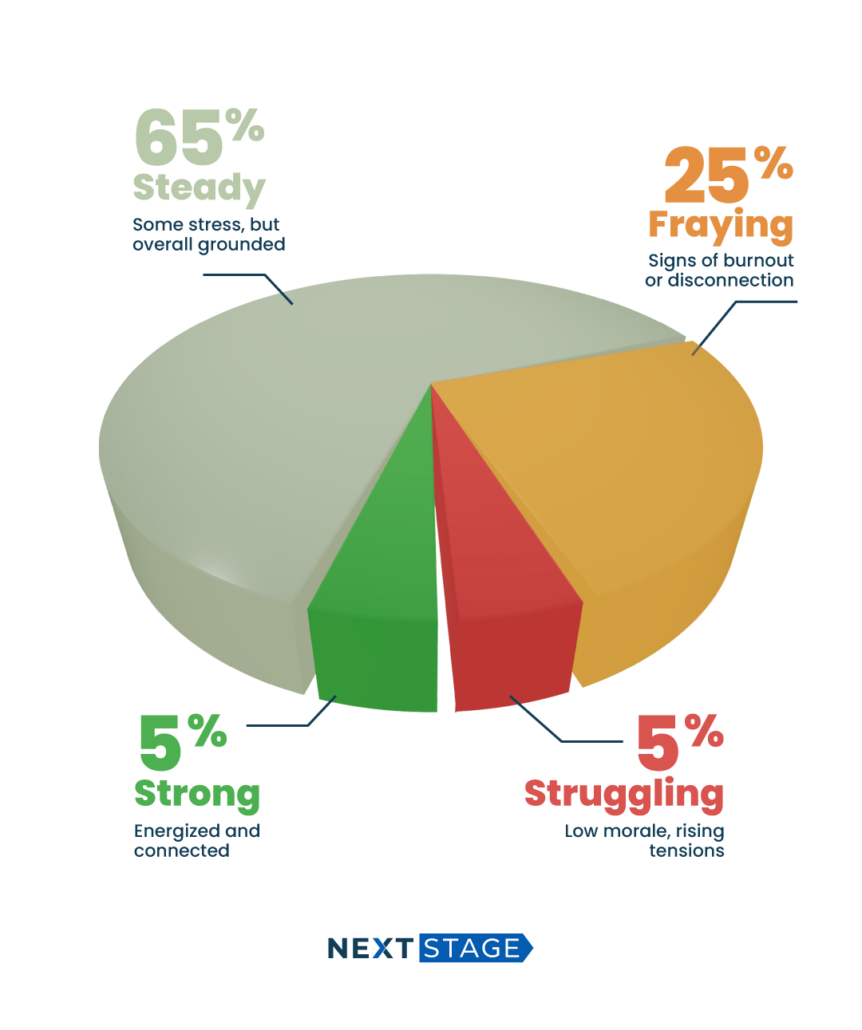
When we asked how teams are really doing, most respondents (65%) said morale is steady — there’s stress, but teams are hanging in there. Still, nearly one-third reported signs of burnout or disconnection, and one described morale as outright struggling.

How respondents described morale:

A graph that represents the current state of nonprofit morale.

This paints a picture of resilience, tempered by real concern about sustainability. As one leader put it, “We’re staying focused on the people we serve.” 


:anger: What’s Putting the Most Pressure on Staff Retention?

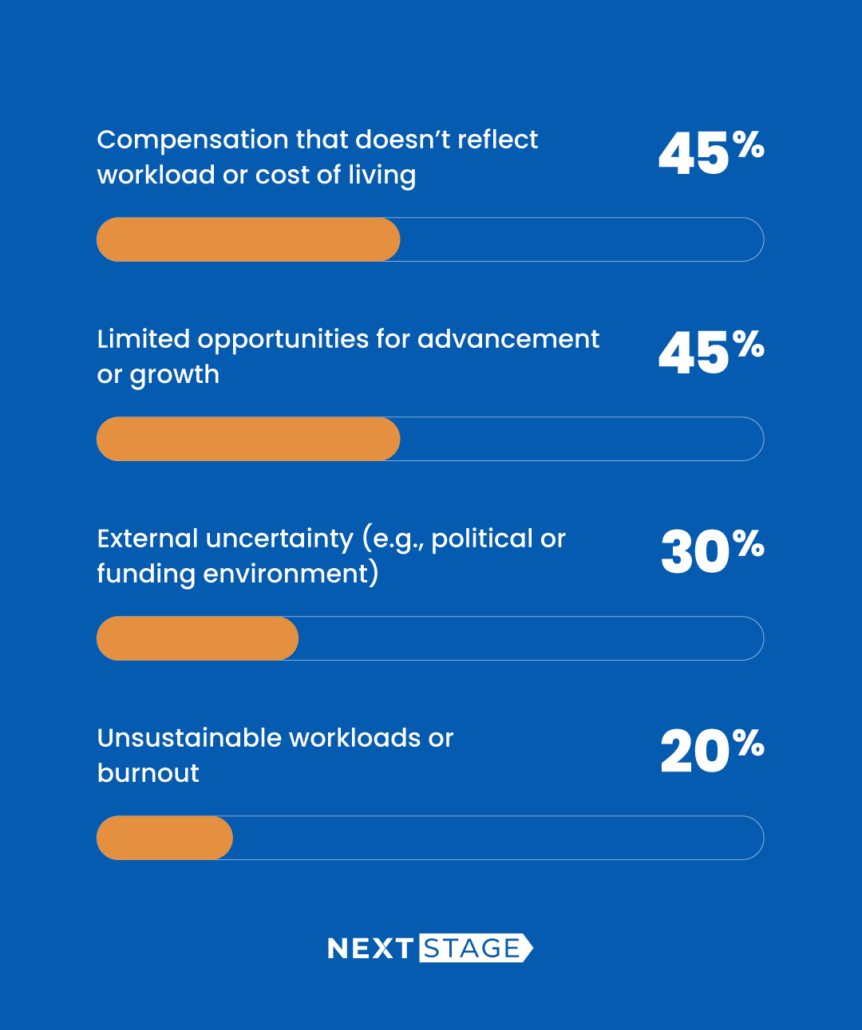
The most common factors weighing on retention aren’t new, but they are increasingly interconnected:

A graph with the survey results.

These responses show that retention challenges aren’t about any one issue — they’re the result of multiple forces converging. Many respondents named several factors at once, reflecting just how deeply personal and organizational stressors overlap.

One leader also pointed to the influence of “personal lives” on staff stability, highlighting how external pressures, like caregiving responsibilities, housing insecurity, or mental health, can directly impact workplace engagement.


:ring_buoy: How Are Organizations Responding?

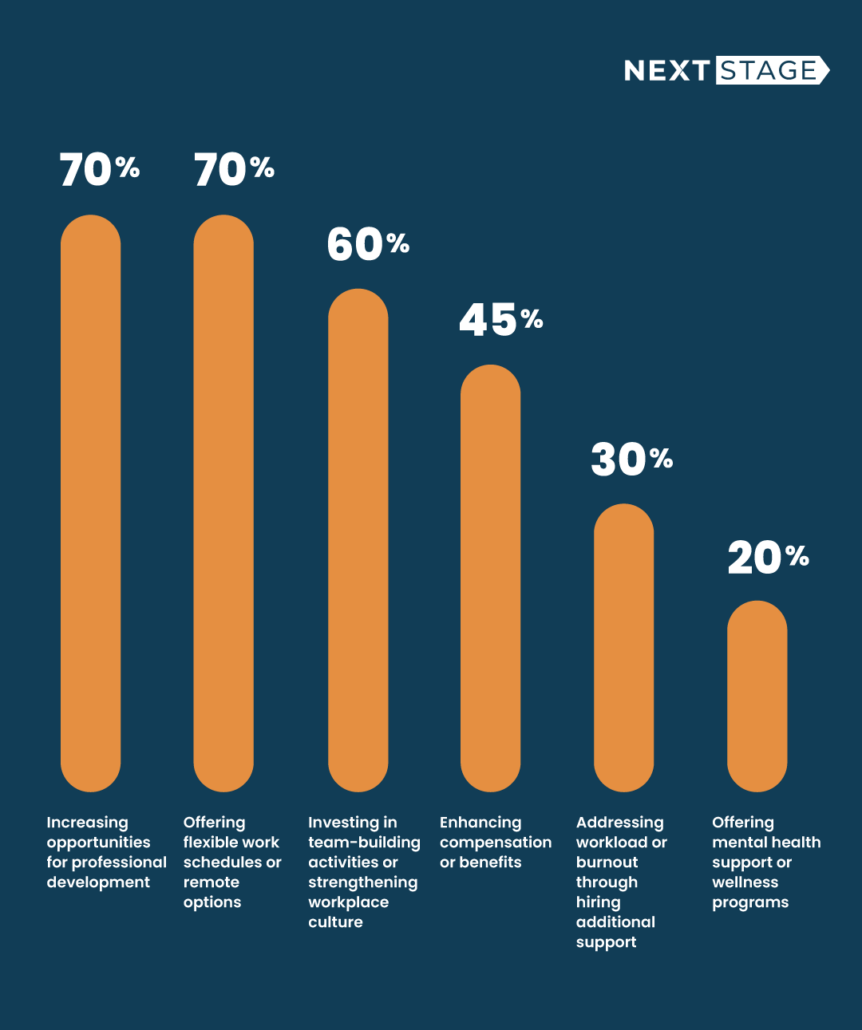
Leaders shared a wide range of actions planned to retain their employees this year:

A graph with survey results.

Professional development and flexibility are leading the charge.

  • The most common responses were increasing opportunities for professional development and offering flexible work schedules or remote options — each cited by 70% of respondents. These options reflect a growing understanding that career growth and flexibility are central to staff satisfaction and long-term commitment.

Culture-building remains key.

  • 60% of respondents are investing in team-building activities or strengthening workplace culture, signaling that nonprofit leaders are prioritizing community, connection, and shared values as a path to retention.

Compensation matters, but it’s not everything.

  • While 45% are enhancing compensation or benefits, it’s notable that nonfinancial strategies like flexibility and culture-building were mentioned more often — perhaps pointing to budget constraints or a broader redefinition of what makes a workplace supportive.

It’s clear that many nonprofit leaders are trying to be as responsive and adaptive as possible — but there’s also room to grow, especially in supporting staff well-being in more holistic ways.


:white_check_mark: What’s Actually Working?

While these numbers help us understand trends across the sector, it’s the qualitative insights that bring the real story to life. We asked leaders what’s helping their teams stay engaged, and here’s what they said:

“Connection among team members.”
“Transparency and communication.”
“Time to gather and celebrate.”
“Focusing on the positive things we’re doing.”
“Giving team members a voice.”
“Our strong relationships with each other.”

Themes of belonging, communication, and meaningful connection stood out loud and clear. Leaders who create space for community — not just productivity — are seeing results:

“We’ve prioritized staying relationally strong so we can keep doing impactful work together.”


:speaking_head_in_silhouette: Encouragement From One Leader to Another

We closed by asking an optional question: What advice or words of encouragement would you give to others leading teams right now?

40% of respondents chose to leave words of wisdom for others, demonstrating our sector’s willingness to step up and support one another. Here’s a snapshot of their insights:

“Help your team to recognize how their individual contributions every day drive the mission of the organization.”

“Listen to understand. Be a bridge for your team, not a wall.”

“Take care of yourself as a leader. You’re probably feeling increased pressure and anxiety. Know that no one knows what’s coming next or how things will shake out, so don’t hold yourself to the expectation that you have to know it all either.”

“Lead with empathy and clarity. People are carrying more than we often realize, so creating a space where your team feels seen, heard, and supported goes a long way. At the same time, don’t be afraid to cast a clear vision — people want to know where they’re going and why it matters. Stay consistent, stay human, and trust that even small moments of encouragement can have a big impact.”

These words reflect what we hear in our work every day: the nonprofit sector is full of people leading with heart, even when times are tough.


:compass: So, What Comes Next?

Nonprofit work has always demanded passion and perseverance. In 2025, it also demands a renewed commitment to the people behind the mission. With burnout, budget pressures, and shifting expectations all in play, workplace culture is no longer a side conversation — it’s central to organizational sustainability.

If your organization is navigating these waters, know this: you’re not alone. And the more we learn from each other, the better we can support the people doing the work that matters most.

Whether your team is thriving, holding steady, or struggling, now’s the time to:

  • Revisit your retention strategies
  • Prioritize real conversations about morale
  • Double down on transparency, flexibility, and team connection

Because when your people thrive, your mission does too.


 Stay tuned for the next survey in the series by subscribing to our monthly newsletter — and thank you for being part of this work.

:bar_chart: Want help translating insight into strategy? Next Stage helps nonprofits and other social good organizations with organizational strengthening and team building. Let’s talk today.

Filed Under: Nonprofit Leadership, Thought Leadership

Trust-Based Philanthropy and “The UnFundable Project”: One Year Later

April 22, 2025 by Caylin

In the intricate landscape of nonprofit support, some of the most critical needs often go unnoticed. This is the story of how one innovative grant helped transform a dance organization’s future by embracing a radical approach to philanthropy.


Traditional grantmaking often constrains nonprofit leaders, forcing them into narrow funding categories that may not address their most pressing challenges. That’s why, in 2024, social innovation company Next Stage sought to change this narrative through a unique $10,000 grant initiative: The UnFundable Project.

The project emerged from the company’s steadfast belief in the power of trust-based philanthropy, a funding approach that encourages grantors to give nonprofit leaders more freedom in figuring out how to fulfill their missions. The initiative’s goal was to support the need of a nonprofit that fell outside conventional funding models.

The recipient of the inaugural award was Caroline Calouche & Co., a Charlotte-based arts organization that aims to build community through dance and circus arts. Their request? An essential but often overlooked need — funding to pay off a credit card used to replace a damaged sprung floor.

One year later, we caught up with the nonprofit’s founder and artistic director, Caroline Calouche, to learn about the impact of the grant and hear what’s next for the organization as it approaches another exciting milestone.

Addressing a Critical, Yet “UnFundable” Need

When Caroline applied for The UnFundable Project, the need was clear but unconventional by typical grantmaking standards. The organization’s sprung floor — a critical piece of equipment for both their professional performing company and dance and circus arts school — had been damaged and required replacement. “We had taken out a credit card to cover the cost of replacing the floor, and we’d been trying to defer interest through balance transfers as long as possible,” Caroline continued.

The specialized sprung floor absorbs shocks and provides a cushioned surface to reduce injuries and enhance performance. And given the organization’s dual purpose of serving both youth and adult students, the floor is in constant use and plays a pivotal role in their artistic mission. By eliminating the financial burden associated with the floor replacement, Caroline Calouche & Co. has been able to provide a safer, more professional space for both aspiring and seasoned artists.

“This grant allowed us to pay off the balance and save money on interest, which gave us some breathing room to focus on our mission.”

Rethinking Philanthropy: Supporting What’s Often Overlooked

One of the most insightful reflections from Caroline was about the broader implications of The UnFundable Project. “It was hard at first to wrap my mind around what an ‘unfundable’ project meant,” she admitted. “Most grants focus on future-facing programs or specific initiatives, but this was different. Paying off past expenses or addressing operational needs isn’t usually something funders are interested in.”

Caroline highlighted how critical operating support and debt relief can be for arts organizations — especially in a funding landscape that has shifted dramatically. “Right now, there’s not much local funding for the arts. Operating support like this is rare but incredibly impactful. But eliminating this debt opens up new possibilities and allows us to move forward with more freedom.”

Looking Ahead: Celebrating 20 Years of Impact

As Caroline Calouche & Co. looks to the future, the organization is gearing up for an exciting milestone in 2026 — celebrating its 20th anniversary. In preparation, the nonprofit’s upcoming season promises to bring more innovative programming, community engagement, and opportunities for audiences to connect with the magic of dance and circus arts. 

“We’ve weathered an economic recession, a pandemic, and changes in arts funding,” Caroline reflected. “To still be here and thriving is something we’re really proud of.”

Continuing the Journey

As Next Stage continues to champion trust-based philanthropy and partner with organizations that push boundaries, we’re proud to celebrate Caroline Calouche & Co.’s success — an inspiring reminder of how sometimes, the most impactful projects are the ones that don’t fit neatly into a grant application box.


Follow Caroline Calouche & Co. on Facebook and Instagram to stay connected and learn how you can support their mission as the organization enters its 20th anniversary season.

Next Stage partners with nonprofits, private sector companies, government agencies, health organizations, faith institutions, and philanthropy and community leaders to develop and implement effective strategies that center community voice, foster collaboration, and fuel social change.


 Want the latest social good trends, insights, and inspiration delivered straight to your inbox? Subscribe to the Impact Insider today!

Filed Under: Corporate Impact, Nonprofit Leadership, Thought Leadership

3 Strategies to Build Organizational Resilience in Uncertain Times

April 8, 2025 by joshjacobson

At Next Stage, we’re always listening for the signals beneath the noise. And right now, those signals are blaring.

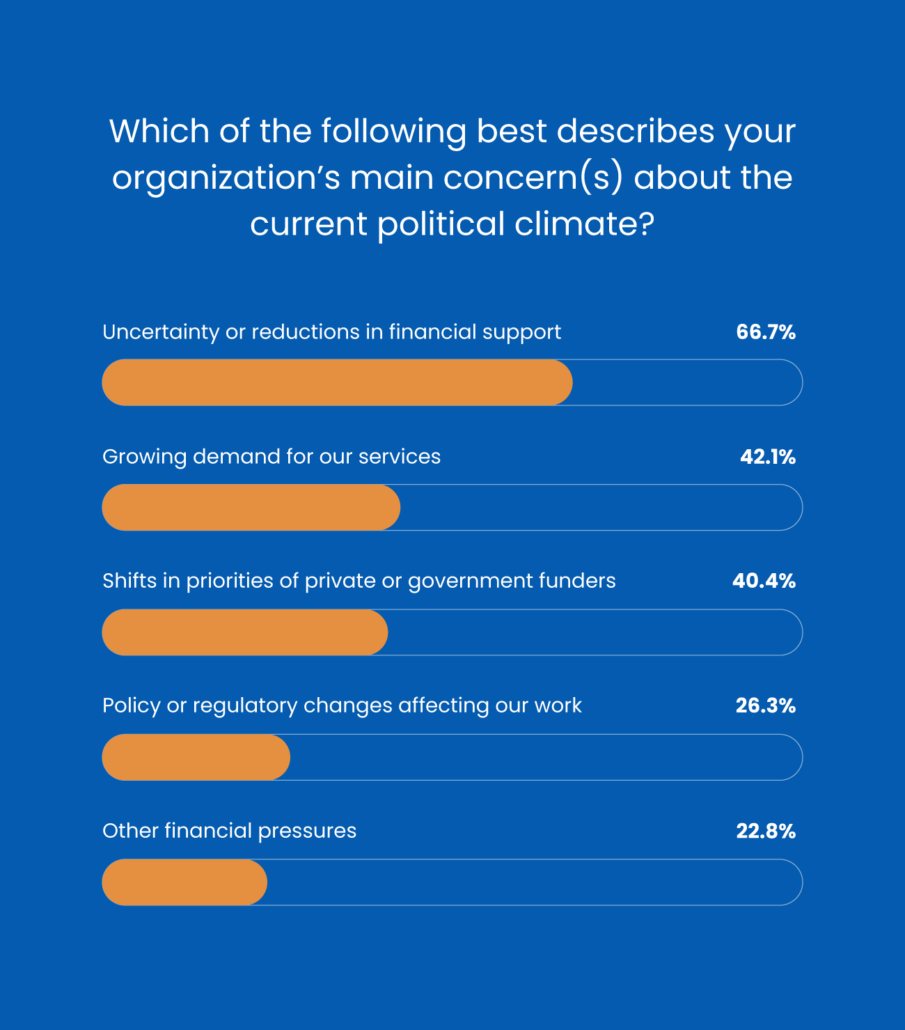
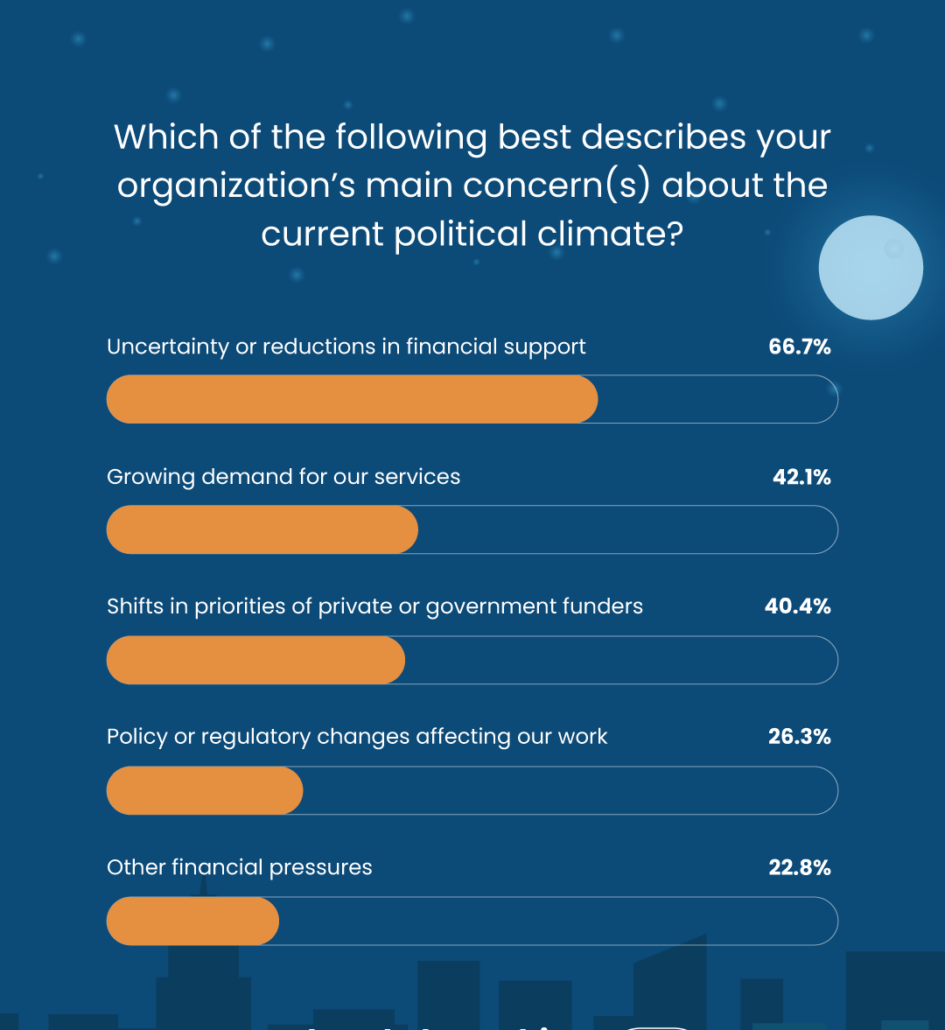
We recently surveyed nonprofit and social good leaders to better understand how today’s political and economic shifts are impacting organizations on the ground. Among 57 respondents, 96% shared that they are struggling with pressing concerns that have already impacted, or are anticipated to impact, their institutions, and 67% of respondents cited financial instability as their top concern. 

A graph that shows the top concerns cited by nonprofit leaders.

For a full report on our findings, click here.

From potential cuts to Medicaid, HUD, and DOE funding to uncertainty around state and local municipality spending in the wake of these cuts, the effects of federal policy changes are immediate and, in many cases, destabilizing.

This is a crisis, full stop. And its ripple effects are showing up in breakroom conversations, Zoom calls, and staff meetings. The stress of so many unknowns, paired with the near-daily disruption of policy change, is wearing on teams — especially those working closest to vulnerable communities. Internal culture is under strain, and social good leaders must respond. 

People are tired and stretched thin. And the hardest part? We may only be at the beginning of what could be a prolonged period of disruption.

Though the challenges ahead may seem daunting, history has shown that mission-driven organizations often find their greatest innovation and community impact during periods of adversity, especially when they invest in their people and culture.

Here are 3 ways to take action today:


1. Create Space for Honest Dialogue

Many staff members are carrying anxiety — about their jobs, the communities they serve, and the future of their organization. It’s tempting to try to shield teams from instability, but silence can breed more fear than transparency. Simply naming the uncertainty can go a long way in maintaining trust and cohesion.

This is particularly true for the people on the front lines of your program delivery — those most proximate to the needs your institution aims to address. Creating opportunities to listen to your employees is something we advocate for through our Community Voice work because it’s a powerful way to build a sense of belonging within your organization, which can help strengthen organizational culture and retain staff.

So aim to create intentional moments for dialogue. Host monthly listening sessions where staff can ask questions and share concerns. If you’re not ready for whole-group conversations, start with anonymous feedback tools that give employees a place to safely speak their minds. It can be as simple as a suggestion or question box in the break room or regular office hours for private conversations. The key is to always close the loop by acknowledging what you’ve heard and outlining what actions (if any) you’ll take.


2. Reaffirm Your Organizational Values

Are your values and guiding principles negotiable? That’s the question many leaders are grappling with, especially as language around diversity, equity, inclusion, and belonging (DEIB) is increasingly politicized. Some funders are distancing themselves from terms that were once celebrated. But changing your language doesn’t mean changing your values.

To keep your team grounded and aligned, consider revisiting your values statements as a group. Facilitate a conversation about what’s essential and nonnegotiable. Turn those into a clear and simple “Values-in-Action” document that can guide communications, grant writing, and external messaging. When everyone is on the same page, it’s easier to move forward with integrity and unity, even in challenging times.

Something to keep in mind: creating an appropriate response to current conditions will be a unique process for each institution. An organization’s size, mission focus, and funding sources will all affect its risk tolerance and next steps.

As you prepare for these important internal conversations, here are two pieces of information to consider:

  • Despite sensationalized claims of “DEI fatigue,” recent research shows only 17% of consumers strongly support DEI cutbacks, with the majority being unsupportive or neutral. Similarly, 85% of consumers do not support companies reducing charitable giving. While public opinion doesn’t directly dictate corporate or federal policy, it provides a useful indicator of broader social sentiment and potential customer/donor reactions.
  • Rev. Bernice A. King (daughter of Martin Luther King Jr.) recently offered valuable advice for nonprofits feeling threatened: remain attuned to the federal government while strategizing quietly and choose language carefully. As she notes, “Everybody has to start looking at language. It doesn’t mean you have to do away with your core mission, but you’re going to have to wordsmith to get through this season… people are going to have to look at ways to be creative.”

No matter what approach you take with your messaging, the key is aligning your team. Because when your team rallies around clearly articulated values, you create a resilient organizational culture that can weather external pressures while staying true to your mission’s heart — regardless of the terminology you choose to express it.


3. Build Confidence Through Contingency Planning

When the future feels uncertain, preparation is a powerful antidote to fear. It’s not about having all the answers, but it is about showing your team that you’re thinking ahead.

Start by outlining a few “what-if” scenarios tied to your current funding structure and program delivery. Bring in department leads or cross-functional teams to help develop response strategies. Consider creating a short internal playbook with draft responses, decision-making frameworks, and communication plans. Even small steps, like naming a contingency planning team or conducting a tabletop exercise, can reassure staff that leadership is proactive and not reactive.

To help shape these efforts, check out resources like this one from Bridgespan. Want more hands-on guidance? Reach out today to see how our team can help.


Above all, we think a key to navigating the future will be collaboration, and that includes partnering with your internal team to wayfind together. Now is not the time for “heroic leadership” — instead, incorporate your direct reports to ensure they feel seen, heard, connected, and inspired to tackle what is coming next. 

Nonprofit leaders: We believe in your courage. We believe in your determination not to let the future be written for you.

That’s why we invite you to continue this learning journey with us through our monthly 2-minute survey series. Because this conversation is just getting started, and your voice is needed to help shape effective solutions for the nonprofit community.

Up next, we’re exploring how external challenges are affecting internal operations and staff. 


See a comprehensive report of last month’s survey results here, and follow us on social media to stay in the loop on future findings.


:inbox_tray: Want the latest social good trends, insights, and inspiration delivered straight to your inbox? Subscribe to the Impact Insider today!

Filed Under: Nonprofit Leadership, Thought Leadership

What’s Keeping Nonprofit Leaders Up at Night? Insights from Our Latest Survey

April 2, 2025 by Caylin

For many in the social good space, the world feels upside down. That’s why we’ve launched a new survey series — to explore the uncertainty and turn it into something useful.

Our first survey asked leaders from across the social good ecosystem to weigh in on the biggest challenges they’re facing in today’s volatile political and economic climate. The results offer a glimpse into the concerns keeping organizations up at night, the most pressing questions leaders are wrestling with, and words of encouragement for navigating what’s ahead.


Who Participated? A Snapshot of Our Respondents

We gathered insights from a diverse group of 57 participants, each offering unique perspectives based on their experiences and roles within their organizations. Our respondents included professionals from various sectors, with a strong representation from nonprofits, government agencies, and community-based organizations. The participants were actively engaged in mission-driven work, focusing on community health, education, housing, social services, and advocacy for marginalized populations.

Sector Representation
  • 93% of respondents came from nonprofit organizations, highlighting the perspective of those working directly on the front lines.
  • A small number of respondents represented other sectors, including government agencies, faith-based organizations, and for-profit companies engaged in social impact work.
Role Representation
  • Nearly 80% held executive leadership roles, including CEOs, executive directors, and senior managers.
  • 7% worked in operations and administration, followed closely by professionals in program delivery and communications.

Our survey design was informed by research conducted by the Center for Effective Philanthropy: Challenging Times: How U.S. Nonprofit Leaders Are Experiencing the Political Context.


 Top Concerns: A Sector Bracing for Uncertainty

Nonprofit leaders are navigating an unprecedented landscape of uncertainty. Federal policy shifts, funding cuts, and cultural polarization create organizational challenges extending beyond financial sustainability — impacting team morale, mission alignment, and stakeholder trust.

Of the 57 respondents who completed the survey, 96% reported struggling with pressing concerns that have already impacted or are anticipated to impact their organizations. 

A graph showing the results of the survey of social good and nonprofit leaders.

When asked about their main concerns related to the current political climate, an overwhelming majority of respondents pointed to financial uncertainty. Across the board, responses underscored a sector that is bracing for an unpredictable funding landscape — a challenge that many fear could destabilize critical programs and services.

Read on for a full breakdown of the top concerns experienced by social good organizations today.


#1 – Uncertainty or reductions in financial support.

Financial instability was the top concern, with 3 out of the top 5 most-cited concerns related to worries about diminished or uncertain funding. Leaders expressed anxiety over changes to or reductions in both short-term and long-term funding streams, particularly from government sources.

“Potential loss of Medicaid funding, which is majority of our revenue.”

“We’re worried about cuts in HUD funding for our work directly but are also worried about the impacts to local government in case they need to withdraw or shift local support to cover gaps in federal funding.”

“How do we continue or expand our impact when populations we serve are losing services and funding is less available?”

“Pledges made with confidence in 2024 are not coming through, and timelines are being extended or uncertain.”


#2 – Growing demand for services.

Another significant concern was the rising demand for services, which is placing tremendous pressure on organizations already operating at or beyond capacity. Respondents shared that as the needs of their communities grow — particularly in areas like housing, food security, and healthcare — they are struggling to keep pace without additional resources or staff.

“Significantly increased need for our services — we have to turn people away.”

“We’re seeing unprecedented levels of food insecurity. Any cuts to government programs/funds (SNAP, WIC, TEFAP, CFSP, etc.) that help feed people will only make our jobs harder if not impossible.”

“How will the current political climate affect the neighbors we serve? What will our response be?”

“What are the implications for vulnerable communities with the widespread loss of funding and disengagement of federally funded or supported services?”


#3 – Shifts in priorities of private and government funders.

Many respondents highlighted concerns about changing funding priorities, both at the federal and local levels. Organizations that depend on private and public funding are unsure whether their missions will align with shifting political and economic agendas.

“How will the backlash against DEI and other beneficial initiatives impact companies’ willingness to invest in community projects and collaborations?”

“How will the reduction in government funding trickle down to individual and foundation-level giving?”

“How will all of the changes impact philanthropic dollars coming from individuals and corporations?”

“Will our funding from grants be impacted? If that’s a possibility, do we need to limit our growth so that we are more nimble if we need to be supported primarily by individuals at some point?”


#4 – Policy or regulatory changes affecting our work.

Beyond financial uncertainty, respondents expressed concerns about potential policy and regulatory changes that could disrupt service delivery. Changes to Medicaid, housing assistance, and other essential programs are looming, leaving organizations uncertain about how to plan for the future. Regulatory changes could also place additional compliance burdens on already stretched teams.

“What’s the impact of changing federal priorities on Medicaid funding in NC?”

“Uncertainty over the dismantling of the US Department of Education and any downstream impact on local school districts, teachers, and students is a real concern.”


#5 – Other financial pressures (e.g., rising costs).

Several organizations noted the impact of rising costs due to inflation on their ability to operate effectively. Increased costs for goods, services, and staffing have created an added layer of complexity in an already tight financial environment.

“How can we quickly replace the funds lost due to policy changes and afford the increase in costs due to tariffs?”

“Will tariffs drive up the price of goods so our in-kind donations drop significantly?”


:world_map: The Leadership Challenge: Navigating Political Sensitivities and Mission Advocacy

Beyond the organizational and operational challenges ahead, many leaders are also grappling with deeply personal questions. At the heart of this is the delicate act of balancing mission advocacy with political sensitivities. Some respondents reported wrestling with whether to speak out, knowing that taking a stand may jeopardize relationships and funding — a decision that can feel like choosing between mission integrity and organizational survival.

As political environments evolve, leaders are grappling with how to steward their organizations and communicate in ways that safeguard relationships and mitigate risk while remaining true to their commitment to equity and inclusion. One survey participant summed it up well:

“We’re figuring out how to navigate in a way that doesn’t alienate people, but instead invites them to understand the impact of certain policy and funding decisions.”


Words of Advice: Leaning into Collaboration and Creativity

While the concerns are real and pressing, there’s also a strong sense of resilience and adaptability across the sector. 

Remarkably, 85% of survey participants chose to answer an optional survey question asking them to share words of hope and encouragement with their peers — a reflection of something we know all too well: the social good sector is uniquely equipped to face difficult times through its deep commitment to collaboration, resilience, and innovation.

Here’s what they had to say:

#1 – Recognize the Emotional Toll and Build Resilience

“The work we do matters; we make a difference; funding is always a challenge, but we can and will survive this crisis.”

“Believe in yourself and others. We’re here for such a time as this.”

“Focusing deeply and passionately on our hyper-local community is the best way to counterbalance the feeling of chaos and hopelessness in the larger world.”

#2 – Build Coalitions and Encourage Collective Advocacy

“Now is the time for advocacy. Let’s not make it an easy decision to cut funding to our sector.”

“Apathy is more dangerous than hate. Use your voice, surround yourself with compassionate people, and volunteer.”

“Communicate and collaborate with everyone in the ecosystem so they understand organizational challenges so we may better provide support to each other.”

#3 – Turn Crisis Into Opportunity

“Crisis is the breeding ground for creativity and innovation. Anticipate potential problems that you may be suited to cultivate solutions and start building NOW.”

“These uncertain times are giving us the opportunity to reimagine the way nonprofits operate.”

“Be clear and compelling about your social value proposition. Look for ways to reinvent yourself in case existing support structures are weakened or eliminated.”


What’s Next?

The key takeaway from our survey is clear: while the road ahead may be challenging, there is power in solidarity and collective action. By leaning into values of equity, collaboration, and impact, organizations can navigate uncertainty and continue making a difference, no matter the political or economic climate.

As we continue to better understand how federal actions impact the social good sector’s work, we’re committed to exploring challenges together and turning them into actionable insights. Our hope is to build a shared learning agenda that captures real-time insights, elevates diverse voices, and equips social good and nonprofit leaders with the tools they need to navigate uncertainty with confidence and support.

Stay tuned for the next survey in the series by subscribing to our monthly newsletter — and thank you for being part of this work.

Together, we can chart a course toward a more resilient, collaborative future.


 Want the latest social good trends, insights, and inspiration delivered straight to your inbox? Subscribe to the Impact Insider today!

Filed Under: Nonprofit Leadership, Thought Leadership

  • « Go to Previous Page
  • Page 1
  • Page 2
  • Page 3
  • Page 4
  • Interim pages omitted …
  • Page 6
  • Go to Next Page »

Primary Sidebar

Footer

Subscribe to the Impact Insider

Your monthly roundup of social good news and trends

only_email

Who we are

What we do

Who we serve

resources

Newsletter

Careers

Let’s work together!

Contact Us

fb
in
ins

© 2026 Next Stage Consulting | All rights reserved | Privacy Policy