• Skip to primary navigation
  • Skip to main content
  • Skip to primary sidebar
  • Skip to footer
Next Stage – Social Impact Services

Next Stage - Social Impact Services

Social good strategy to amplify your impact

  • Who we are
  • What we do
  • Who we serve
  • Resources
    • Impact Stories
    • News & Insights
  • Contact
  • Newsletter
  • fb
  • in
  • ins

Thought Leadership

Trust-Based Philanthropy and “The UnFundable Project”: One Year Later

April 22, 2025 by Caylin

In the intricate landscape of nonprofit support, some of the most critical needs often go unnoticed. This is the story of how one innovative grant helped transform a dance organization’s future by embracing a radical approach to philanthropy.


Traditional grantmaking often constrains nonprofit leaders, forcing them into narrow funding categories that may not address their most pressing challenges. That’s why, in 2024, social innovation company Next Stage sought to change this narrative through a unique $10,000 grant initiative: The UnFundable Project.

The project emerged from the company’s steadfast belief in the power of trust-based philanthropy, a funding approach that encourages grantors to give nonprofit leaders more freedom in figuring out how to fulfill their missions. The initiative’s goal was to support the need of a nonprofit that fell outside conventional funding models.

The recipient of the inaugural award was Caroline Calouche & Co., a Charlotte-based arts organization that aims to build community through dance and circus arts. Their request? An essential but often overlooked need — funding to pay off a credit card used to replace a damaged sprung floor.

One year later, we caught up with the nonprofit’s founder and artistic director, Caroline Calouche, to learn about the impact of the grant and hear what’s next for the organization as it approaches another exciting milestone.

Addressing a Critical, Yet “UnFundable” Need

When Caroline applied for The UnFundable Project, the need was clear but unconventional by typical grantmaking standards. The organization’s sprung floor — a critical piece of equipment for both their professional performing company and dance and circus arts school — had been damaged and required replacement. “We had taken out a credit card to cover the cost of replacing the floor, and we’d been trying to defer interest through balance transfers as long as possible,” Caroline continued.

The specialized sprung floor absorbs shocks and provides a cushioned surface to reduce injuries and enhance performance. And given the organization’s dual purpose of serving both youth and adult students, the floor is in constant use and plays a pivotal role in their artistic mission. By eliminating the financial burden associated with the floor replacement, Caroline Calouche & Co. has been able to provide a safer, more professional space for both aspiring and seasoned artists.

“This grant allowed us to pay off the balance and save money on interest, which gave us some breathing room to focus on our mission.”

Rethinking Philanthropy: Supporting What’s Often Overlooked

One of the most insightful reflections from Caroline was about the broader implications of The UnFundable Project. “It was hard at first to wrap my mind around what an ‘unfundable’ project meant,” she admitted. “Most grants focus on future-facing programs or specific initiatives, but this was different. Paying off past expenses or addressing operational needs isn’t usually something funders are interested in.”

Caroline highlighted how critical operating support and debt relief can be for arts organizations — especially in a funding landscape that has shifted dramatically. “Right now, there’s not much local funding for the arts. Operating support like this is rare but incredibly impactful. But eliminating this debt opens up new possibilities and allows us to move forward with more freedom.”

Looking Ahead: Celebrating 20 Years of Impact

As Caroline Calouche & Co. looks to the future, the organization is gearing up for an exciting milestone in 2026 — celebrating its 20th anniversary. In preparation, the nonprofit’s upcoming season promises to bring more innovative programming, community engagement, and opportunities for audiences to connect with the magic of dance and circus arts. 

“We’ve weathered an economic recession, a pandemic, and changes in arts funding,” Caroline reflected. “To still be here and thriving is something we’re really proud of.”

Continuing the Journey

As Next Stage continues to champion trust-based philanthropy and partner with organizations that push boundaries, we’re proud to celebrate Caroline Calouche & Co.’s success — an inspiring reminder of how sometimes, the most impactful projects are the ones that don’t fit neatly into a grant application box.


Follow Caroline Calouche & Co. on Facebook and Instagram to stay connected and learn how you can support their mission as the organization enters its 20th anniversary season.

Next Stage partners with nonprofits, private sector companies, government agencies, health organizations, faith institutions, and philanthropy and community leaders to develop and implement effective strategies that center community voice, foster collaboration, and fuel social change.


 Want the latest social good trends, insights, and inspiration delivered straight to your inbox? Subscribe to the Impact Insider today!
Filed Under: Corporate Impact, Nonprofit Leadership, Thought Leadership

3 Strategies to Build Organizational Resilience in Uncertain Times

April 8, 2025 by joshjacobson

At Next Stage, we’re always listening for the signals beneath the noise. And right now, those signals are blaring.

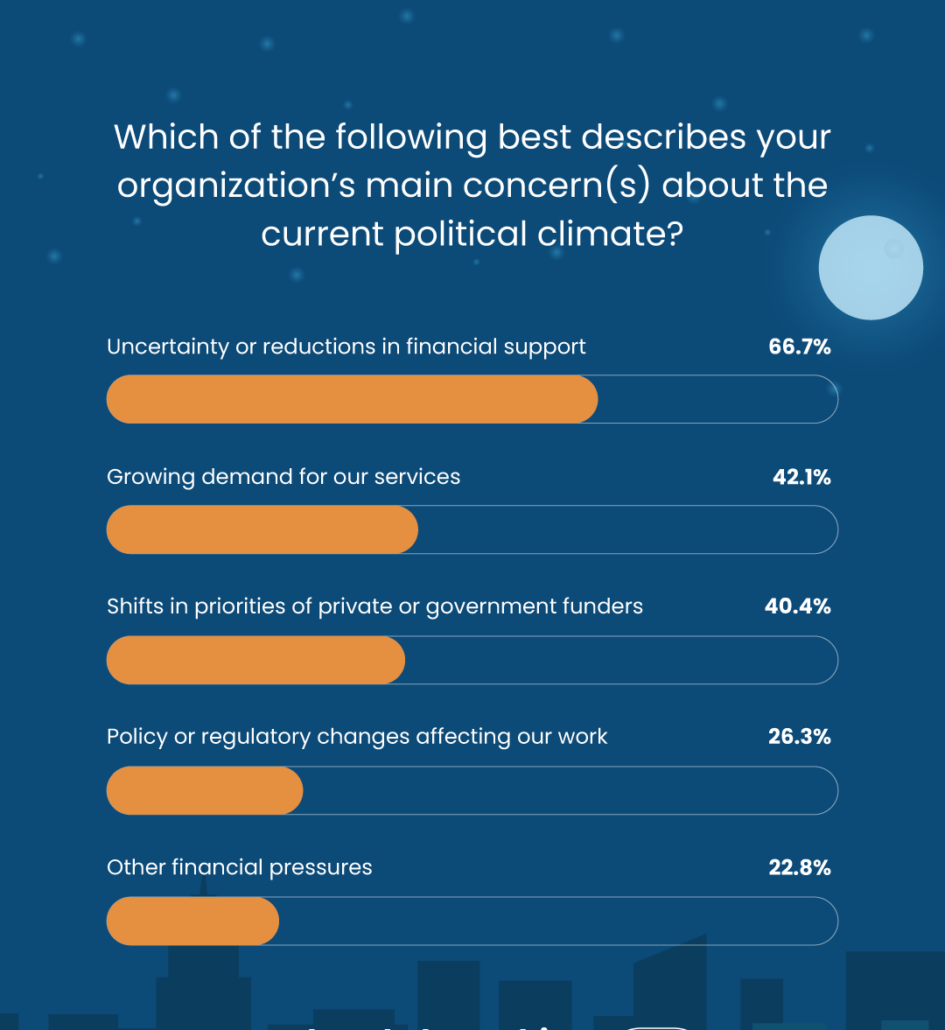
We recently surveyed nonprofit and social good leaders to better understand how today’s political and economic shifts are impacting organizations on the ground. Among 57 respondents, 96% shared that they are struggling with pressing concerns that have already impacted, or are anticipated to impact, their institutions, and 67% of respondents cited financial instability as their top concern. 

A graph that shows the top concerns cited by nonprofit leaders.

For a full report on our findings, click here.

From potential cuts to Medicaid, HUD, and DOE funding to uncertainty around state and local municipality spending in the wake of these cuts, the effects of federal policy changes are immediate and, in many cases, destabilizing.

This is a crisis, full stop. And its ripple effects are showing up in breakroom conversations, Zoom calls, and staff meetings. The stress of so many unknowns, paired with the near-daily disruption of policy change, is wearing on teams — especially those working closest to vulnerable communities. Internal culture is under strain, and social good leaders must respond. 

People are tired and stretched thin. And the hardest part? We may only be at the beginning of what could be a prolonged period of disruption.

Though the challenges ahead may seem daunting, history has shown that mission-driven organizations often find their greatest innovation and community impact during periods of adversity, especially when they invest in their people and culture.

Here are 3 ways to take action today:


1. Create Space for Honest Dialogue

Many staff members are carrying anxiety — about their jobs, the communities they serve, and the future of their organization. It’s tempting to try to shield teams from instability, but silence can breed more fear than transparency. Simply naming the uncertainty can go a long way in maintaining trust and cohesion.

This is particularly true for the people on the front lines of your program delivery — those most proximate to the needs your institution aims to address. Creating opportunities to listen to your employees is something we advocate for through our Community Voice work because it’s a powerful way to build a sense of belonging within your organization, which can help strengthen organizational culture and retain staff.

So aim to create intentional moments for dialogue. Host monthly listening sessions where staff can ask questions and share concerns. If you’re not ready for whole-group conversations, start with anonymous feedback tools that give employees a place to safely speak their minds. It can be as simple as a suggestion or question box in the break room or regular office hours for private conversations. The key is to always close the loop by acknowledging what you’ve heard and outlining what actions (if any) you’ll take.


2. Reaffirm Your Organizational Values

Are your values and guiding principles negotiable? That’s the question many leaders are grappling with, especially as language around diversity, equity, inclusion, and belonging (DEIB) is increasingly politicized. Some funders are distancing themselves from terms that were once celebrated. But changing your language doesn’t mean changing your values.

To keep your team grounded and aligned, consider revisiting your values statements as a group. Facilitate a conversation about what’s essential and nonnegotiable. Turn those into a clear and simple “Values-in-Action” document that can guide communications, grant writing, and external messaging. When everyone is on the same page, it’s easier to move forward with integrity and unity, even in challenging times.

Something to keep in mind: creating an appropriate response to current conditions will be a unique process for each institution. An organization’s size, mission focus, and funding sources will all affect its risk tolerance and next steps.

As you prepare for these important internal conversations, here are two pieces of information to consider:

  • Despite sensationalized claims of “DEI fatigue,” recent research shows only 17% of consumers strongly support DEI cutbacks, with the majority being unsupportive or neutral. Similarly, 85% of consumers do not support companies reducing charitable giving. While public opinion doesn’t directly dictate corporate or federal policy, it provides a useful indicator of broader social sentiment and potential customer/donor reactions.
  • Rev. Bernice A. King (daughter of Martin Luther King Jr.) recently offered valuable advice for nonprofits feeling threatened: remain attuned to the federal government while strategizing quietly and choose language carefully. As she notes, “Everybody has to start looking at language. It doesn’t mean you have to do away with your core mission, but you’re going to have to wordsmith to get through this season… people are going to have to look at ways to be creative.”

No matter what approach you take with your messaging, the key is aligning your team. Because when your team rallies around clearly articulated values, you create a resilient organizational culture that can weather external pressures while staying true to your mission’s heart — regardless of the terminology you choose to express it.


3. Build Confidence Through Contingency Planning

When the future feels uncertain, preparation is a powerful antidote to fear. It’s not about having all the answers, but it is about showing your team that you’re thinking ahead.

Start by outlining a few “what-if” scenarios tied to your current funding structure and program delivery. Bring in department leads or cross-functional teams to help develop response strategies. Consider creating a short internal playbook with draft responses, decision-making frameworks, and communication plans. Even small steps, like naming a contingency planning team or conducting a tabletop exercise, can reassure staff that leadership is proactive and not reactive.

To help shape these efforts, check out resources like this one from Bridgespan. Want more hands-on guidance? Reach out today to see how our team can help.


Above all, we think a key to navigating the future will be collaboration, and that includes partnering with your internal team to wayfind together. Now is not the time for “heroic leadership” — instead, incorporate your direct reports to ensure they feel seen, heard, connected, and inspired to tackle what is coming next. 

Nonprofit leaders: We believe in your courage. We believe in your determination not to let the future be written for you.

That’s why we invite you to continue this learning journey with us through our monthly 2-minute survey series. Because this conversation is just getting started, and your voice is needed to help shape effective solutions for the nonprofit community.

Up next, we’re exploring how external challenges are affecting internal operations and staff. 


See a comprehensive report of last month’s survey results here, and follow us on social media to stay in the loop on future findings.


:inbox_tray: Want the latest social good trends, insights, and inspiration delivered straight to your inbox? Subscribe to the Impact Insider today!

Filed Under: Nonprofit Leadership, Thought Leadership

What’s Keeping Nonprofit Leaders Up at Night? Insights from Our Latest Survey

April 2, 2025 by Caylin

For many in the social good space, the world feels upside down. That’s why we’ve launched a new survey series — to explore the uncertainty and turn it into something useful.

Our first survey asked leaders from across the social good ecosystem to weigh in on the biggest challenges they’re facing in today’s volatile political and economic climate. The results offer a glimpse into the concerns keeping organizations up at night, the most pressing questions leaders are wrestling with, and words of encouragement for navigating what’s ahead.


Who Participated? A Snapshot of Our Respondents

We gathered insights from a diverse group of 57 participants, each offering unique perspectives based on their experiences and roles within their organizations. Our respondents included professionals from various sectors, with a strong representation from nonprofits, government agencies, and community-based organizations. The participants were actively engaged in mission-driven work, focusing on community health, education, housing, social services, and advocacy for marginalized populations.

Sector Representation
  • 93% of respondents came from nonprofit organizations, highlighting the perspective of those working directly on the front lines.
  • A small number of respondents represented other sectors, including government agencies, faith-based organizations, and for-profit companies engaged in social impact work.
Role Representation
  • Nearly 80% held executive leadership roles, including CEOs, executive directors, and senior managers.
  • 7% worked in operations and administration, followed closely by professionals in program delivery and communications.

Our survey design was informed by research conducted by the Center for Effective Philanthropy: Challenging Times: How U.S. Nonprofit Leaders Are Experiencing the Political Context.


 Top Concerns: A Sector Bracing for Uncertainty

Nonprofit leaders are navigating an unprecedented landscape of uncertainty. Federal policy shifts, funding cuts, and cultural polarization create organizational challenges extending beyond financial sustainability — impacting team morale, mission alignment, and stakeholder trust.

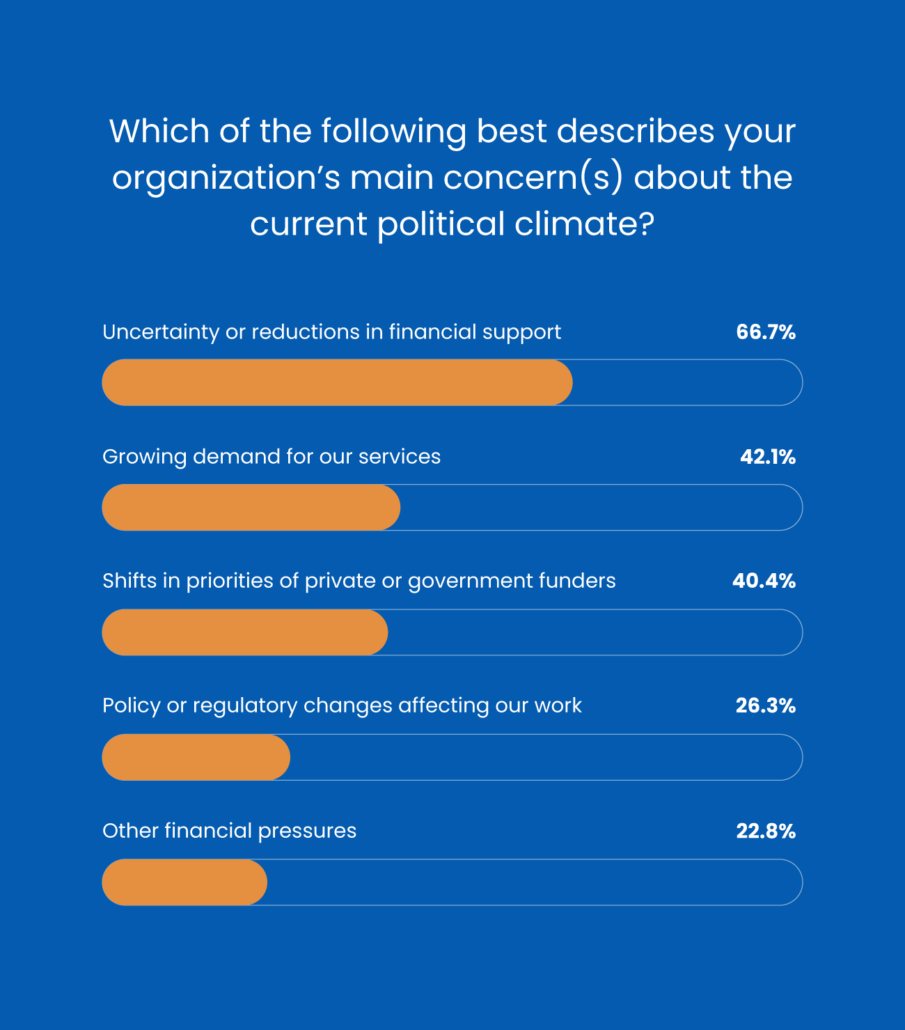
Of the 57 respondents who completed the survey, 96% reported struggling with pressing concerns that have already impacted or are anticipated to impact their organizations. 

A graph showing the results of the survey of social good and nonprofit leaders.

When asked about their main concerns related to the current political climate, an overwhelming majority of respondents pointed to financial uncertainty. Across the board, responses underscored a sector that is bracing for an unpredictable funding landscape — a challenge that many fear could destabilize critical programs and services.

Read on for a full breakdown of the top concerns experienced by social good organizations today.


#1 – Uncertainty or reductions in financial support.

Financial instability was the top concern, with 3 out of the top 5 most-cited concerns related to worries about diminished or uncertain funding. Leaders expressed anxiety over changes to or reductions in both short-term and long-term funding streams, particularly from government sources.

“Potential loss of Medicaid funding, which is majority of our revenue.”

“We’re worried about cuts in HUD funding for our work directly but are also worried about the impacts to local government in case they need to withdraw or shift local support to cover gaps in federal funding.”

“How do we continue or expand our impact when populations we serve are losing services and funding is less available?”

“Pledges made with confidence in 2024 are not coming through, and timelines are being extended or uncertain.”


#2 – Growing demand for services.

Another significant concern was the rising demand for services, which is placing tremendous pressure on organizations already operating at or beyond capacity. Respondents shared that as the needs of their communities grow — particularly in areas like housing, food security, and healthcare — they are struggling to keep pace without additional resources or staff.

“Significantly increased need for our services — we have to turn people away.”

“We’re seeing unprecedented levels of food insecurity. Any cuts to government programs/funds (SNAP, WIC, TEFAP, CFSP, etc.) that help feed people will only make our jobs harder if not impossible.”

“How will the current political climate affect the neighbors we serve? What will our response be?”

“What are the implications for vulnerable communities with the widespread loss of funding and disengagement of federally funded or supported services?”


#3 – Shifts in priorities of private and government funders.

Many respondents highlighted concerns about changing funding priorities, both at the federal and local levels. Organizations that depend on private and public funding are unsure whether their missions will align with shifting political and economic agendas.

“How will the backlash against DEI and other beneficial initiatives impact companies’ willingness to invest in community projects and collaborations?”

“How will the reduction in government funding trickle down to individual and foundation-level giving?”

“How will all of the changes impact philanthropic dollars coming from individuals and corporations?”

“Will our funding from grants be impacted? If that’s a possibility, do we need to limit our growth so that we are more nimble if we need to be supported primarily by individuals at some point?”


#4 – Policy or regulatory changes affecting our work.

Beyond financial uncertainty, respondents expressed concerns about potential policy and regulatory changes that could disrupt service delivery. Changes to Medicaid, housing assistance, and other essential programs are looming, leaving organizations uncertain about how to plan for the future. Regulatory changes could also place additional compliance burdens on already stretched teams.

“What’s the impact of changing federal priorities on Medicaid funding in NC?”

“Uncertainty over the dismantling of the US Department of Education and any downstream impact on local school districts, teachers, and students is a real concern.”


#5 – Other financial pressures (e.g., rising costs).

Several organizations noted the impact of rising costs due to inflation on their ability to operate effectively. Increased costs for goods, services, and staffing have created an added layer of complexity in an already tight financial environment.

“How can we quickly replace the funds lost due to policy changes and afford the increase in costs due to tariffs?”

“Will tariffs drive up the price of goods so our in-kind donations drop significantly?”


:world_map: The Leadership Challenge: Navigating Political Sensitivities and Mission Advocacy

Beyond the organizational and operational challenges ahead, many leaders are also grappling with deeply personal questions. At the heart of this is the delicate act of balancing mission advocacy with political sensitivities. Some respondents reported wrestling with whether to speak out, knowing that taking a stand may jeopardize relationships and funding — a decision that can feel like choosing between mission integrity and organizational survival.

As political environments evolve, leaders are grappling with how to steward their organizations and communicate in ways that safeguard relationships and mitigate risk while remaining true to their commitment to equity and inclusion. One survey participant summed it up well:

“We’re figuring out how to navigate in a way that doesn’t alienate people, but instead invites them to understand the impact of certain policy and funding decisions.”


Words of Advice: Leaning into Collaboration and Creativity

While the concerns are real and pressing, there’s also a strong sense of resilience and adaptability across the sector. 

Remarkably, 85% of survey participants chose to answer an optional survey question asking them to share words of hope and encouragement with their peers — a reflection of something we know all too well: the social good sector is uniquely equipped to face difficult times through its deep commitment to collaboration, resilience, and innovation.

Here’s what they had to say:

#1 – Recognize the Emotional Toll and Build Resilience

“The work we do matters; we make a difference; funding is always a challenge, but we can and will survive this crisis.”

“Believe in yourself and others. We’re here for such a time as this.”

“Focusing deeply and passionately on our hyper-local community is the best way to counterbalance the feeling of chaos and hopelessness in the larger world.”

#2 – Build Coalitions and Encourage Collective Advocacy

“Now is the time for advocacy. Let’s not make it an easy decision to cut funding to our sector.”

“Apathy is more dangerous than hate. Use your voice, surround yourself with compassionate people, and volunteer.”

“Communicate and collaborate with everyone in the ecosystem so they understand organizational challenges so we may better provide support to each other.”

#3 – Turn Crisis Into Opportunity

“Crisis is the breeding ground for creativity and innovation. Anticipate potential problems that you may be suited to cultivate solutions and start building NOW.”

“These uncertain times are giving us the opportunity to reimagine the way nonprofits operate.”

“Be clear and compelling about your social value proposition. Look for ways to reinvent yourself in case existing support structures are weakened or eliminated.”


What’s Next?

The key takeaway from our survey is clear: while the road ahead may be challenging, there is power in solidarity and collective action. By leaning into values of equity, collaboration, and impact, organizations can navigate uncertainty and continue making a difference, no matter the political or economic climate.

As we continue to better understand how federal actions impact the social good sector’s work, we’re committed to exploring challenges together and turning them into actionable insights. Our hope is to build a shared learning agenda that captures real-time insights, elevates diverse voices, and equips social good and nonprofit leaders with the tools they need to navigate uncertainty with confidence and support.

Stay tuned for the next survey in the series by subscribing to our monthly newsletter — and thank you for being part of this work.

Together, we can chart a course toward a more resilient, collaborative future.


 Want the latest social good trends, insights, and inspiration delivered straight to your inbox? Subscribe to the Impact Insider today!

Filed Under: Nonprofit Leadership, Thought Leadership

Collaboration in Crisis: Why We Need Each Other More Than Ever

March 7, 2025 by joshjacobson

The nonprofit and social impact sector is bracing for a new kind of crisis — one driven not by a sudden disaster, but by the slow erosion of federal funding for health, human services, and conservation efforts. The trickle-down effect will be widespread, creating a chain reaction of funding realignments, unexpected shortfalls, and increased competition for limited resources.

For many organizations, these budget shifts won’t be a distant concern — they’ll be an immediate existential threat. Many providing direct services will find themselves forced to justify their existence, making the case for why food access should take priority over education, or why housing deserves investment over healthcare. But this is a false choice. These issues are not isolated — they are interconnected, part of what we at Next Stage call the social drivers of everything.

No single mission stands alone. The success of any individual — or an entire community — relies on the work of many. And that’s exactly why social good collaborations are no longer optional. They’re a necessity.

Crisis as a Catalyst for Collective Action

Next Stage is motivated to support collaboration for exactly this reason, and our work to advance collective efforts is becoming a bigger part of our company’s service offerings.

Given the importance of collaboration to the funding community, one might expect a more expansive body of evidence-based research advocating for it. The Sustained Collaboration Network makes a compelling case for social good collaborations in their 2024 report, Nurturing Nonprofit Collaborations: Insights for Philanthropic Funders. Of the 45 collaborations studied, 73% demonstrated quantifiable success, reinforcing the effectiveness of collective approaches.

Unfortunately, it often takes a crisis to bring people together to collaborate. When a hurricane decimates a community or an earthquake shakes the infrastructure of a city, the institutions positioned to help leap into action. No one is debating mission creep or defending their funding sources when a crisis is actively causing harm.

Our passion for collaboration was forged in the early days of the COVID-19 pandemic — another crisis that taught us a lot about the interrelationship of social impact. It proved the importance of neighborhood-level trust brokers — community-based organizations (CBOs) that serve as a critical bridge to ensuring the delivery of services (and vaccines) to disinvested community members uncertain of who to trust. Our communities were forever changed by the pandemic, with CBOs now firmly positioned as a critical link in the supply chain of social good.

The Next Crisis Is Already Here

The dismantling of America’s social safety net is happening with record speed. Government and nonprofit service providers alike are preparing for significant funding cuts that will negatively impact individuals living below the poverty line (and this is to say nothing of the global impact of dismantling USAID, but that is a blog for another time).

Like a rollercoaster approaching the zenith of its incline, we’re preparing ourselves for the uncertainty of the plummet still to come. If only we could transport ourselves a few years in the future where, with the benefit of hindsight, we’d be able to offer counsel to each other. We might share the following as advice:

  1. Leverage preexisting relationships. The hardest time to build trust is in the middle of a crisis. Your best bet is to tap into partners where there’s already a history of working together. That being said, if you haven’t yet mapped out your ecosystem of collaborators, now is the time. Identify organizations in your network with complementary missions and aligned values, and work to deepen those relationships. The strongest collaborations don’t start with formal agreements — they begin with mutual trust and a willingness to support one another.

  2. Develop your communication carefully. Organizations can fall into the trap of positioning their funding crisis as the main headline rather than the outcomes of their services. The sudden loss of funding makes for a compelling news story, but it typically doesn’t motivate generosity the way human-centered storytelling can. Donors, funders, and stakeholders need to understand the people behind the numbers — the lives changed, the impact made, and the ripple effects of the work. Now’s the time to refine messaging, ensuring that your organization’s value is clear, compelling, and easy to articulate.

  3. Manage for now, but plan for the future. While the need in front of us feels urgent and visceral, it’s important to take the long view. Your institution is likely going to need to manage change and make difficult decisions in the months and years to come. But keep in mind that an inspirational vision is among your most important assets. In times of uncertainty, people follow leaders who offer more than just stability — they follow those who can paint a picture of what’s possible. Even as you navigate immediate financial challenges, stay focused on the bigger picture. What does success look like five years from now? How can your organization evolve to meet the changing landscape?


A Time for Collaboration, Not Competition

We’re approaching an inflection point. The months ahead will test organizations in ways they may not yet fully understand. But if there’s one lesson to be learned from past crises, it’s this: no one wins by going it alone.

No single mission is most important, because the success of any service provider is dependent on the work of others. Collaboration is not just a strategy for survival — it’s the best way to drive meaningful, sustainable impact.

This isn’t the time for territorialism or scarcity mindsets. It’s a moment to double down on partnerships, lean into collective solutions, and recognize that our greatest strength has always been — and will always be — each other. The question isn’t whether collaboration is necessary. The question is whether we’ll embrace it before the crisis forces us to, and if the lessons learned will lead to a permanent change to how social good gets done.


Want the latest social good trends, insights, and inspiration delivered straight to your inbox? Subscribe to the Impact Insider today!

Filed Under: Nonprofit Leadership, Thought Leadership

Executive Compensation for Nonprofit Leaders: A Critical Moment

February 7, 2025 by joshjacobson

The world of social good is a bit upside down right now. The federal spending freeze announced early last week set in motion a flurry of communications from current and past Next Stage clients, all seeking clarity on what it meant and how to navigate it. While the Office of Management and Budget ultimately rescinded the proposed payments pause, the writing is firmly on the wall—be prepared.

These conversations reminded us yet again how challenging the role of executive leadership in the nonprofit sector is today. The COVID-19 pandemic had a beleaguering effect on administrators who needed to care for their staff members and volunteers while keeping their mission focus alive. And now, just as the world seemed to be getting back to normal, new federal policy directions are throwing them another massive curveball.

We feel for these leaders and want to recognize their importance at this critical juncture in history.

Retention Strategies in Times of Stress

Once upon a time, Next Stage offered executive search as a core service line, conducting as many executive searches as strategic planning efforts. This has since moved to more of a “secret menu item” for client engagements where we’re more deeply involved (like our recent sourcing of Kristine Urrutia as Catawba Nation Foundation’s inaugural Executive Director).

But through our extensive experience in executive search, we identified a significant gap in local data around executive compensation for nonprofit leaders. In response, we created an in-depth community report in 2020 to help address this issue.

The Charlotte-Mecklenburg Nonprofit Executive Compensation Study provided detailed insight into compensation by sector, revenue size, and number of employees, offering key data on base compensation, benefits, and pay-for-performance. While information like this existed at the statewide and national levels, no one had done a deep dive into the data on a local level.

In the years since the report’s release, we’ve received regular inquiries from board chairs and nonprofit leaders about its findings. This ongoing need for local and organization-specific data led us to launch an Executive Compensation Study service line. Through this offering, we provide custom recommendations and analysis for organizations looking to design an executive director retention strategy.

We’re reminded of this work now as nonprofit leaders face an uncertain future. We feel strongly that they deserve our advocacy at a time when they would have us focus instead on the people their organizations serve.

Read on to learn more about retention strategies your organization can implement to help support your leadership during turbulent times.

Nonprofit Leadership in Times of Crisis

Nonprofit executives are navigating a landscape of increasing complexity, where economic uncertainty, shifting public policy, and evolving donor expectations place extraordinary demands on their leadership. These professionals must balance mission-driven work with operational sustainability, all while ensuring their organizations remain resilient in the face of external pressures. 

As these challenges mount, so does the need for organizations to examine how they can best support and retain their leaders.

Avoid Self-Advocacy in the Budgeting Process

Nonprofit CEOs often face the difficult position of advocating for their own compensation while balancing other organizational needs. This challenge is exacerbated when the budgeting process begins with the CEO, who submits an initial draft to the Executive Committee of the Board of Directors. 

The need for transparency and fairness in executive compensation is more urgent than ever. Selflessness is in the nonprofit DNA, with leaders putting the needs of others ahead of their own. This frequently manifests in CEOs prioritizing salary increases for staff over their own compensation, leading to long-term retention challenges. We’ve seen time and again how nonprofit administrators sacrifice personal financial security in favor of sustaining their teams—an expectation that’s neither sustainable nor fair.

A recent article by the Maine Association of Nonprofits emphasizes developing a transparent compensation philosophy. Such a philosophy not only demonstrates the critical role of staff retention in advancing the organization’s mission but also holds decision-makers accountable to guidelines grounded in organizational values, rather than market data alone. This approach equips staff with information that supports self-advocacy and broader organizational accountability.

Sync Executive Assessment to a Strategic Plan

How is your organization’s chief administrator performing? Our take on this hasn’t changed: nonprofit boards lacking strong executive assessment methodology struggle to set compensation fairly, tending to “keep up with the Joneses” rather than compensate for outstanding performance.  

Aligning the executive assessment process with the organization’s strategic plan is essential for ensuring leadership efforts directly contribute to overarching goals. A quality strategic plan will outline objectives across programming, operations, and resource development, complete with measurable targets. By basing executive assessment metrics directly on the strategic plan, there’s a clear understanding of how the CEO achieves desired outcomes and creates measurable impact in their role. This must be adjusted during times of crisis, revisiting these goals against the backdrop of change. 

Nonprofit boards should also consider incorporating pay-for-performance bonuses. According to a survey by BDO USA, 42% of nonprofit organizations now include annual incentives or bonuses as part of their compensation packages for executive directors—a statistic that matches Next Stage’s local findings of 39% back in 2020. This marks a continued shift toward performance-based compensation, reflecting a desire to align executive pay more closely with organizational goals and outcomes.

Scrutiny from the Outside

Media interest in nonprofit salaries tends to be cyclical, often producing sensationalist headlines that frame executive compensation as excessive. A recent Charlotte Observer article (“See who is making millions at 15 top nonprofits”) exemplifies this trend, highlighting salaries without broader context about the complexity of nonprofit leadership. While transparency is critical, these stories often reinforce the false narrative that nonprofits should underpay their leaders—despite the immense responsibility they carry in ensuring organizational success, financial sustainability, and impact.

It has always baffled me that leaders working to make the world a better place are penalized for earning fair compensation while corporate executives are encouraged to earn millions—even when their work sometimes runs counter to social good. This dynamic not only affects how the public perceives nonprofit executives but also discourages top talent from pursuing or remaining in leadership roles.

Instead of perpetuating these misleading narratives, we should advocate for fair compensation structures that recognize the expertise, dedication, and leadership required to sustain mission-driven organizations.

A Call for Change

Nonprofit leaders are at the center of social impact, yet they continue to navigate an uphill battle when it comes to fair compensation. As we look ahead, we must address this imbalance head-on, ensuring that executive compensation for nonprofit leaders reflects the value these individuals bring to their organizations and communities.

This is particularly true now as we face an uncertain future and what will likely be years of policy shifts that impact the nonprofit business model. 

For board members and stakeholders invested in organizational sustainability, the conversation about retention must include compensation. Now more than ever, it’s time to advocate for the leaders who dedicate their careers to building a better world.


Interested in a custom executive compensation study for your organization? Schedule a free consultation today to discuss your nonprofit’s unique needs.


Want the latest social good trends, insights, and inspiration delivered straight to your inbox? Subscribe to the Impact Insider today!

Filed Under: Nonprofit Leadership, Talent, Thought Leadership

4 Essential Best Practices for Strategic Planning in 2025

January 13, 2025 by joshjacobson

It’s a new year, and that means new opportunities for your organization to build a strategic roadmap.

Strategic planning is Next Stage’s cornerstone service line. It’s a process we’ve guided more than 100 organizations through—from nonprofits and community-based organizations to health care groups and government agencies. We understand the words “strategic planning” can elicit very different reactions: for some, the process is exciting and full of possibility, while for others, it’s a daunting or even cringe-worthy task.

In recent years, strategic planning in the social good sector has faced significant disruption. The lingering effects of the COVID-19 pandemic, combined with an uncertain political environment and the looming threat of economic recession, caused many organizations to shift to a “wait-and-see” mindset, opting to rely on short-term annual plans rather than committing to multiyear strategic roadmaps. According to one recent study, up to 49% of nonprofits lack a strategic plan.

However, as we enter 2025, the external landscape has begun to stabilize. We’re operating under a new federal administration, the economy has achieved relative stability, and advancements in technology are firmly taking hold. While challenges remain for institutions working to advance social good, we’re no longer navigating in the fog of ambiguity. The near-term future has become clearer—and with that clarity comes opportunity.

So, what now? The time has come to get proactive because developing a multiyear strategy has wide-ranging benefits. One study found that 86% of nonprofit respondents believed their strategic plan positively impacted revenue generation through grants, donors, events, and other avenues.

So whether you’re contemplating your first strategic plan or looking to refresh your approach, we’ve prepared a list of four best practices for strategic planning to help your organization create a roadmap that drives real impact.


1. Listen to Your Constituents

A microphone in front of an audience.

Market research is big business—a $150 billion global industry according to ESOMAR’s Global Market Research report. And with more sources of data than ever before thanks to advancements in technology and AI, there are seemingly endless opportunities to secure key constituent insights. 

That’s welcome news because regularly listening to your constituents is essential. Don’t make the all-too-common mistake of believing you already know what your key stakeholders are thinking, feeling, and experiencing. Conditions change over time, and so too do the needs and opportunities faced by the people critical to your institution’s success.

That’s why we always encourage our clients to use learnings gained by listening to their constituents to inform their operational direction. It’s more than worth the time investment because truly effective strategic planning must begin with robust primary research. This includes interviews, focus groups, surveys, and observational studies that gather diverse perspectives and insights.

And listening to your constituents shouldn’t just be a one-time thing. By regularly engaging in such activities, your organization will gain a pulse on changing needs, opportunities, and challenges. This ongoing process not only informs your strategy but also keeps it grounded in reality, making it more adaptive and actionable.


2. Include Stakeholders in Planning

A diverse group of people stand and sit around a planning table.

As we’ve shared before, Americans have a deepening mistrust of most institutions. According to Pew Charitable Trust’s 2024 report, confidence levels across sectors remain at or near historic lows, with only modest recovery since the pandemic’s onset.

​​Many organizational leaders mistakenly believe their organization is immune to this trend. But the reality is, even the most trusted institutions are feeling the impact of this broader erosion of public faith.

The good news is your organization’s strategic planning efforts present a key opportunity to reverse this trend. By making the process genuinely inclusive, you can build stronger strategies while fostering authentic stakeholder buy-in. When you bring together diverse voices—staff, board members, beneficiaries, and community partners—on your strategic planning task force, the resulting roadmap better reflects the full spectrum of perspectives and voices that matter to your organization’s success.

This sense of inclusion also fosters a sense of ownership among stakeholders, which is essential for successful implementation down the road.

The 2024 whitepaper “Nothing About Us Without Us,” which examines disability representation in media and branding, powerfully illustrates this concept. While focused on the disability community, the report’s central message resonates broadly: sustainable solutions emerge only when the communities we serve are active participants in designing their future.

Because true stakeholder inclusion isn’t just about gathering input—it’s about sharing power in the planning process itself.


3. Build Belonging Through Engagement

A group of people high-fiving.

Strategic planning is more than just charting a course—it’s an opportunity to deepen stakeholder investment in your institution’s future. When done well, it creates a compelling roadmap that inspires diverse groups to unite around shared goals and outcomes.

This has become particularly crucial amid what experts call a “crisis of belonging.” As highlighted in a 2024 Chronicle of Philanthropy article: “It’s not just marginalized populations and marginalized communities that feel a sense of not belonging; it’s also those who traditionally have been higher up in the societal hierarchy who feel they don’t belong.”

Your strategic planning process can help address this crisis by fostering genuine connection and shared purpose. But the work doesn’t end when the plan is complete. To build lasting bonds between your organization and its constituents, it’s essential to close the communication loop with everyone who contributed to the process.

Clearly communicate to stakeholders exactly how their input shaped the final plan. Make their impact visible. By acknowledging their role in shaping your organization’s future, you do more than just build transparency—you cultivate the trust and enthusiasm needed to turn strategic vision into reality.


4. Create a Launch Campaign

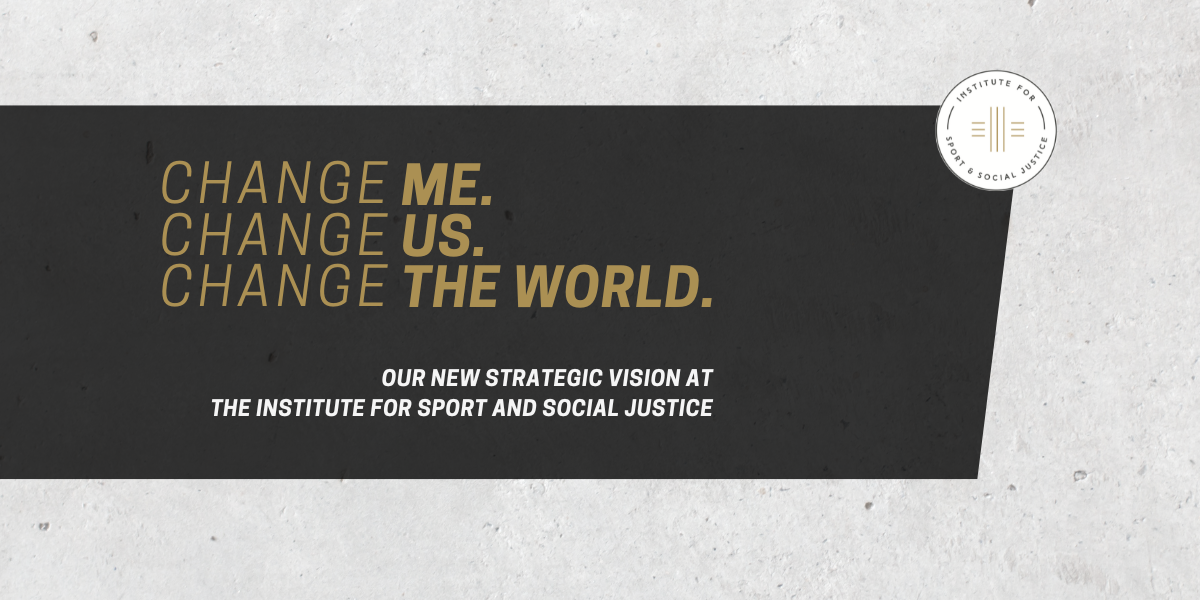
The image contains the text Change Me. Change Us. Change the World.

A strategic plan is only as powerful as its implementation. And all too often, this is where organizations stumble. In fact, according to an organizational diagnostic survey by BridgeSpan Group, staff members at more than 120 nonprofits rated their employers’ capacity to implement their strategies 10% below their average rating for all other organizational capability areas. Respondents gave their organizations especially low marks on their abilities to break down their strategies into actionable steps, communicate their vision effectively, allocate resources appropriately, and adapt to change.

To ensure successful implementation, launch your strategic plan with the energy and intentionality of a campaign. The Institute for Sport and Social Justice offers an inspiring example of this approach. Despite having a clear mission of advancing social justice through sport, they needed to unite their diverse programs under a cohesive narrative. Through Next Stage-facilitated strategic planning sessions, they developed the powerful campaign theme “Change Me. Change Us. Change the World.” This framework elegantly connected their four pillars of impact (Training & Education, Community & Youth, Global Engagement, and Knowledge Creation) into a compelling narrative that resonated with stakeholders at every level.

This campaign-style approach transforms strategic plans from static documents into dynamic forces for organizational change. When you develop a unifying theme that speaks to your stakeholders’ aspirations, your strategy becomes more than a roadmap—it becomes a rallying cry that energizes staff, inspires donors, and activates allies in pursuit of shared goals.


The time for strategic planning is now. As the external landscape stabilizes and new opportunities emerge, organizations need robust, multiyear strategies more than ever. And if the past few years have taught us anything, it’s that strategic planning should no longer be treated as a one-off exercise that happens every few years. Instead, it must become a core capability embedded into your organization’s adaptive DNA.

Is your organization looking to develop or amend its strategic plan in 2025?

Reach out today—we’d love to partner with you!


Want the latest social good trends, insights, and inspiration delivered straight to your inbox? Subscribe to the Impact Insider today!

Filed Under: Nonprofit Leadership, Planning & Implementation, Thought Leadership

  • « Go to Previous Page
  • Page 1
  • Page 2
  • Page 3
  • Page 4
  • Page 5
  • Interim pages omitted …
  • Page 13
  • Go to Next Page »

Primary Sidebar

Footer

Subscribe to the Impact Insider

Your monthly roundup of social good news and trends

only_email

Who we are

What we do

Who we serve

resources

Newsletter

Careers

Let’s work together!

Contact Us

fb
in
ins

© 2026 Next Stage Consulting | All rights reserved | Privacy Policy