• Skip to primary navigation
  • Skip to main content
  • Skip to primary sidebar
  • Skip to footer
Next Stage – Social Impact Services

Next Stage - Social Impact Services

Social good strategy to amplify your impact

  • Who we are
  • What we do
  • Who we serve
  • Resources
    • Impact Stories
    • News & Insights
  • Contact
  • Newsletter
  • fb
  • in
  • ins

Thought Leadership

5 Social Good Trends to Look for in 2025

December 10, 2024 by joshjacobson

It’s December which means the return of a Next Stage tradition—our annual look-ahead to the social good trends for the coming year!

Looking back at our predictions in 2022 and 2023, we feel good about how our previous forecasts unfolded—from recognizing the growing importance of community voice to the rise of digital communities of practice and the increasing role of corporate social responsibility in addressing workforce gaps.

To determine the top social good trends for 2025, we drew from rigorous third-party research and the frontline learnings we’ve gained from our collaborative partnerships with mission-driven organizations.

We’re profoundly grateful to all the nonprofits, corporations, and government entities who have entrusted us to partner with them this year to advance their social good efforts, allowing us to develop a nuanced understanding of the sector’s most pressing challenges and opportunities.

So, what do we think 2025 will hold? Let’s explore…


1. Federal Spending Cuts Will Disrupt Post-Pandemic Recovery
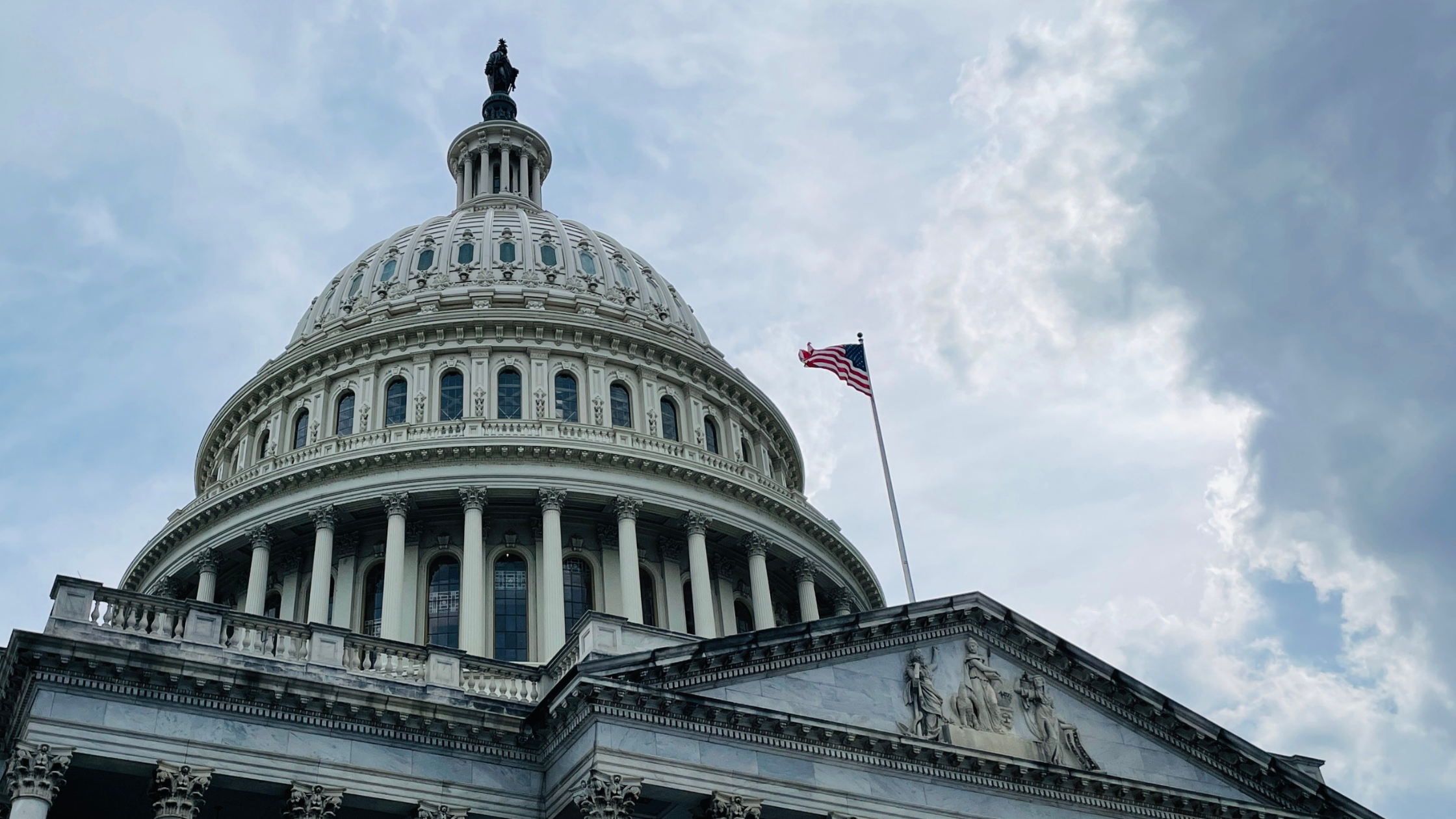
A federal building.

As federal budget cuts loom, the ripple effects will be felt at every level of the social good ecosystem. Federal funding represents a significant portion of state budgets, and reductions are likely to result in decreased revenue for local municipalities. These budgetary shortfalls will have an outsized impact on health and human service nonprofits, which are often the last line of defense for underserved communities.

The stakes are high. Many trusted community-based organizations lack the robust fundraising infrastructure needed to compete for increasingly scarce resources. This financial squeeze comes as pandemic recovery efforts remain incomplete, with critical social indicators—education, housing stability, and mental health—still struggling to return to pre-pandemic levels.

For these organizations—and the social good ecosystem as a whole—the challenge of meeting rising needs with fewer resources could be one of the defining struggles of 2025. What’s more, the ripple effects could also lead to long-term consequences for community resilience and the ability to address systemic inequities.

References:

  • Business perspectives: President Trump and the nonprofit sector. The Berkshire Edge (2024).
  • Commentary: The Stakes In Washington For Nonprofits In 2025. The NonProfit Times. (2024).
  • Opinion | Nonprofit groups are in the Trump administration’s crosshairs. MSNBC (2024).

2. Collaboration as an Imperative

A group of people around a table. They are all smiling and two are shaking hands.

Nonprofits and social service providers will face mounting pressure to work together more effectively in an era of diminished funding. Competition for resources often leads to fragmented efforts, with organizations prioritizing their own sustainability over the broader good. But siloed approaches risk creating gaps in services and duplicating efforts, which can ultimately harm the very populations they aim to serve.

But out of such challenges may come some silver linings.

At Next Stage, we’ve coined the term “the social drivers of everything” to emphasize the interconnected nature of the social safety net and its critical role in fostering economic mobility. Just as health outcomes depend on addressing social determinants like housing, education, and food security, the entire social sector benefits when organizations work collaboratively to align goals, pool resources, and innovate together.

In 2025, cross-organizational collaboration won’t just be an ideal—it will be a necessity. Expect to see service providers forming coalitions, pursuing shared funding opportunities, and leveraging partnerships to weather financial uncertainty while ensuring better outcomes for the communities they serve. Organizations that embrace transparency, open communication, and joint problem-solving will emerge stronger, demonstrating the power of sustained collaboration in addressing complex social challenges.

References:

  • Unlocking the Power of Sustained Collaboration. Sustained Collaboration Network (2024).
  • Bridging the Health Divide: The Social Drivers of Everything. Next Stage (2024).

3. An Innovation Turning Point for Philanthropy

A light bulb to symbolize innovation.

The pressure on philanthropy to fill shortfalls in social good budgets is set to intensify. But let’s be clear—philanthropy can’t single-handedly solve the problem. Government sources account for one of the largest portions of nonprofit revenue (31.8%) while foundations, corporations, and individual donors collectively contribute less than 15%. Asking philanthropy to bridge such a significant gap is like expecting a garden hose to extinguish a wildfire.

In this challenging environment, philanthropists face a pivotal choice: continue to provide stopgap funding for immediate needs or focus on driving innovation to address systemic challenges. A prolonged period of diminished resources will require a shift in how philanthropy operates. Simply maintaining the status quo won’t suffice—philanthropic efforts will need to take bold risks, prioritize systems change, and support initiatives that reimagine how social good is delivered.

Expect 2025 to usher in an era of philanthropic innovation, where funders experiment with new models such as collective impact grants, venture philanthropy, and capacity-building investments. These approaches, while not a cure-all, could catalyze the systemic transformation required to sustain the sector in the face of financial uncertainty.

References:

  • Report Predicts Uptick in Giving in 2024 and 2025. NonProfit Pro (2024).
  • Nonprofit Impact Matters: How America’s Charitable Nonprofits Strengthen Communities and Improve Lives. National Council of Nonprofits (2019).
  • Giving USA: U.S. charitable giving totaled $557.16 billion in 2023. Indiana University Indianapolis (2024).

4. Increased Focus on Social Cohesion

A nonprofit volunteer handing some food supplies to a woman in need.

In the aftermath of an election year marked by unprecedented division, the already-fragile relationship between service providers and the communities they serve is under even greater strain. This dynamic is particularly pronounced among those experiencing poverty—people who are inundated with politicized rhetoric while witnessing the dismantling of equity-focused systemic frameworks.

Rebuilding social cohesion will be a critical focus in 2025. Organizations must prioritize meaningful engagement, moving beyond transactional engagement approaches to build authentic connections grounded in trust, empathy, and mutual respect. This will require creative solutions, such as leveraging “prosocial media” initiatives (think YouTube’s Community Notes or Bluesky’s anti-toxicity tools), which are designed to foster inclusivity and constructive dialogue. These emerging features offer a hopeful counterbalance to traditional social media which often amplifies division and misinformation.

By embracing innovative communication tools and doubling down on community-centered strategies, social good organizations can begin to repair frayed societal bonds and foster a renewed sense of shared purpose. Trust will become a cornerstone of sustainable impact, influencing everything from program design to donor relations.

References:

  • Embrace the Shift to ‘Prosocial Media’. Wired (2024).
  • Community Voice: Passing Fad or Lasting Disruption? Next Stage (2024).

5. AI Makes Its Mark on Social Good

A graphic that shows the flow of new technologies working together.

How can any self-respecting prognosticator not include AI in a list of future trends? The tools we commonly refer to as “AI” are better described as advanced learning systems. These systems excel at processing vast amounts of data, identifying patterns, and automating tasks—essential capabilities for a social good sector that typically struggles with limited resources for data management, evaluation, and marketing.

AI has the potential to accelerate social impact while significantly reducing costs, a critical need in an era of diminishing resources. From predictive analytics to personalized outreach, these tools can help organizations optimize operations, improve outcomes, and do more with less. However, effective adoption of AI in the social good space is hindered by a lack of access to technology experts and infrastructure.

In 2025, we expect to see greater philanthropic investment in process improvement initiatives aimed at equipping service providers with AI-driven tools and insights. These efforts will likely extend beyond individual organizations, seeking to enhance the efficiency and effectiveness of entire ecosystems working toward common goals.

References:

  • Impactful AI: How tech leaders and social innovators are advancing AI for social good. World Economic Forum (2024).

—

Want the latest social good trends, insights, and inspiration delivered straight to your inbox? Subscribe to the Impact Insider today!
Filed Under: Corporate Impact, Nonprofit Leadership, Thought Leadership

Generosity as a Bridge: How Nonprofits Can Use Year-End Campaigns to Unify Supporters

November 20, 2024 by joshjacobson

As the post-election dust settles, we wake in a world still deeply divided. Division and polarization continue to permeate our society, creating significant barriers to positive social and economic change.

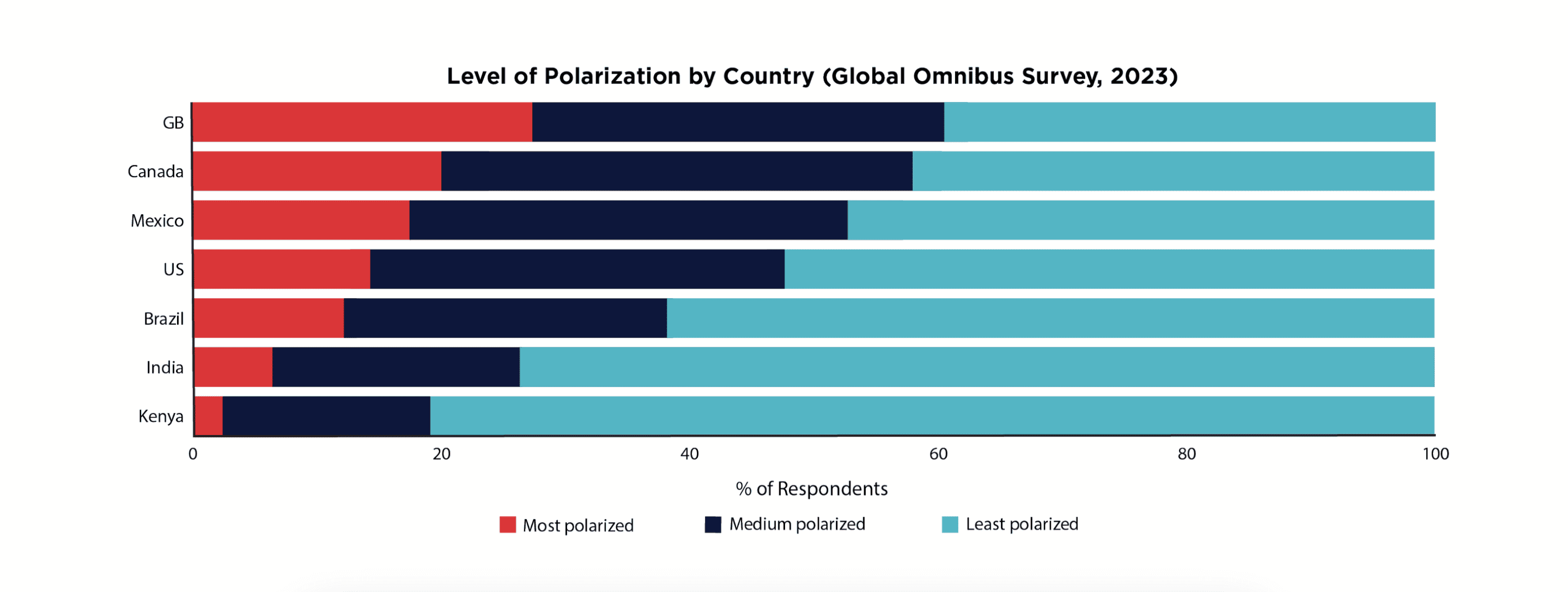
It may feel as though this level of division is a uniquely American experience, but rising political and social divisions are a global challenge, threatening the foundations of community, trust, and cooperation worldwide. As noted in Giving Tuesday’s 2023 “Giving Bridge” trend report, many countries are grappling with fractured public landscapes, where conflicting viewpoints and values threaten to widen gulfs between people.

Source: The Giving Bridge: A Lookback at 2023 Trends in Global Generosity

But for U.S. nonprofits, these divisions present a unique challenge—and a unique opportunity. As Giving Tuesday and the year-end giving season approach, organizational leaders may wonder how to best appeal for support amid this highly polarized environment. How can they build strong, lasting connections with their communities when people’s trust in institutions, government—and each other—feels so frayed?

Recognizing Generosity as a Bridge

The nonprofit sector has an opportunity—and a responsibility—to play a role in bringing people together. Why?

Because nonprofits are uniquely positioned to bridge divides.

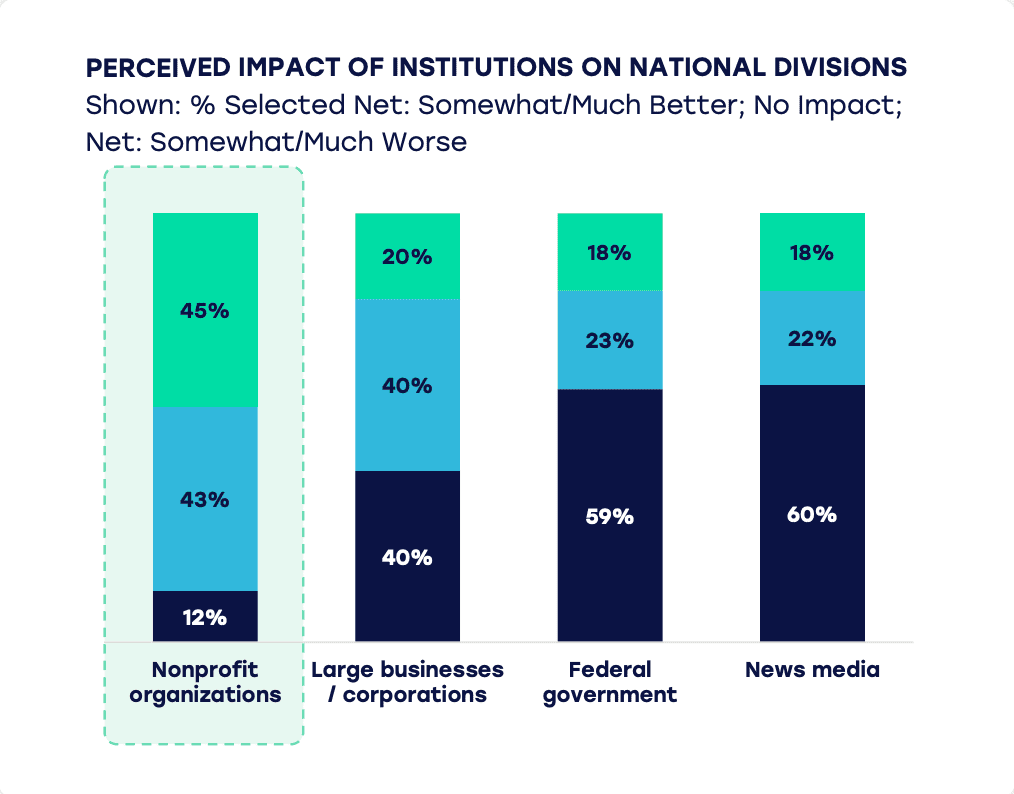
According to the Independent Sector’s 2024 report, Americans trust nonprofits more than corporations, the government, and the media when it comes to reducing national divisions. This trust empowers nonprofits to lean into their role as unifiers, offering people a path to connection rather than conflict. 

Source: Independent Sector, Trust in Nonprofits and Philanthropy

What’s more, Giving Tuesday’s report suggests that people are more willing to help others whose values or lifestyles may differ from their own when that connection is rooted in respect, care, and generosity.

These findings suggest that macro ideological differences tend to fall away when people are presented with opportunities to help others, especially through acts of giving and volunteerism.

And this powerful “giving bridge” concept—that generosity can act as a connector between people—is one that nonprofits are well-suited to embrace.

Creating a Giving Bridge in Your Year-End Campaign

Ahead of the upcoming season of giving, nonprofits can help mend divides by drafting messaging that advocates for common ground, community, and human connection.

Here are three strategies for creating more resonant, human-centered communications that invite donors to become part of something greater:

  • Shift the Narrative. Your nonprofit is not the “hero” of the story—your supporters are. Use your messaging to show donors they have the power to drive change through your work. Instead of focusing on your organization’s efforts, highlight how donors make a tangible difference, inviting them to be part of something bigger. At Next Stage, we design movement-building brand strategies, informed by the StoryBrand framework, that help nonprofits empower their supporters as the true heroes of their missions. Here’s how it works in practice:

Before: “We provided shelter to 500 families.“

After: “You helped 500 families find safety.“

By positioning donors as heroes, you transform fundraising into a shared journey, deepening their commitment and making them integral players in your mission—not just passive supporters. These human-centered appeals inspire lasting impact and reinforce the power of generosity.

  • Tell Empowering Stories. Move beyond storytelling that positions people’s hardships as the emotional drivers of your appeal. Instead, highlight the positive outcomes generosity creates—with an emphasis on empowerment rather than collective sympathy. Showcase stories that capture the strengths and achievements of the people your nonprofit supports, letting donors see the full picture of what their generosity enables through your programming. By focusing on outcomes and dignity, nonprofits can inspire support grounded in respect and shared humanity.
  • Build Belonging Between Your Supporters. Create opportunities for donors to feel a sense of belonging with your organization. In essence, aim to create a support community that embodies the giving bridge concept itself. Nonprofits often build one-to-one relationships with donors, but they rarely encourage donors to connect with each other. But by acting as a catalyst for cross-donor connections, nonprofits can nurture a vibrant and engaged philanthropic community united in shared purpose. Creating spaces for supporters to engage with one another—through local events, online platforms, or peer groups—can help them feel like they’re part of an impactful, values-driven network.

Healing Division Through Generosity

I know many of you may be feeling conflicted about the world and your nonprofit’s place in it. And it’s important to take the time to reflect and heal before recommitting to advancing social good and support for our communities.

But at a time when 94% of Americans are worried about growing divisions and a lack of national unity, we want nonprofit leaders to take heart knowing that their work is largely seen as part of the solution.

Source: Independent Sector, Trust in Nonprofits and Philanthropy

Our communities need the hope and human connection nonprofits can provide—not just through the programs they deliver but through their ability to build cultures of caring and generosity that transcend differences.

So nonprofit leaders, when you’re ready, I hope you’ll feel empowered to forge a path of new possibilities and opportunities.

Because your work matters—perhaps now more than ever.

Let this upcoming season of giving be a call to action. Step forward not only as providers of impactful programs but as catalysts for empathy, understanding, and unity.

Because we each hold the power to bridge divides—one act of generosity at a time.

—

Want the latest social good trends, insights, and inspiration delivered straight to your inbox? Subscribe to our monthly Impact Insider newsletter today!

Filed Under: Nonprofit Leadership, Thought Leadership

Value-Based Care: Transforming Healthcare Through Strong Patient-Provider Relationships

September 24, 2024 by nextstage

Imagine for a moment a healthcare system where quality trumps quantity—where your relationship with your entire care team is the cornerstone of your well-being.

This isn’t a far-off dream. It’s the promise of value-based care, a revolutionary approach with the potential to reshape the landscape of American healthcare. As we stand at the crossroads of tradition and innovation, let’s explore how this shift is not just changing payment models, but fundamentally altering the way we think about health and healing.

Exploring the Shift to Value-Based Care

When I started my professional career in the early 2000s as a research analyst on the Patient Relations team in a large 800-bed academic medical center, I had an extraordinary, eye-opening experience. The classroom setting in my undergraduate health administration program had prepared me for the basics, but it barely scratched the surface when it came to the complexities of one of the most critical systems in the United States—the healthcare system.

The campus operated like a small town, with the number of employees nearly equal to the full-time residents of the surrounding college town. Clinicians, staff, researchers, and volunteers would drive in from rural communities to support and seek care at this sprawling, dynamic center that provided vital health services to thousands of people in need. Staff humorously dubbed the busy main corridor connecting the children’s, women’s, and main hospital “I-40,” after the nearby interstate.

In my early days, I connected classroom knowledge to real-world applications. I heard terms like allowable charge and relative value units from the finance team while clinicians talked about quality of care, patient safety, and clinical protocols. While my education felt relevant, I found myself confused by the swirl of terminology bandied about. One term that I soon learned was a key driver of how healthcare functioned at the time was fee-for-service.

In this traditional model, insurance companies pay healthcare providers for each individual service they provide. For instance, an office consultation is reimbursed separately from each test, procedure, or follow-up care associated with the visit. The relationship between payers, providers, and patients is set up to be transactional. In this system, the focus is on the volume of services delivered, rather than the value those services bring to a patient’s health

However, the landscape of healthcare is evolving. In recent years, value-based care has gained momentum as a payment model. This model shifts the focus from quantity to quality, emphasizing better patient outcomes and lower overall costs. Value-based care reimburses healthcare systems for the results achieved, not for the number of services provided. It’s a fundamental shift that requires more than just procedural changes—it demands a change in how we build and sustain relationships with patients, families, and other key stakeholders.

In a fee-for-service model, interactions with patients could be limited and transactional, as providers were tasked with focusing on delivering services within short windows of time. But value-based care relies on fostering deeper, more continuous connections with patients. It’s no longer enough to see a patient, treat a condition, and move on. Healthcare providers must engage with patients over time, focus on preventative care, and ensure health outcomes are sustainable. This requires a strong patient-provider relationship built on trust, communication, and shared decision-making.

The future of healthcare will depend on the strength of these relationships. Patients need to feel a sense of ownership and agency to actively participate in their care. And providers must understand the full context of a patient’s health—both inside and outside the clinic setting. Strong patient-provider relationships lead to better adherence to care plans, improved health outcomes, and a more collaborative approach to healthcare delivery. In a value-based care model, these relationships are essential, dare I even say non-negotiable, for success.

Healthcare is a complex ecosystem of individuals, organizations, and regulatory bodies working together to provide essential care. A deeper understanding of this system by all stakeholders—both inside, next to, and outside of healthcare—can lead to more informed questions, more effective collaborations, and better-designed solutions. As we continue this shift toward value-based care, fostering stronger relationships between patients and providers will be critical to improving outcomes and ensuring the long-term health of our communities.

So how can healthcare leaders and community organizations work together to best develop these strong relationships? At Next Stage, we believe the answer lies in radical, authentic cross-sector collaboration.

Launching Impact for Health

Next Stage believes trusted community assets serve as essential mediating structures and are uniquely positioned to support the collective drive for all people to have the resources they need to thrive.

We feel so strongly in this concept that we recently launched a new service line, Impact for Health, to support innovative health initiatives and community health collaborations. Our approach begins with community voice, shifting organizations and cross-sector collaborations from a top-down approach to an inside-out process. This methodology centers the perspectives of the people receiving care, which fosters increased trust and a sense of belonging.

But Impact for Health is more than just a concept: it’s a movement. Next Stage is partnering with innovation-minded organizations to address the deep-seated disparities in health across socioeconomic demographics. Rather than perpetuate broken systems, our partnerships aim to disrupt the status quo that allows health to be seen as a privilege instead of a human right.

As part of our Impact for Health service line launch, we’re hosting a series of five free webinars designed to broaden understanding of the healthcare system and its evolving dynamics.

Demystifying the Complex U.S. Health System

Do you work in community or population health, social work, care management, health education, or a clinical health setting? If so, we invite you to register today for the first webinar in our free series: Demystifying the Complex U.S. Health System. We’ll dive deeper into the transition to value-based care and highlight real-world examples of innovative partnerships and programs transforming health outcomes.

You’ll also be able to engage with peers and industry experts committed to advancing health equity and care quality. Join us to share your experiences and build networks to help your organization design innovative, community-driven health solutions.

Register for free today! We look forward to seeing you there.

—

Nimisha Patel joined Next Stage in 2024. Previously, she led The New Guard, a consultancy working with clients in health care, hospitality, real estate, nonprofits, and technology. She also served as National Director of Innovation & Design for Health Leads, a national leader in addressing the systemic causes of racial health inequalities, and as Associate Vice President at Duke Health, where she led innovation design and implementation.

Filed Under: Impact for Health, Thought Leadership

Social Good’s Collaboration Challenge: Why Is It So Damn Difficult?

September 18, 2024 by joshjacobson

In the world of social impact, a persistent question echoes: Why are nonprofits, municipalities, health systems, and private-sector companies so reluctant to collaborate?

While many point to competition for resources and inherent power disparities, research suggests that the root cause may be cultural—particularly here in the United States.

Exploring the Cultural Barrier: American Individualism

Sociologist Geert Hofstede’s 6-D model of national culture suggests Americans are uniquely defined by their fierce individualism. In Hofstede’s rating system, the United States ranks as the most individualistic society in the world, strongly favoring independence over interdependence.

Our penchant as Americans to resist working harmoniously together is literally everywhere you look — social media, political advertisements, homeowner’s associations, heck, even the aisles of your local grocery store (looking at you pushy shoppers at my Plaza-Midwood Harris Teeter).

And that’s perhaps in part because competition is deeply woven into the American experience, creating a significant barrier to building unified efforts. But, like it or not, collaboration is necessary, both in everyday life and as part of peer engagement  inside the for-profit and nonprofit sectors.

So how do today’s top organizations address the collaboration challenge?

Identifying Obstacles to Nonprofit Collaboration

In corporate America, the struggle to foster collaborative teams is well-recognized. The team-building service market tops $3 billion annually and is expected to grow to $9 billion by 2031.

Nonprofits and community-based organizations are expected to work together to solve society’s biggest challenges, but here’s something to consider: If corporate teams from a single organization, with similar educational backgrounds and related professional experiences, struggle to collaborate naturally, what hope do social good leaders have of effective cross-organizational collaboration? Without access to the team-building tools and resources afforded to the private sector, how can nonprofit leaders align their organizations’ diverse staff, needs, and interests?

That said, a general lack of resources is nothing new for those in social good.

At Next Stage, we often quote Dan Pallota, American entrepreneur and author, who in his famous TED Talk argued that our society places unrealistic expectations on nonprofits. He explores how our culture’s wrongheaded thoughts on compensation in social good force nonprofits into survival mode, stifling their potential for real impact:

“In the for-profit sector, the more value you produce, the more money you can make. But we don’t like nonprofits to use money to incentivize people to produce more in social service. We have a visceral reaction to the idea that anyone would make very much money helping other people. Interesting that we don’t have a visceral reaction to the notion that people would make a lot of money not helping other people. You know, you want to make 50 million dollars selling violent video games to kids, go for it. We’ll put you on the cover of Wired magazine. But you want to make half a million dollars trying to cure kids of malaria, and you’re considered a parasite yourself.”

And in a time where 22% of nonprofit employees are living paycheck to paycheck, it’s easy to understand why nonprofit leaders are feeling the pressure to prove their organization’s efficiency and worth to grantmakers and funders. This ever-present state of “survival mode” inevitably leaves little room for experimenting with cross-organizational collaboration — despite its potential benefits for addressing complex social issues.

But the collaboration barriers social good institutions face aren’t just cultural or financial. Nonprofits often are dealing with widely diverse perspectives, complicated power dynamics, twisted incentives for output metrics imposed by donors, and competition for limited funding opportunities.

Against these odds, it’s any wonder collaborative efforts in social good ever get off the ground in the first place.

So where do we go from here?

Shifting the Narrative

Nonprofit leaders are often motivated by a deep sense of mission and feel personally responsible for their organization’s success. While this perspective is noble and much needed in this sector, it’s important to recognize this outlook can create a “silo mentality,” making leaders hesitant to open up their operations or share resources with other nonprofits. Collaboration, in this context, can feel like a risk — a relinquishment of autonomy that might dilute their own organization’s impact or slow its progress.

But that sense of ownership and mission that drives nonprofit leaders could be leveraged to encourage cross-organizational collaboration. By shifting the narrative away from competition and toward shared outcomes, we can highlight that nonprofits are all part of a larger ecosystem working for the common good.

This requires not just a shift in mindset but also practical support for the underpinnings of collaboration — relationship-building that leads to feelings of connection and trust.

It’s the main idea behind Cultivate Impact®, our digital collaboration management tool that centers the building of social cohesion between platform participants as a central goal. We believe that, deep down, people working to create positive outcomes for others have more in common than they think they do. By highlighting those areas of intersection and sparking engagement around them, we work to forge more effective networks of people working together toward common goals.

Achieving Cross-Organizational Collaboration

If corporate America is spending billions of dollars on team building to sell consumer products, shouldn’t institutions advancing social good be encouraged to invest in similar supports?

By addressing the cultural and practical barriers to collaboration, we can unlock the full potential of nonprofit organizations and create significant, lasting impact in our communities.

Interested in learning more about Cultivate Impact® and how it creates more effective collaboration? Reach out to schedule time to chat.

—

Next Stage CEO Josh Jacobson launched Next Stage as a social enterprise in 2014, bridging his professional experiences as a nonprofit practitioner with his consulting expertise. He has led Next Stage’s work with 200+ clients, including nonprofits, private-sector companies, municipalities, faith institutions, philanthropies, and community-based organizations. Josh’s skills in strategic positioning and tactical design help clients achieve their goals. He guides Next Stage’s work in strategic planning and collaboration management and is a major contributor to the company’s thought leadership efforts.

Filed Under: Nonprofit Leadership, Thought Leadership

Reclaiming Advocacy: A Nonprofit’s Guide to Impactful Community Action

September 16, 2024 by nextstage

In today’s polarized climate, “advocacy” sometimes gets a bad rap. As a result, some nonprofits and community-based organizations shy away from engaging in such efforts. 

But advocacy is so much more than just outspoken public support for a particular cause or policy.

For nonprofits and community-based organizations, advocacy represents a powerful opportunity to:

  • Present a case for support of the organization’s mission through storytelling, comparative analysis, and trend research
  • Build and cultivate relationships with community partners
  • Publicize what your organization hopes to achieve by outlining funding support, resources, and defined next steps

To be a nonprofit leader is to be an advocate. But leading a movement requires organizations to drive systemic change—which is no small task. At Next Stage, we feel nonprofits and mission-driven organizations are uniquely positioned to fuel effective and sustainable efforts to achieve that needed change. They just need to know where to start.

Pushing Past Discomfort

Many nonprofits have established, comfortable methods for promoting their mission, vision, programs, and services. These traditional approaches often include educating the public about their work, raising awareness of their cause, or engaging donors and volunteers to help build organizational capacity or assist with branding efforts.

While these methods are a form of advocacy and help people understand the organization’s scope, there’s a more intensive approach that requires “thinking outside the box” and embracing discomfort. This deeper level of advocacy may involve:

  • Meeting with local government officials (e.g., city council members or county commissioners)
  • Writing public letters to make initiatives part of public record
  • Organizing protests to draw attention to the cause

These assertive tactics can be uncomfortable but may be necessary to effectively and thoroughly address the nonprofit’s cause and help drive meaningful change.

Building Your Advocacy Blueprint

In a recent Next Stage client engagement, we asked the following questions regarding advocacy efforts to help spark this kind of “out of the box” thinking:

  • What ways can your organization share information beyond standard communication methods like social media and email?
  • What decision-makers could support your initiative (e.g., elected officials, community partners, etc.)?

Wondering where your organization should begin? Here are some key action steps to consider:

  • Amplify community voices. Speak up for individuals who are overlooked. Share stories about your personal journey and invite others to share theirs. This kind of storytelling is not only validating but also enlightening.
  • Adopt an asset-based lens. Educate yourself on how to best communicate the challenges of the people your nonprofit faces by recognizing what resources are already in place. What “neighborhood PhDs” exist that you can connect with? Where are key community locations you can leverage to connect with and poll constituents to gain their input? What do you already know about the most pressing issues facing your community? How can you use that knowledge to design open-ended questions that invite room for additional concerns to be surfaced and addressed?
  • Establish an action plan and determine goals. What do you want to achieve and how do those goals align with your organization’s values? This allows for accountability in staying the course on specific objectives. Plus, it enables you to share your visionary advocacy plan with others to gain their approval and support.
  • Find allies—and opposition. Identify people who share your mindset around challenging the status quo but be willing to also discuss your goals with people who may not necessarily agree with your line of thinking to gain a holistic perspective. Having conversations across the aisle proves that you don’t necessarily have to fully agree to achieve change in a positive direction.

Embracing Your Advocacy Mission

One of the primary goals of advocacy is to bridge the gap and provide an equitable framework between constituents and decision-makers while advancing policy change and collective impact on the local, regional, and federal level. The stakes are high—especially for the children, families, and individuals your organization serves. It’s also important to recognize that advocacy can be a slow and lonely process. It requires patience to achieve sustainable and life-changing outcomes, but it’s worth it.

So don’t shift the responsibility thinking it’s another organization’s job to do the critical work of advocacy. Nope, it’s your job. But you don’t have to do it alone!

Review your approach. Push through the discomfort. And lead the charge in your unique way.

—

Looking for support on how your organization can get involved in advocacy efforts?

Join us for our next FREE webinar in our Community Voice series: Advocacy & Community Voice: Building a Movement of People.

We’ll examine:

  • How to integrate advocacy efforts into your nonprofit
  • Why using community insights can drive change
  • Strategies for building a movement of people

This free webinar will run September 19 at 11:00 am ET. Register here!

—

Next Stage Senior Director of Community Voice Helen Hope Kimbrough centers the perspective and lived experience of others to inform meaningful strategic planning and implementation efforts. Helen also champions diversity, equity, and inclusion for societal and organizational change. She serves on the board of the Charlotte Mecklenburg Library Foundation and Parent Child+ and is the author of four multicultural children’s books. She’s the founder of an independent publishing company and cohost of the Behind The Throne podcast. A graduate of Hampton University, Helen holds a Bachelor of Science in Marketing. She also has certifications in “Systems Thinking” and “Diversity, Equity, and Inclusion in the Workplace” from Cornell University and the University of South Florida, respectively.

Filed Under: Community Voice, Nonprofit Leadership, Thought Leadership

Fundraising or Business Development: What Are We Really Doing Here?

September 9, 2024 by joshjacobson

A few weeks ago, I presented at the 2024 AFP NC Philanthropy Conference with a talk titled Why Was It Declined? Navigating the New Realities of Corporate Social Responsibility. It not only marked my return to engagement with AFP-related events but also revisited Next Stage’s Profit & Purpose series of community research.

My presentation outlined what Next Stage has learned over the years about what drives private-sector companies to allocate resources to nonprofits. I’ve presented this talk in some form or another for the better part of a decade, peeling the onion with each passing year to get at the heart of the matter.

The session appeared on the learning track Rebels, Renegades & Pioneers — apropos for thought leadership from our social innovation company. And, as usual, this talk raised some eyebrows.

The talk’s primary message is that many companies — not just publicly traded corporations — have increased their internal expectations for creating positive community impact as a result of pressure via socially responsible investing. It’s a trendline that’s only increasing (despite the headlines), and this trend is positioned to be one of the most important paradigm shifts in the philanthropy landscape over the next decade. These expectations will influence how organizations can address inequity, economic and social mobility, and a host of other societal ills for years to come.

This shift suggests a new marketplace for investment where nonprofits can build lasting relationships with companies centered on service delivery instead of byproducts, like cause marketing or employee engagement.

The primary barrier? The common nonprofit perception that “corporate philanthropy” is merely a reward for a job well done. 

Is Philanthropy Selfless or Selfish?

Self-interest has always been at the heart of philanthropy, whether we like to acknowledge it or not. And yet it’s verifiably the truth.

An essential book on the topic — Donor-Centered Fundraising by Penelope Burk, the founder of Cygnus Applied Research — uses data-supported research to back up the assertion that donors give selfishly. They give because it feels good to give, and organizations that help donors feel good about their contributions retain them and grow their giving.

“Warm glow altruism,” as Burk describes it, is a function of the donor positioning themselves as the protagonist on a journey. It’s the good they want to do that drives their story forward.

And while nonprofits tend to readily celebrate a donor’s generosity, they often make the misstep of centering those celebrations around their own story, their own programming, and their own efforts. But when organizations talk primarily about themselves, they risk alienating such donors. A donor may wonder, “How do I fit into this narrative?” And importantly, if they don’t see their starring role in the ultimate impact of their contribution, they’ll be less inclined to donate again in the future. 

Adopting a Business Development Mindset

With this focus on self-interest as a backdrop, nonprofit development professionals would be well-served to shift to seeing themselves as vendors to companies — ones that deliver a service that meets a need. The term “fundraising” emphasizes the dollar raised rather than the value produced in an exchange. Nonprofit fundraisers who view their role as building win-win partnerships that add value for both parties (donor and recipient) are far more likely to be successful.

In this way, the development department in most nonprofits could be rebranded as a form of business development. The nonprofit’s services serve as a platform for value exchange. The key is to understand better what the customer’s (in this case, the donor’s) needs are and then build an alignment.

This is not only true for the relationship between nonprofits and the private sector. It’s a concept that can be applied to financial support from foundations, individual major gifts, and the annual fund. What’s more, it’s likely how most nonprofits already view funding from the government (where grant compliance makes clear the role data plays in demonstrating value exchange).

As a former development professional who now leads business development for my own private-sector company, I can speak from experience — it’s the needs of the customer (again, the donor) that matter. Here’s how you can better position yourself for these discussions:

  • Do your research. Donor research tends to focus on identifying capacity and affinity for a mission based on support for similar causes. Understanding what might be driving specific interest in your nonprofit requires reframing the cultivation process, exploring how values, relationships, and external factors influence decision-making.
  • Talk less (Smile Listen more). Showing interest in your prospect should be about more than just small talk before launching into a pitch. Demonstrate a desire to learn. Ask for a tour of the company’s headquarters. Inquire about the philanthropy foundation’s namesake. Show a desire to build a partnership rather than engage in a purely transactional relationship.
  • Focus on the value. Nonprofits tend to over-deliver on content when presenting to institutions, burying the lede in ways that can frustrate prospective donors. A one-page summary that draws attention to the value exchange can help clarify expectations for all parties. If you think of your solicitation less as a request for support and more as a memo of understanding, you’re starting to get the picture.

Embracing a New Nonprofit-Donor Dynamic

It’s time for nonprofits to embrace a business development mindset when engaging with those who provide them financial support — especially corporate partners. Fundraising should no longer be viewed as asking for contributions as a reward. Instead, fundraising should be positioned as a way to create value-driven partnerships with mutual benefits. By understanding the self-interest of donors and aligning your services with their goals, nonprofits can establish long-term, sustainable philanthropic relationships. 

As the landscape of philanthropy continues to evolve, nonprofits who prioritize understanding their donors’ needs and focus on value exchange will be better positioned for success in the increasingly competitive marketplace for social impact.

If you disagree, I’ll probably be presenting on the topic at a philanthropy conference in the future. Stay after and chat for a while — I’d welcome your feedback.

—

Next Stage CEO Josh Jacobson launched Next Stage as a social enterprise in 2014, bridging his professional experiences as a nonprofit practitioner with his consulting expertise. He has led Next Stage’s work with 200+ clients, including nonprofits, private-sector companies, municipalities, faith institutions, philanthropies and community-based organizations. Josh’s skills in strategic positioning and tactical design help clients achieve their goals. He guides Next Stage’s work in strategic planning and collaboration management and is a major contributor to the company’s thought leadership efforts.

Filed Under: Corporate Impact, Nonprofit Leadership, Thought Leadership

  • « Go to Previous Page
  • Page 1
  • Page 2
  • Page 3
  • Page 4
  • Page 5
  • Page 6
  • Interim pages omitted …
  • Page 13
  • Go to Next Page »

Primary Sidebar

Footer

Subscribe to the Impact Insider

Your monthly roundup of social good news and trends

only_email

Who we are

What we do

Who we serve

resources

Newsletter

Careers

Let’s work together!

Contact Us

fb
in
ins

© 2026 Next Stage Consulting | All rights reserved | Privacy Policy