• Skip to primary navigation
  • Skip to main content
  • Skip to primary sidebar
  • Skip to footer
Next Stage – Social Impact Services

Next Stage - Social Impact Services

Social good strategy to amplify your impact

  • Who we are
  • What we do
  • Who we serve
  • Resources
    • Impact Stories
    • News & Insights
  • Contact
  • Newsletter
  • fb
  • in
  • ins

Thought Leadership

Boundary-Spanning Strategies to Expand Your Pool of Individual Donors

September 7, 2025 by joshjacobson

Everywhere you look these days in the world of nonprofits, there’s a focus on threats to the sector. The optimism about the direction of social good that was so prominent one year ago has been replaced by a strong thread of pragmatism. “This isn’t going to be pretty.”

The cuts to the social safety net imposed in the One Big Beautiful Bill Act (OBBBA), passed into law this past July, will have a domino effect on all nonprofits — whether their organization or sector was directly impacted or not. Huge reductions to federal spending on social good will force states, municipalities, foundations, and corporate social responsibility leaders to make difficult decisions about how to allocate limited resources. This reshuffling will inevitably lead to a contraction of the overall nonprofit system. With less overall funding available, many organizations are going to have to get smaller.

The one saving grace is just how slowly the federal government moves. Demands by policymakers that the OBBBA modifications be enacted within six months are colliding with the realities of such sweeping change management. What was expected to take half a year will more likely take 12–18 months, giving nonprofits a critical opportunity to get proactive in defending their castle.

Why Individual Giving Should Be a Primary Focus

Across the country, philanthropic leaders are preparing organizations for the coming wave of financial strain. Much of the early emphasis has been on internal change management: layoffs, reduced programming, and consolidation. This support is badly needed — it’s been some time since nonprofits faced an economic downturn of this magnitude.

But just as important is a renewed focus on fundraising. Finding new sources of financial support will be essential, and that means taking a harder look at individual giving. Many nonprofits rely heavily on grants and sponsorships from institutional funders while underinvesting in their ability to cultivate individual donors. Institutional sources are inherently capped — there are only so many municipalities, foundations, and companies in your orbit. But individuals who care deeply about your mission are far more plentiful.

The good news is that even in these uncertain times, Americans remain open and willing to give. A recent Vanguard Charitable survey found that 70% of Americans donated to charity in the past six months, and 87% plan to give the same or more in the next six months despite economic uncertainty. Notably, more than one-third (36%) of donors who intend to maintain or increase giving say they do so because they view charitable giving as a civic duty.

Giving USA’s 2025 report reinforces this, showing that individuals continue to account for three-quarters of all charitable giving — far outpacing foundations and corporations. In other words, while institutional funding is likely to contract and realign, the largest portion of charitable support remains accessible — if nonprofits are prepared to reach for it.

The challenge, of course, is that individuals don’t have entry points like foundations or corporations do. There is no application portal for a major donor. Building relationships with individuals requires strategy, patience, and a willingness to expand beyond your existing circles.

Creating a Focus on Acquisition

At a time when individual support is more important than ever, organizations have two clear strategies: increase investment from existing donors or acquire new donors who have never given before.

Our latest two blogs focused primarily on strengthening connections with existing supporters — moving beyond crisis messaging and designing call-to-action campaigns. These efforts may pick up some new givers, but the people most likely to respond when you communicate digitally are those who already follow and subscribe. The harder, and often more neglected, path is the acquisition of individual donors.

We call this boundary-spanning acquisition — the effort to identify, engage, cultivate, and ultimately solicit individuals who are not currently in your donor database. Hospitals, universities, and cultural institutions have long been set up to do this, leveraging grateful patients, alumni, and visitors to fuel their pipelines. Health and human service organizations, on the other hand, often lack a natural pool of prospects. With events and galas losing their luster, the question becomes: how can these organizations compete for individual donor dollars?

Building a Culture of Philanthropy

The answer lies not just in tactics, but in mindset. The organizations that succeed are those that foster a “culture of philanthropy” — one that extends beyond the development office and permeates the entire organization.

Three key components stand out:


1. Focus on Your Supportive Constituency

Donors are not simply rewarding impact; they’re joining a movement of people aligned to a cause. Nonprofits that highlight donor stories alongside programmatic outcomes create a sense of belonging that draws in future supporters. Prospects are more inspired by seeing themselves reflected in the generosity of others than by a list of program statistics.

In practice, this can look like a restructuring of your newsletter, blog, and social media to feature a steady stream of volunteer- and donor-centered stories. Interviewing and engaging these people also provides excellent opportunities to learn what got them involved in the first place and why they stay involved, which is important data to inform your future strategy development.


2. Grow Ambassadorship

Too much pressure is placed solely on board members to open doors. While governance volunteers play an important role, organizations often overlook the potential of volunteers and donors who want to deepen their involvement. A structured ambassador program allows these allies to extend your reach, helping to identify new prospects while staff lead the cultivation process. The request isn’t for them to solicit gifts — it’s to help others discover your mission.

Organizations often struggle to create volunteer opportunities because their programming and operations do not lend themselves to outside involvement. When ambassadorship is treated like volunteerism, the effort extends beyond friends and neighbors to center constituent recruitment as a way to give back. That will require creating new methods to activate this interest, raising the visibility of your organization through outreach efforts.


3. Create Targeted, Multiyear Strategies — And Stick With Them

Acquisition takes time. Quick-hit experiments rarely deliver immediate results, and too often they are abandoned prematurely. Instead, organizations should identify a tightly defined segment of potential supporters — perhaps a profession, a faith community, or a geographic area — and commit to a multiyear strategy. Like any program expansion, this requires research, planning, volunteer leadership, and measurable goals. The most successful campaigns recruit current donors to lead efforts to connect with their peers, making acquisition an extension of authentic relationships.

For example, if Bob the Architect is one of your biggest supporters, it may be worth exploring whether others at his architecture firm may have similar interests. More adventurous would be to link architecture firms across the community in a sector-wide effort that makes your nonprofit a beneficiary. These sorts of ideas come when nonprofits proactively put themselves in a position to make them happen.


Making the Most of This Gift of Time

The slow rollout of the OBBBA is, in its own way, a gift (I swear, go with me here…). The Great Recession and the COVID-19 pandemic hit suddenly, giving nonprofits little time to prepare. This time is different. We can see the storm on the horizon. The question is how we use the time we’ve been given.

Yes, nonprofits should prepare their operations for leaner days ahead. But they should also seize this moment to strengthen their culture of philanthropy. By embracing boundary-spanning strategies and focusing on individual giving, organizations can grow even as others contract.

At Next Stage, we believe that movement-building brand marketing offers a roadmap to do just that — aligning donor acquisition with community building in ways that create resilience and momentum.

If you’d like to explore how your organization can expand its pool of individual donors, let’s start a conversation.


An ad for the Impact Insider newsletter.

 Want the latest social good trends, insights, and inspiration delivered straight to your inbox? Subscribe to the Impact Insider today!

Filed Under: Resource Development, Thought Leadership

Design a Call-To-Action Campaign That Actually Works: 4 Key Tips

August 12, 2025 by joshjacobson

Last month, we explored how nonprofits can move beyond reactionary messaging by sharpening their value proposition and communicating with greater intentionality. We argued that it’s time to stop speaking into the void and instead engage with purpose.

This month, we’re following that post with something practical — how to design a call-to-action campaign that cuts through the noise. Not a crisis campaign. Not a one-time emergency ask. But a thoughtful, intentional effort to grow your base of support in a way that aligns with your mission and builds trust over time.

Read on for four essential components of a successful campaign strategy:


1. Narrow Your Audience

You’ve got a mission that matters, and you want more people to care about it. So, you broadcast your message as widely as possible, hoping it sticks. But in a world saturated with content, a general message will almost always get lost.

This age-old adage still rings true: when you speak to everyone, you speak to no one.

Narrow your communication efforts to specific audiences. Who are you trying to reach? And what do you want them to do as a result?

Is this a campaign to acquire new supporters? Reengage lapsed donors? Recruit volunteers? Establish credibility with institutional funders? Each of those calls to action requires a different message.

Because even if your mission impacts “everyone,” your campaign shouldn’t try to. The narrower your target audience, the more tailored your message can be, and the more likely it is to resonate.


2. Align Messaging with the Call to Action

Many nonprofit campaigns jump straight to a request for financial support. And while that may be the ultimate goal, it’s rarely the right first ask. Once you’ve identified your audience, craft messaging that meets them where they are.

This is especially true if you’re trying to bring new people into your ecosystem. For that to work, you’ll need to do some trust-building first. The better approach is to design a message funnel that starts with low-barrier engagement — a social follow, event registration, or newsletter signup — and then gradually deepens over time.

Your messaging should support this progression. That means:

  • Leading with values and impact, not just needs and gaps.
  • Speaking in human terms, not organizational jargon.
  • Clearly articulating how someone can get involved — and why it matters.

Most importantly, the call to action should feel proportionate to the audience’s current level of engagement. Asking for $100 from someone who’s never heard of you is a long shot. But inviting them to learn more, attend something, or connect with others? That’s a lot more doable — and a better long-term bet.


3. Choose Platforms and Creative That Match the Audience and Message

We see organizations decide they need to run a “video” or a “social campaign” without considering whether that’s the right fit for their audience or call to action. Just because TikTok exists doesn’t mean your audience is on it. Just because email is free doesn’t mean it’s your best option.

Start with your audience: Where do they already spend time? What kinds of messages do they engage with? What inspires them to act? This is where narrowing your audience comes in handy. It’s difficult to make these decisions if you’re defining your target audiences too broadly.

Next, design creative that feels like it belongs in that space. That might mean:

  • A short video that humanizes your mission with powerful storytelling
  • A carousel post that breaks down a complex idea in a visual way
  • A series of emails that take someone on a journey of learning and engagement
  • A physical postcard or invitation that feels personal and compelling

Remember: consistency is more important than perfection. A campaign doesn’t need to go viral — it needs to be clear, consistent, and repeated enough to make an impression.


4. Follow Up and Deepen the Relationship

The best call-to-action campaigns are not designed as one-offs — they are doorways.

When someone takes that first step, whether it’s signing up, attending, donating, or sharing, what happens next? Do they get a thank-you? An impact story? A real opportunity to stay connected? Or do they fall into the void, never to hear from you again?

This is why movement-building is so crucial. Every interaction, no matter how small, presents an opportunity for your organization to strengthen your relationship with your target audience while also creating opportunities for people to connect.

Because people are seeking belonging, and social good organizations are well-positioned to foster it. But that will only happen if you set out to make it a measurable outcome. When you follow up with intention and create space for shared experience and purpose, you begin to build something far more powerful than a donor file. You build a community.


The Bottom Line

Every nonprofit campaign should be designed with purpose — anchored in strategy, tailored to your audience, and built for relationship.

If your organization is ready to design a call-to-action campaign that cuts through the noise and fosters long-term support, we’d love to help. Drop us a line.

Because the future belongs to those who design it — one call to action at a time.


An ad for the Impact Insider newsletter.

 Want the latest social good trends, insights, and inspiration delivered straight to your inbox? Subscribe to the Impact Insider today!

Filed Under: Communications, Thought Leadership

Beyond Crisis Messaging: How Nonprofits Can Cut Through the Noise

July 7, 2025 by joshjacobson

When everyone is asking for help, lasting impact comes from inviting participation rather than requesting rescue.


A wave of financial instability is building across the nonprofit sector. Policy changes are threatening major funding streams, and health and human services organizations are bracing for the ripple effects of government contraction that could have long-term implications on their operations, staffing, and programmatic impact.

In response, many organizations are preparing to shift their focus to private philanthropy. The hope is to “close the gap” before budgets go underwater, but there’s a real risk this strategy could backfire.

As many local nonprofits activate crisis messaging at once, the volume of appeal communications will reach levels that are hard to process. Because although each organization will tell its story with clarity and conviction, with urgent messaging that highlights clear consequences should support fall short, the reality is, there are only so many donors.

And perhaps more concerning in the current climate, there’s only so much attention and emotional energy available.

A recent system leader put it bluntly: Fundraising in this environment is like trying to fill an empty swimming pool with a Dixie cup. Point blank, there’s simply insufficient capacity in the private sector to make up for public sector shortfalls. 

While the instinct to sound the alarm is understandable, organizations that lean too heavily into crisis messaging may inadvertently push away the very people they’re trying to reach. 

So what if there was a different way?

Read on to learn how nonprofits can “cut through the noise” by centering community strength and inviting genuine partnership — even in the most challenging times.


When Crisis Messaging Becomes the Default

In times of uncertainty, organizations often fall back on communicating urgent need. Appeals become centered on organizational survival, painting a picture of programs at risk and community members who could go unserved.

However, need-based, organization-centric appeals are often not fully effective. While they may generate a short-term giving boost, messaging that frames a nonprofit as a central character needing the public to come to its aid changes the dynamics of relationship-building. Constituents must become saviors. Donors simply become a means to an end.

Over time, this approach can fatigue even the most loyal supporters. 

And we’re already seeing signs of community disengagement. Across the board, people are pulling back from civic involvement. Because when people feel overwhelmed by societal pressures, they seek distance and distraction. That’s why a steady stream of crisis communications, no matter how well-intended, can increase that desire to retreat.

The good news is that nonprofits have something commercial brands spend millions trying to create: authentic purpose that naturally brings people together. So by making small shifts in how you talk about your work — focusing on possibility rather than peril — organizations like yours can build deeper, more sustainable relationships with your supporters. 


Centering People, Not Programs

Next Stage’s approach to brand marketing is rooted in the belief that nonprofits are uniquely positioned to foster connection, belonging, and shared purpose. The challenge is to ensure marketing efforts reflect that dynamic.

We’ve adapted Donald Miller’s StoryBrand framework for social good institutions in a service line we call Movement-Building Brand Marketing. This approach uses the “hero’s journey” narrative structure to position the person hearing the message as the protagonist in their own story.

Movement-building brand marketing assumes that the people you serve, and those who support your work, are already on their own unique paths to creating change. Your organization becomes the “hero’s guide” who helps them stay on course — introducing them to others on the journey, creating opportunities for collective action, and reminding them they’re not alone.

When organizations market through this lens, stories highlight resilience rather than scarcity. Campaigns focus on what’s possible rather than what may be lost. And people receiving the message are treated as active participants rather than sideline observers.


What to Do Now: A Practical Starting Point

Here are three simple shifts you can make in your nonprofit’s communication strategy to help cut through the noise and make a positive first impression with new constituents and donors:

1. Affirm community strength in your messaging. Start with what’s already working. Shine a light on the grit, creativity, and determination of the people you serve. Let your storytelling reflect forward motion, even in the face of difficulty. Crisis communication tends to highlight need rather than showcase a can-do attitude in the face of adversity. Find ways to be strengths-based rather than deficit-based in your communication.

Instead of: Food insecurity is at an all-time high, and we’re struggling to keep up with demand. Without your help, families will go hungry this winter.

Try: Local families are finding creative ways to stretch their budgets and support each other through these tough times. Your partnership helps us amplify their resourcefulness by connecting them with fresh produce and cooking classes that build long-term food security.


2. Invite participation rather than transactions. Campaigns rooted in shared values tend to be more sustainable than those focused on crisis response. Consider the long-term relationship you want to build with your audience and develop messaging that invites them to join you (and others) in advancing a cause rather than solving a funding problem. Being part of a growing movement of caring people fosters a greater sense of purpose than having a one-to-one relationship built on the need for a financial contribution. 

Instead of: We need $50,000 by December 31 or we’ll have to cut our after-school program. Can you help us reach our goal?

Try: Join hundreds of neighbors who believe every child deserves a safe place to learn and grow after school. Together, we’re building a community where working parents can thrive knowing their kids are supported, engaged, and developing skills for their future.


3. Focus on alignment, not comparison. Acknowledge the larger ecosystem in which you operate. Instead of arguing for your organization’s singular importance, emphasize the role you play within a broader community of partners. By lifting up your role in collaboration, you position the donor or funder in a role of catalytic action.

Instead of: As the only organization providing mental health services to teens in our region, we’re uniquely positioned to address the youth mental health crisis. Without us, these kids have nowhere else to turn.

Try: Your support helps us collaborate with schools, healthcare providers, and peer organizations to create a comprehensive network of mental health support for teens. Together with our partners, we’re ensuring young people have multiple pathways to healing and resilience.


Preparing for the Surge

If early indicators hold true, the back half of 2025 will bring a surge of appeals from nonprofits, particularly in health, housing, food access, and other safety net sectors. 

As we enter this time of intense competition for attention, the instinct will be to lean into that urgency. But without thoughtful framing, your marketing’s call to actions may blend into the crowd or unintentionally contribute to a sense of futility — another wave of worthy causes crashing into supporters’ minds already awash with overwhelm.

So we encourage you to pause and consider your marketing approach. Ask yourself what story you’re telling and who you’re centering in that story. Ground your communication in belonging, community, and possibility.

The needs are real, but so is the strength of the people you serve. Let your brand reflect that. And let us know if we can help.


:mega: Help Shape the Future of Nonprofit Communications

We’re continuing our 2025 nonprofit leadership survey series to better understand how social good organizations are navigating today’s uncertain operating climate.

Join your fellow nonprofit colleagues and make your voice heard by taking a brief survey on the current state of fundraising communications. Your input will help inform strategies for digital engagement and donor activation, and we look forward to sharing those insights with you and the broader nonprofit community soon.


An ad for the Impact Insider newsletter.

 Want the latest social good trends, insights, and inspiration delivered straight to your inbox? Subscribe to the Impact Insider today!

Filed Under: Communications, Nonprofit Leadership, Thought Leadership

Bridging the Gap: How Nonprofit Executives and Boards Perceive Governance Engagement in 2025

June 26, 2025 by Caylin

In recent years, the governance landscape for nonprofits has become increasingly complex. Between political turmoil and policy change, economic uncertainty, shifting funding patterns, and evolving community needs, nonprofit boards and executive teams are navigating unprecedented challenges together. But are they truly on the same page?

To explore this dynamic, we launched a brief survey to explore how the nonprofit board-executive relationship is evolving in real time. Survey responses reveal some surprising disconnects in how leadership teams perceive their own effectiveness and engagement levels.


:busts_in_silhouette: Who We Heard From

Our survey gathered responses from 45 individuals, representing organizations ranging from small community-based nonprofits to larger regional organizations:

  • 20 nonprofit executives or senior staff leaders
  • 25 current nonprofit board members

This dual perspective offered a valuable opportunity to compare how both sides of the table are experiencing board engagement, where they align, and where gaps are emerging.

A note on methodology: While this exploratory study provides valuable preliminary findings, organizations should view these insights as conversation starters rather than definitive conclusions. The response rate imbalance (more board members than nonprofit executives) and potential self-selection bias should be considered when interpreting results. Organizations might also consider supplementing these findings with their own assessment processes.


:mag_right: A Perception Gap on Engagement

The most striking finding? A clear disconnect in how board engagement is perceived.

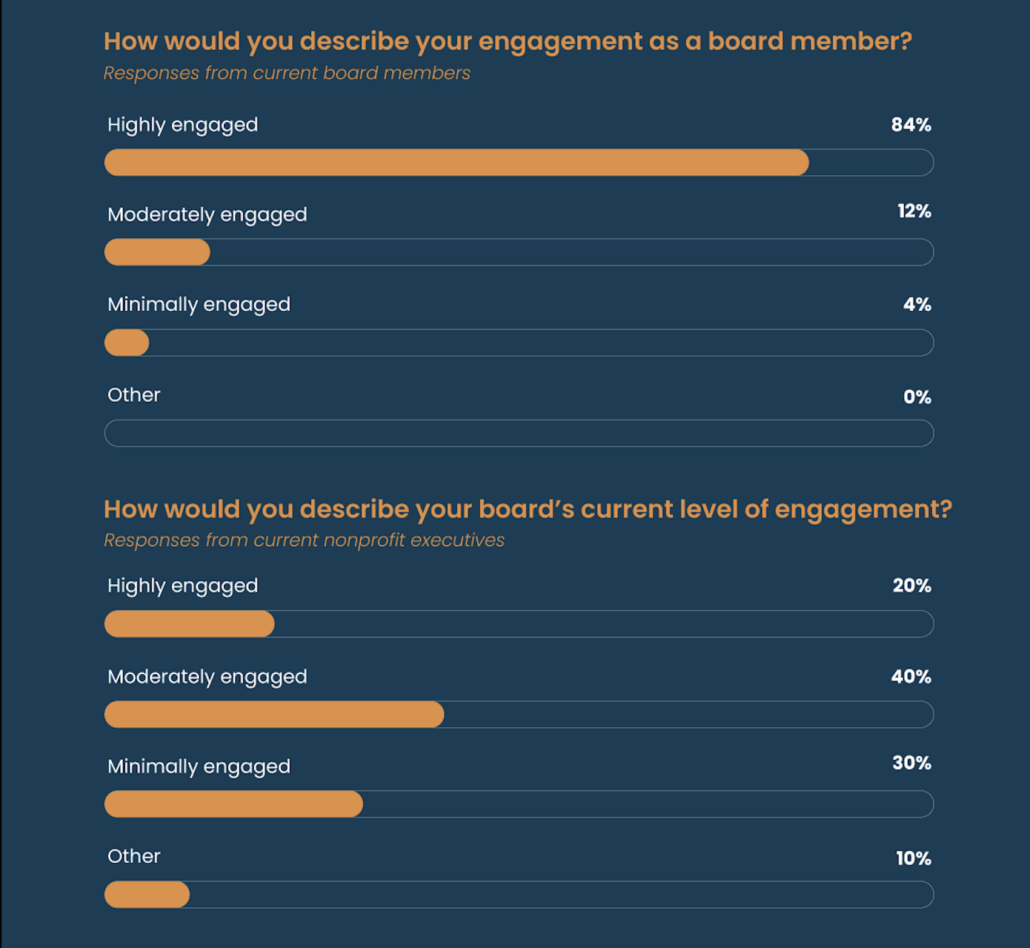
A chart that shows the findings described in the text.

84% of board members described themselves as “highly engaged” — proactive, responsive, and deeply involved in strategic issues. Yet, only 20% of nonprofit executives described their boards the same way.

Conversely, 30% of nonprofit executives said their boards were “minimally engaged” — attending meetings but offering limited involvement otherwise.

We believe this isn’t just a difference in experience, but it points to a larger, more systemic opportunity: a difference in how we define and measure board engagement. What does “engagement” really mean? Is it attending meetings? Providing strategic guidance? Fundraising? Something else entirely? For many organizations, that answer is still evolving.


:arrow_right: What’s Changing — and What’s Not

When asked how board engagement has shifted in the past six months:

  • 45% of executives reported no major change.
  • 40% saw engagement increase somewhat or significantly.
  • 15% experienced a slight decline.

Contrary to what we might expect in today’s volatile environment, nearly half of nonprofit executives reported no major change in board engagement due to external factors over the past six months. However, among those who have seen changes, increases in engagement outpaced decreases significantly.

:chart_with_upwards_trend: The organizations experiencing increased engagement often cited heightened urgency around their mission as a driving factor, suggesting that crisis can indeed catalyze commitment, but it’s not universal. When asked how board engagement has changed, one executive said: “We’re watching the macroeconomic conditions that would impact inflation, employment, and discretionary giving.” Others shared their boards are “being proactive” and “very supportive.” 

:chart_with_downwards_trend: Those experiencing decreased engagement shared a nuanced reality about the volunteer nature of board roles: “There are fewer people willing to take on voluntary roles,” while another noted: “Some of them own and run their own businesses, so they’ve had to step away from our board so they can concentrate more on keeping their businesses thriving.”

Many comments related to decreased engagement focused on a reluctance around fundraising: 

“I feel like my board members have a lot more on their plates personally and professionally, giving little to no time for board engagement, especially in fundraising areas.”

“They continue to remain interested in operations with the external pressures, but aren’t willing to be the solution in raising funds.”


:blue_car: What’s Driving (or Draining) Board Engagement?

Board members, on the other hand, shared what’s helping and hindering their ability to stay engaged. The top positive driver? Increased urgency or relevance of the organization’s work (15 responses).

Top challenges:

  • Competing personal or professional demands (15 responses)
  • Frustration or lack of clarity around strategic priorities (6 responses)
  • Uncertainty about role expectations (4 responses)

Taken together, these responses paint a picture of well-intentioned leaders navigating time constraints and a desire for clearer direction.

When asked what would increase their engagement, board members requested:

  • Peer relationships and mentorship opportunities (15 responses)
  • More context about external challenges (10 responses)
  • Clearer strategic direction and priorities (9 responses)
  • Better communication timing and structure (9 responses)

:building_construction: Building Empathy

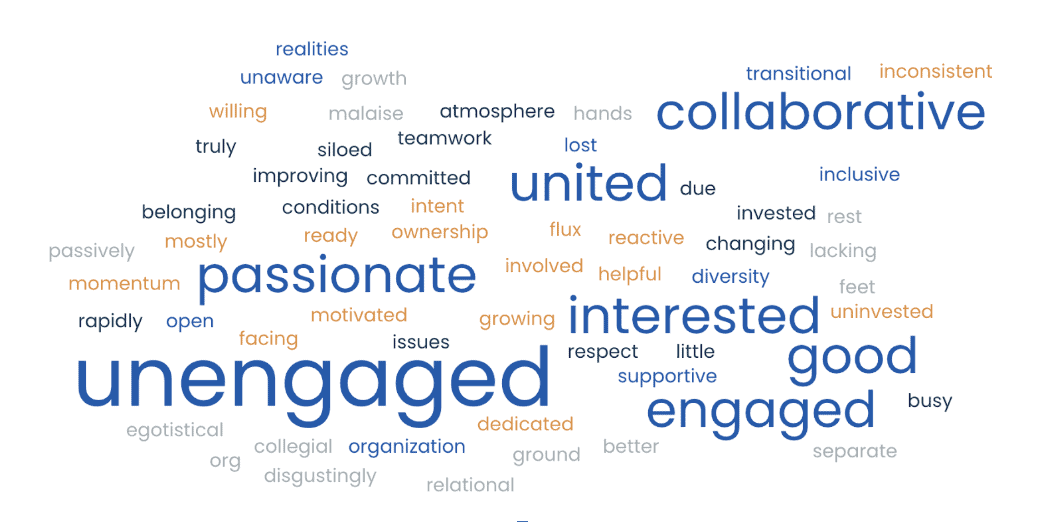
In closing, we asked survey participants to respond to optional qualitative questions exploring what they wished their counterparts understood about their roles, as well as a single word or phrase that described their current board culture. Here’s a sample of their responses.

What nonprofit executives wish they could tell their board members:

“How hard it is to manage everything as the only full-time employee. How much I need their help in fundraising.”

“That I wear many hats, from trash collector to Major Donor ‘Friend’, and I have very little staff capacity to assist in the needed work.”

“I wish they’d see the amount of time spent on administrative tasks, such as scheduling meetings, taking notes, handling ALL the logistics of events, meetings, and programs, in addition to my key roles of fundraising, leading the organization, etc.”

“I wish the board realized that this isn’t a small business that I own. It’s a shared partnership.”

“The impact it has on our team and mission when board members don’t follow through on their commitments.”

What board members wish their nonprofit executive peers understood:

“Sometimes I feel used and not like a partner.”

“I feel like we have important needs to fulfill as a board (stronger governance, structure, nominating), but they aren’t “assigned” to anyone on the board to execute or follow up. We often talk about the importance of these things, but it’s just talk.

“I think it’s critical for everyone employed at the nonprofit to understand that this is a volunteer role, and it can often be challenging to juggle our full-time work commitments and the demands of the board.”

“We’re not full-time employees; keep in mind this is a volunteer role; need to be reminded often & at board meetings why we are doing the work-don’t forget the mission’s moment.”

“The lull in between meetings can be challenging to re-engage where we left off.”

What’s one word or phrase that best describes your board’s current culture?A word cloud.


:motorway: The Path Forward: Three Recommendations

This survey comes just weeks after our team explored another facet of governance: the growing difficulty of recruiting and retaining board members. Overreliance on the same small pool of leaders is creating burnout, redundancy, and a lack of fresh perspectives.

The findings from this engagement survey reinforce that challenge (and expand on it). It’s not just about getting the right people on the board. It’s about making sure they understand their role, feel equipped to engage fully, and are meaningfully connected to the mission. 

For nonprofit leadership teams looking for ways to build a stronger board culture and cultivate deeper engagement, here are three areas to explore:

  1. :heavy_equals_sign: Expectation Alignment on “Engagement”: The perception gap suggests boards and executives are operating with different definitions of “engagement.” While board members may view strategic oversight and governance as high engagement, executives need more tactical partnership. Organizations need to have explicit conversations about what meaningful board involvement actually looks like in today’s resource-constrained environment.

  2. :bulb: Fundraising Skill Development: Fundraising remains one of the greatest pressure points in board-executive dynamics. While many board members express discomfort or uncertainty around donor engagement, nonprofit leaders are looking for more hands-on support. Closing this gap means moving beyond expectations to skill-building — equipping board members with the tools, language, and confidence to engage authentically in resource development.

  3. :busts_in_silhouette: Partnership Mindset Shift: Many of the most engaged boards operate from a place of true partnership, not just oversight. This means cultivating a culture where board members feel both responsibility and agency, understanding that their leadership extends beyond bimonthly meetings. Building that mindset starts with clearer role design, better communication, and an emphasis on shared outcomes over formal titles.

:compass: What’s Next?

The governance challenges facing nonprofits aren’t going away (if anything, they’re intensifying). But organizations that invest in bridging the executive-board engagement gap will be better positioned to navigate whatever comes next.

The question isn’t whether your board is “good” or “bad” — it’s whether your leadership team is aligned around shared expectations, clear roles, and genuine partnership in service of your mission.

What resonates most with your experience? We’d love to hear how your organization is navigating these governance dynamics.


Stay tuned for the next survey in our 2025 nonprofit leadership series by subscribing to our monthly newsletter, and thank you for being part of this work!

:bar_chart: Want help translating insight into strategy? Next Stage helps nonprofits and other social good organizations with organizational strengthening and team building. Let’s talk today.

Filed Under: Nonprofit Leadership, Thought Leadership

Dipping from the Same Well: Why Finding and Retaining Board Members Is Getting Harder

June 10, 2025 by joshjacobson

For many nonprofits, June brings the end of the organization’s fiscal year. It’s a time when organizational leaders are deep in the process of approving budgets, planning summer retreats, and preparing for a new set of challenges in the year to come. 

This season also serves to activate the annual reset of board rosters and committee assignments. For nonprofits that follow a calendar-year nomination process, summer is the time to assess who will be leaving and what gaps will need to be filled. And that task seems to be getting more difficult.

At Next Stage, we’re digging into this governance challenge as part of our broader nonprofit leader listening series. Our current survey focuses on board engagement, and we’re eager to hear from both executive teams and board leaders. Please consider sharing your perspective and forwarding the survey to your governance committee or board chair to help ensure the findings are grounded in a diversity of voices.

But before diving into the data, it’s important to set the stage. Because we’re observing how leadership is evolving in real time, shaped by growing uncertainty and mounting pressure on the systems designed to support sound decision-making.

The Challenge of Recruitment

Serving on a nonprofit board has never been an easy ask. It requires a commitment of time, energy, and personal capital; the kind of service that doesn’t always show up on a résumé or come with applause. And yet, it’s long been a vital part of the social contract for those in positions of influence and capacity. It’s a way to contribute to the greater good by providing oversight and strategic guidance to institutions that serve the public.

Lately, though, the pool of people willing to take on that responsibility seems to be shrinking. Nominating committees are spending more time recruiting. Executive directors are voicing concern about lagging engagement and unclear expectations. And in some cases, boards are operating well below their full complement; not by choice, but by default.

What’s driving this shift? Part of it may simply be math. Each year, thousands of new nonprofits are launched across the country, and each one requires at least a handful of board members to satisfy basic IRS requirements. Add to that the growing number of advisory councils, task forces, homeowner associations, PTAs, and professional associations — each with its own board, its own meetings, its own call for service — and you begin to understand the larger context. We’re drawing from the same well of talent, but more buckets are being dipped.

At the same time, people are recalibrating how and where they spend their time. The post-pandemic world has prompted a new clarity around bandwidth. A growing number of would-be board members are either stretched too thin or opting out altogether, choosing more flexible forms of volunteerism or simply declining the request when it comes. 

This has also gotten worse in recent months, as people who would normally lean into community needs are instead sitting this moment out. The politicized environment, coupled with real concerns for the economy, is having a chilling effect on civic engagement. It’s reflected in diminished audiences for cultural institutions, lower-than-expected attendance at fundraising events, and sluggish response rates to digital calls-to-action. A general malaise has settled into social good, and it spells trouble given the enormity of the task ahead.

What’s at Stake

This would all be less concerning if boards were being asked to do less. But in fact, the opposite is true. The road ahead for nonprofit organizations is full of complexity, and boards will play a central role in navigating it.

We believe three key issues will dominate nonprofit boardrooms in the months ahead:

  • Budget Shortfalls. First and foremost, revenue uncertainty is real. While it may still feel like the early click-clack of a wooden roller coaster climbing the first hill, the signals of an impending plunge are hard to ignore. Pandemic-era funding is drying up. Major donors are re-evaluating their portfolios. State and local governments are signaling pullbacks and reprioritization as a result of federal policy changes. For many nonprofits, this will be the first real budget reckoning in years, and boards will be tasked with making sense of it all. That includes recalibrating fundraising strategies, reviewing reserve policies, and approving cuts that will impact the communities they serve.
  • Leadership Transitions. Executive turnover is an inevitable part of organizational life, but it can feel more disruptive when layered on top of other changes. The executive turnover that was predicted five years ago is beginning to show up in practice. Executive directors and CEOs who led organizations through the pandemic are stepping away. Burnout is real, and for some, the time has come to pass the baton. In those moments, the board must be ready to not only hire a new leader but to stabilize the organization during a period of change, reassure staff and donors, and provide vision and clarity amid transition.
  • Strategic Integrations. We’re hearing more and more interest in integration, including collaborative ventures, shared back-office services, co-location strategies, and full-on mergers. These ideas require careful consideration, risk assessment, and a vision for what could be gained or lost. Board members will be asked to engage in that ambiguity, serving on working groups that require extra meetings and reflective critical thinking. That’s a tall order for even the most committed volunteers, especially while their own sectors and industries wrestle with the impact of tariffs and policy change.

The Skills That Matter Now

Board service has always called for dedication. But what’s needed now is something more. We need board members who have the time to meaningfully engage, who bring expertise in finance, strategy, fundraising, and organizational health. We need board members who lead with empathy, who understand the real impact of their decisions, and who are willing to show up during difficult seasons.

Above all, we need board members who care. 

These skills are available. The people who can lead nonprofits through these challenges are out there, but they must be cultivated, invited, supported, and equipped. This work takes time and requires a strong board culture, clear expectations, and a governance committee that takes its charge seriously.

What Comes Next

If this all sounds like a big ask, that’s because it is. But the alternative is to let boards drift toward ineffectiveness at a time when organizations need them most.

Next month, we’ll publish the findings from our current survey on board engagement, along with actionable recommendations for strengthening your own board.

Please consider completing the survey if you haven’t already. Your experience matters, and your response will help shape the future of nonprofit governance.

Take the 2-minute survey now.


Next Stage CEO Josh Jacobson launched Next Stage as a social enterprise in 2014, bridging his professional experiences as a nonprofit practitioner with his consulting expertise. He has led Next Stage’s work with 225+ clients, including nonprofits, private-sector companies, municipalities, faith institutions, philanthropies, and community-based organizations. Josh’s skills in strategic positioning and tactical design help clients achieve their goals. He guides Next Stage’s work in strategic planning and collaboration management and is a major contributor to the company’s thought leadership efforts.


See a comprehensive report of our previous nonprofit leader survey results here, and follow us on social media to stay in the loop on future findings.


:inbox_tray: Want the latest social good trends, insights, and inspiration delivered straight to your inbox? Subscribe to the Impact Insider today!

Filed Under: Nonprofit Leadership, Talent, Thought Leadership

What’s Fueling (and Fraying) Nonprofit Morale? Insights from Our Latest Workplace Culture Survey

May 12, 2025 by Caylin

At a moment when social good work feels more critical than ever, many leaders are wrestling with an increasingly urgent question: How do we keep our teams motivated, supported, and committed in the face of rising pressure and uncertainty?

Workplace culture isn’t just a “nice-to-have” for nonprofits — it’s mission-critical in a sector where burnout is common, resources are stretched thin, and the emotional weight of the work runs high. When the day-to-day feels overwhelming, it’s the strength of your culture — trust, communication, belonging — that determines whether your team can weather the storm.

That’s why we launched a survey to understand the current temperature on team morale, staff retention pressures, and what’s working to keep people engaged. Whether you’re trying to stabilize a struggling team or future-proof your staff strategy, this data can help guide your next steps. 

Here’s what we heard from leaders in our network — and what it means for the months ahead.


Who Participated? A Snapshot of Our Respondents

We gathered insights from 20 participants, each bringing valuable perspectives shaped by their leadership roles and organizational contexts. The respondents primarily represented nonprofit organizations, with a strong presence of executive leaders committed to advancing mission-driven work across North Carolina communities.

Sector Representation

  • 95% of respondents came from nonprofit organizations working across a wide set of impact areas, including health, human services, education, arts and culture, and more. 
  • One respondent represented the for-profit sector, working in direct service delivery with a social impact orientation.

Role Representation

  • 75% held executive leadership positions, including CEOs, executive directors, and vice presidents, reflecting a strong voice from decision-makers within their organizations.
  • 15% worked in operations and administration, with a small number representing roles in communications, fundraising, and frontline program delivery.

Geographic Representation

  • The survey data highlights a strong cluster of nonprofit leadership in Mecklenburg County and surrounding areas, offering a snapshot of organizational activity and influence within the region.
  • Other geographies represented include: Huntersville, Mint Hill, Greensboro, and Winston-Salem.

:mending_heart: Most Teams Are Steady — But Some Challenges Are Emerging

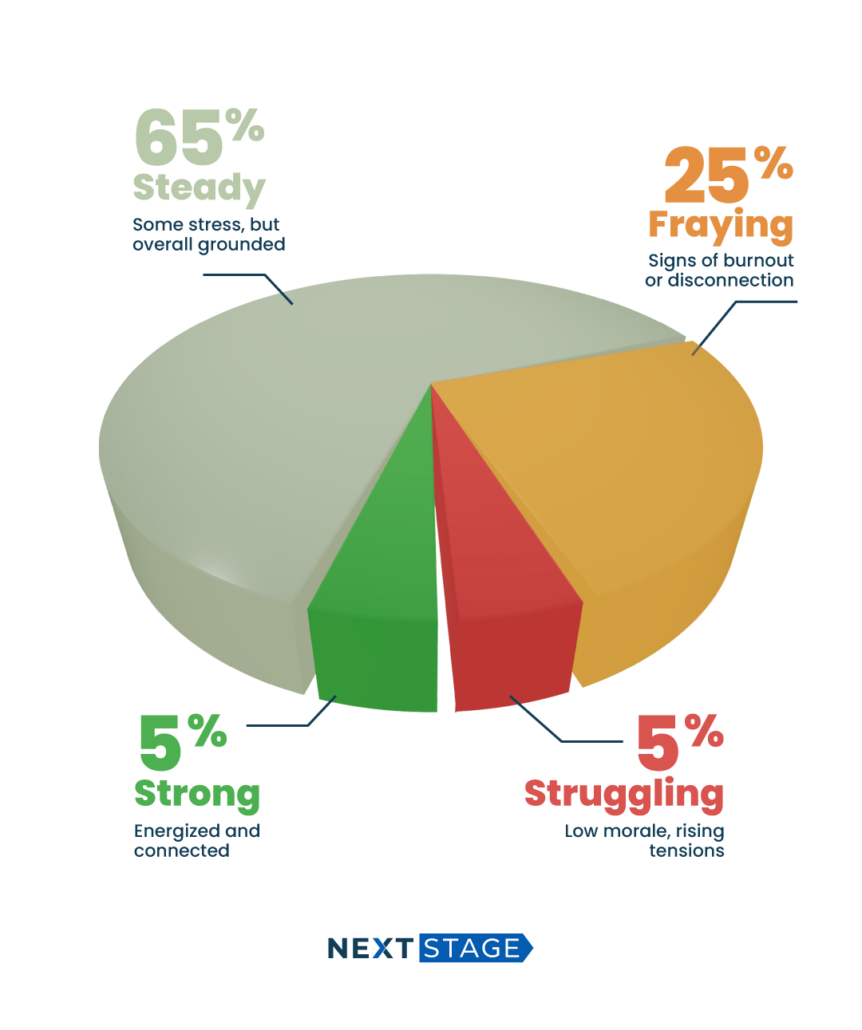
When we asked how teams are really doing, most respondents (65%) said morale is steady — there’s stress, but teams are hanging in there. Still, nearly one-third reported signs of burnout or disconnection, and one described morale as outright struggling.

How respondents described morale:

A graph that represents the current state of nonprofit morale.

This paints a picture of resilience, tempered by real concern about sustainability. As one leader put it, “We’re staying focused on the people we serve.” 


:anger: What’s Putting the Most Pressure on Staff Retention?

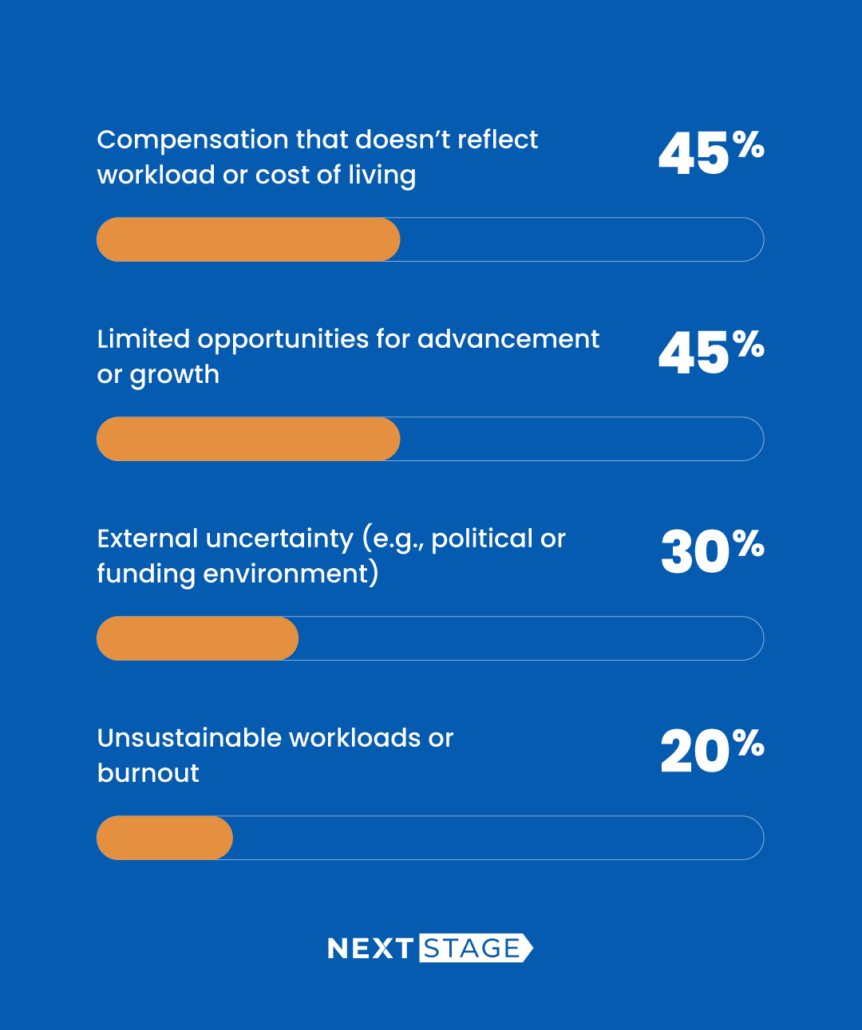
The most common factors weighing on retention aren’t new, but they are increasingly interconnected:

A graph with the survey results.

These responses show that retention challenges aren’t about any one issue — they’re the result of multiple forces converging. Many respondents named several factors at once, reflecting just how deeply personal and organizational stressors overlap.

One leader also pointed to the influence of “personal lives” on staff stability, highlighting how external pressures, like caregiving responsibilities, housing insecurity, or mental health, can directly impact workplace engagement.


:ring_buoy: How Are Organizations Responding?

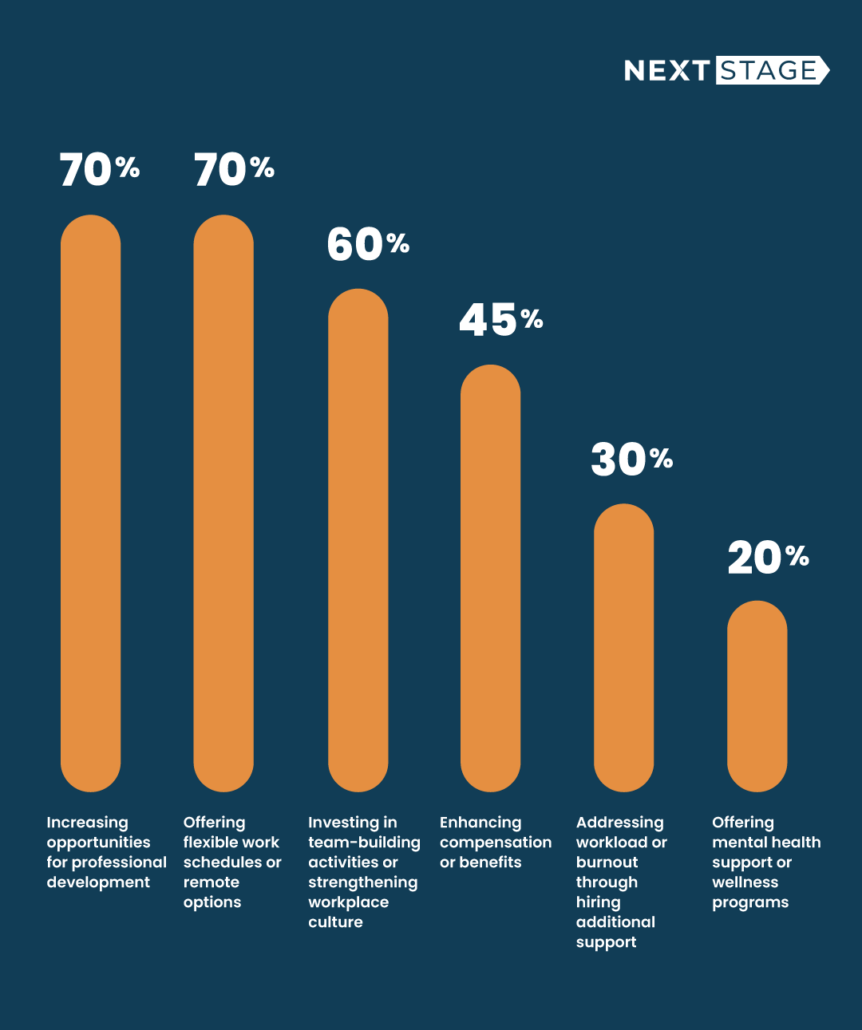
Leaders shared a wide range of actions planned to retain their employees this year:

A graph with survey results.

Professional development and flexibility are leading the charge.

  • The most common responses were increasing opportunities for professional development and offering flexible work schedules or remote options — each cited by 70% of respondents. These options reflect a growing understanding that career growth and flexibility are central to staff satisfaction and long-term commitment.

Culture-building remains key.

  • 60% of respondents are investing in team-building activities or strengthening workplace culture, signaling that nonprofit leaders are prioritizing community, connection, and shared values as a path to retention.

Compensation matters, but it’s not everything.

  • While 45% are enhancing compensation or benefits, it’s notable that nonfinancial strategies like flexibility and culture-building were mentioned more often — perhaps pointing to budget constraints or a broader redefinition of what makes a workplace supportive.

It’s clear that many nonprofit leaders are trying to be as responsive and adaptive as possible — but there’s also room to grow, especially in supporting staff well-being in more holistic ways.


:white_check_mark: What’s Actually Working?

While these numbers help us understand trends across the sector, it’s the qualitative insights that bring the real story to life. We asked leaders what’s helping their teams stay engaged, and here’s what they said:

“Connection among team members.”
“Transparency and communication.”
“Time to gather and celebrate.”
“Focusing on the positive things we’re doing.”
“Giving team members a voice.”
“Our strong relationships with each other.”

Themes of belonging, communication, and meaningful connection stood out loud and clear. Leaders who create space for community — not just productivity — are seeing results:

“We’ve prioritized staying relationally strong so we can keep doing impactful work together.”


:speaking_head_in_silhouette: Encouragement From One Leader to Another

We closed by asking an optional question: What advice or words of encouragement would you give to others leading teams right now?

40% of respondents chose to leave words of wisdom for others, demonstrating our sector’s willingness to step up and support one another. Here’s a snapshot of their insights:

“Help your team to recognize how their individual contributions every day drive the mission of the organization.”

“Listen to understand. Be a bridge for your team, not a wall.”

“Take care of yourself as a leader. You’re probably feeling increased pressure and anxiety. Know that no one knows what’s coming next or how things will shake out, so don’t hold yourself to the expectation that you have to know it all either.”

“Lead with empathy and clarity. People are carrying more than we often realize, so creating a space where your team feels seen, heard, and supported goes a long way. At the same time, don’t be afraid to cast a clear vision — people want to know where they’re going and why it matters. Stay consistent, stay human, and trust that even small moments of encouragement can have a big impact.”

These words reflect what we hear in our work every day: the nonprofit sector is full of people leading with heart, even when times are tough.


:compass: So, What Comes Next?

Nonprofit work has always demanded passion and perseverance. In 2025, it also demands a renewed commitment to the people behind the mission. With burnout, budget pressures, and shifting expectations all in play, workplace culture is no longer a side conversation — it’s central to organizational sustainability.

If your organization is navigating these waters, know this: you’re not alone. And the more we learn from each other, the better we can support the people doing the work that matters most.

Whether your team is thriving, holding steady, or struggling, now’s the time to:

  • Revisit your retention strategies
  • Prioritize real conversations about morale
  • Double down on transparency, flexibility, and team connection

Because when your people thrive, your mission does too.


 Stay tuned for the next survey in the series by subscribing to our monthly newsletter — and thank you for being part of this work.

:bar_chart: Want help translating insight into strategy? Next Stage helps nonprofits and other social good organizations with organizational strengthening and team building. Let’s talk today.

Filed Under: Nonprofit Leadership, Thought Leadership

  • « Go to Previous Page
  • Page 1
  • Page 2
  • Page 3
  • Page 4
  • Interim pages omitted …
  • Page 13
  • Go to Next Page »

Primary Sidebar

Footer

Subscribe to the Impact Insider

Your monthly roundup of social good news and trends

only_email

Who we are

What we do

Who we serve

resources

Newsletter

Careers

Let’s work together!

Contact Us

fb
in
ins

© 2026 Next Stage Consulting | All rights reserved | Privacy Policy