• Skip to primary navigation
  • Skip to main content
  • Skip to primary sidebar
  • Skip to footer

Next Stage - Social Impact Services

Social good strategy to amplify your impact

  • Who we are
  • What we do
  • Who we serve
  • Resources
    • Impact Stories
    • News & Insights
  • Contact
  • Newsletter
  • fb
  • in
  • ins

nextstage

The Next Stage Team Welcomes Jalah Blackmon

January 8, 2024 by nextstage Leave a Comment

Introducing Jalah

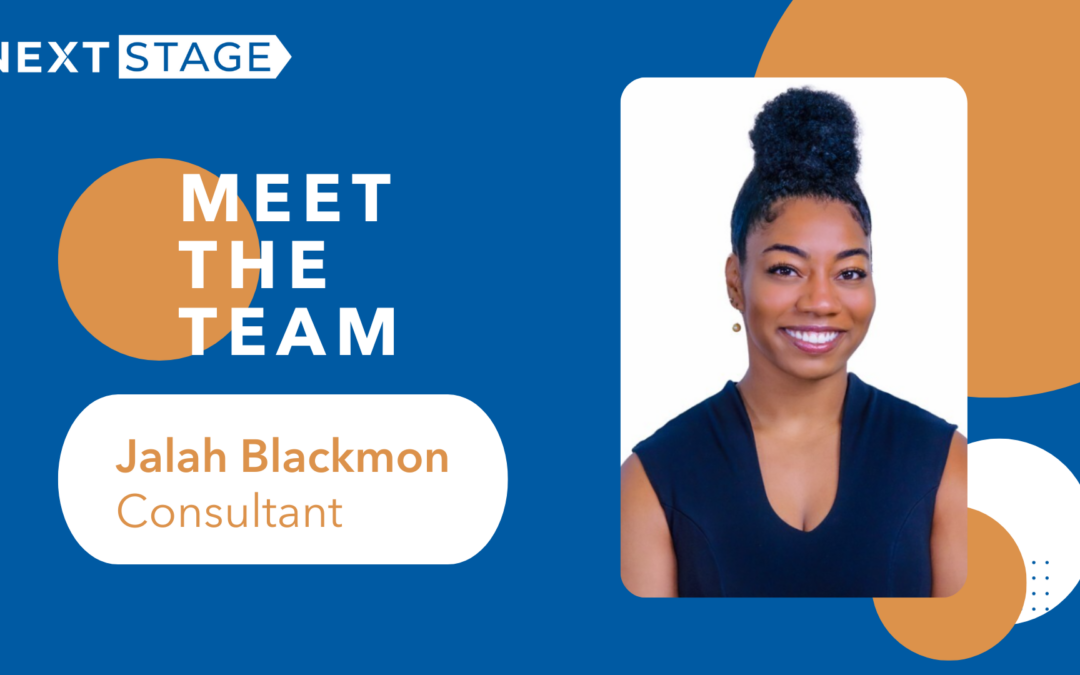
The Next Stage team is thrilled to introduce Jalah Blackmon – our newest member of the team serving as a Consultant.

Jalah is a skilled public health educator dedicated to using a social justice and health equity lens to empower underrepresented communities and challenge systemic barriers to wellness. Her passion is fueled by a commitment to destigmatize mental health in communities of color, emphasizing education, community, and social support. She deeply believes in challenging and reshaping health outcomes entrenched within systems of structural racism.

She previously served as the Director of Innovation and Capacity Building at Care Share Health Alliance and as a Program Director at Charlotte Mecklenburg Food Policy Council. Additionally, Jalah is the Co-Founder of The Black Light Foundation, a 501(c)3 nonprofit focused on bringing light to dark places for individuals suffering from suicidal thoughts and mental health issues by providing the necessary resources for emotional support, education and intervention.

A graduate of UNC-CH and UNCG, Jalah holds a BA in Exercise and Sports Science and Sociology and a Master of Public Health. Jalah was born and raised in North Carolina and enjoys being a functional fitness trainer.

In Her Own Words

I’m returning to my roots in Charlotte and am particularly enthusiastic about Next Stage’s profound commitment to nurturing local nonprofits while disrupting and reimagining social systems for the greater good. As I step into this consultant role, I’m eager to contribute actively to Next Stage’s mission, specifically in projects targeting community health promotion.

My approach is to not just lead client engagement and project management, but to also champion community-driven strategies. I thrive upon fostering a sense of belonging, a value I am already extending through the innovative use of Cultivate Impact, Next Stage’s online collaboration management platform.

Within and beyond my professional endeavors, I am committed to amplifying diverse voices, fostering inclusivity, and sparking impactful change through thought leadership. In alignment with Next Stage’s visionary mission, I look forward to contributing toward tangible strides toward a more equitable and healthier future for all.

Join us in welcoming Jalah to the team!

Filed Under: Talent, Values & Culture

2024 Social Good Forecast for Businesses

December 14, 2023 by nextstage Leave a Comment

With the year winding down, the Next Stage team is looking at the road ahead. What will change about social impact efforts in 2024? What will CSR leaders prioritize? How will nonprofits evolve to meet new challenges and change? In this ‘2024 Social Good Forecast for Business, we’re breaking from our usual ‘trend’ language – because we don’t believe that anything on this list is temporary – and instead we are forecasting.

Overall, sustainability and environmental concerns will be top of mind for companies everywhere. Just as important is the ‘Social’ part of corporate social responsibility efforts – and the we expect to see the the predictions below remain well into the future: 

Authenticity is the Word of the Year

Merriam-Webster recently declared ‘authentic’ to be the word of year. While this is a reaction to a wide set of cultural phenomena, it aligns with what younger generation consumers and employees have been asking of companies for years. Savvy company and CSR leaders will focus on aligned impact efforts rooted in community and employee voice. Companies who can create environments where social good feels authentic will reap the benefits of employee retention, recruitment and strong culture. In the same vein – expect greater sensitivity to impact-based marketing campaigns. Watch for the trap of ‘greenwashing’ or ‘rainbow capitalism’ campaigns without meaningful action behind them. 

Trust-Based Philanthropy Will Pick Up Steam

The concept of trust-based philanthropy is already picking up steam among philanthropy and nonprofits. This year, we expect it to become a hotter topic among companies – and for good reason. Trust-based philanthropy is all about creating more equity in grant-making processes. This most often shows up as multi-year, unrestricted funding, streamlined application processes and more transparent, bi-directional feedback. Our team is dipping our toes in these waters through our UnFundable Grant – stay tuned for more of what we’re learning!

Mental Health Will Matter More Than Ever

If we learned anything during the pandemic, it was that mental health is critical for a healthy organization and maximum impact. We expect organizations everywhere to prioritize mental health, both inside and outside their companies walls. This will show up as companies developing strong internal campaigns to support their people, as well as greater funding to ensure that communities stay mentally strong and healthy. 

Funders Will Prioritize Collaboration 

The biggest challenges facing our communities are layered and multi-faceted, with positive outcomes in any one focus area dependent on supports in other, seemingly unrelated areas. How can a child achieve academically when affordable housing for that child’s family is out of reach? How do we build workforce pipelines that realize economic mobility when transportation options are limited? We have arrived at a clearing in the woods, where leaders in overlapping sectors are realizing there is no successful path forward without collaboration. This drive for collaboration will be fueled in part by the private sector – and we see great potential companies who are willing to help tackle these challenges head-on.

Businesses Will Look to Fund More Community-Based Organizations

Companies are increasingly looking to fund community-based organizations (CBOs) as a way to fuel local impact. It’s a way to support hyper-local impact through organizations most proximate and trusted by communities – but the challenges for companies can be equally steep. For companies used to funding highly structured, large nonprofits with strong processes, working with CBOs can require more patience and support. Watch for more companies dipping their toes into hyper-local waters – and more conversation on how to do this effectively. 

Employees Will Go To Bat for DEI

After the death of George Floyd, DEI evolved and structural changes were prioritized at many companies – but many of those same positions have been cut over the past twelve months. And while it is certainly an uphill battle, this article recognizes the increase in employee activism for DEI initiatives. Some DEI professionals are finding that, “Internal activism is on the rise, with four in 10 of all employees and half of millennials reporting that they had spoken out about controversial issues at work.” Expect to see this trend continue with younger generation employees ‘leading from their seats.’ 

We’d love to know – what would you add to this list?

Filed Under: Communications, Corporate Impact

Our 2024 Social Good Forecast

December 12, 2023 by nextstage Leave a Comment

One of Next Stage’s annual traditions is this blog post. We think about what’s ahead for social innovators everywhere. This year, we’re breaking from our usual ‘trend’ language – because we don’t believe that anything on this list is temporary – and instead we are forecasting. In our 2024 Social Good Forecast, we delve into how emerging trends like AI integration in content creation, the expanding role of Medicaid in the nonprofit sector, and the rising significance of trust-based philanthropy are redefining the landscape of social innovation and community collaboration.

Here’s what we are predicting for next year – and beyond:

AI for All

2024 is the year when artificial intelligence naysayers will start seeing the benefits of this tool and integrating it into their workflow. For content creators, the emergence of ChatGPT and similar AI-powered writing “assistants” has felt a little shaky. Are we being replaced? If we tap into this, are we contributing to our craft’s doomsday? The answer is no. There’s no replacement (yet) for lived experience, relational nuance or your emotional connection to your stakeholders/audience. In 2024, expect more late-tech-adopters to lean into AI as a collaborator for brainstorming, refining thoughts and combating writer’s block.

Medicaid Expansion Will Impact Nonprofits

Medicaid officially expanded in NC on December 1. The impact on individuals and families has been well documented – but what hasn’t been mentioned is the slew of impacts this could have on nonprofits. It is likely to mean more funding and new referral pipelines as more community-based organizations have the opportunity to participate in service delivery. Stay tuned for more specifics on the ways this will inevitably affect nonprofits across our state!

Trust-Based Philanthropy Will Pick Up Steam

The concept of trust-based philanthropy is already picking up steam among philanthropy and nonprofits. This year, we expect it to become a hotter topic among companies – and for good reason. Trust-based philanthropy is all about creating more equity in grant-making processes. This most often shows up as multi-year, unrestricted funding, streamlined application processes and more transparent, bi-directional feedback. Our team is dipping our toes in these waters through our UnFundable Grant – we can’t wait to share what we’ve learned.

Collaboration Will Be Even More Critical

The biggest challenges facing our communities are layered and multi-faceted, with positive outcomes in any one focus area dependent on supports in other, seemingly unrelated areas. How can a child achieve academically when affordable housing for that child’s family is out of reach? How do we build workforce pipelines that realize economic mobility when transportation options are limited? We have arrived at a clearing in the woods, where leaders in overlapping sectors are realizing there is no successful path forward without collaboration. We wrote earlier this year about the Federal Plan for Equitable Long-Term Recovery and Resilience – an initiative that lays out how federal funds will be invested to advance positive outcomes in these areas of intersection. We see great potential in it to help take on these social challenges head-on – but only if we do it together.

Businesses Will Look to Fund Community-Based Organizations

Companies are increasingly looking to fund community-based organizations (CBOs) as a way to fuel local impact. It’s a way to support hyper-local impact through organizations most proximate and trusted by communities – but the challenges for companies can be equally steep. For companies used to funding highly structured, large nonprofits with strong processes, working with CBOs can require more patience and support. Watch for more conversation on how to do this effectively.

Cultivating Community-Level Engagement Through Trust

The collaboration mentioned above will only happen if we use a methodology of trust. It is essential to displaying care and responsibility for one another as well as addressing pertinent issues around affordable housing, education, healthcare, navigating systems, workforce development and more. Charlotte and cities across the country are seeking ways to do this kind of engagement more effectively while assessing areas for growth, improvement and opportunities.

Polarizing Politicization

It’s an election year, and you know what that means. And I don’t just mean obnoxious candidate commercials that make us all want to throw our TVs out a window. No, these days an election year brings with it increased vitriol and baseless hatred at a time when we need to be coming together for the greater good. Politicized messaging can create rifts and disrupt forward progress in communities at a time when they are addressing the long-term impacts of a global pandemic. Keep that in mind as you engage the people you serve, your colleagues and others. What may just seem like empty rhetoric and hot air to some can feel like the reopening of old wounds that rarely ever fully heal.

DEI Will Remain Under Attack

Speaking of polarization – Diversity, Equity, and Inclusion (DEI) will remain under attack and will continue to have opposition in 2024. And that is unfortunate. After the death of George Floyd, DEI evolved and structural changes were prioritized. And yet, we believe there are individuals, companies, and institutions that will continue to hold the line and create space for DEI, belonging, and respect, evaluating processes and examining the root of systemic disempowerment – and calling that out. In 2023, we wrote a blog entitled “Walk A Mile In My Shoes” – in 2024, who’s willing to go the distance?

Intentionality Will Replace ‘Disruption’ in Change Management

An intentional focus on change management and ‘just-in-case’ planning will be top of mind. Many companies have recovered from the emergency state of the pandemic and have pocketed a lot of wisdom from their experiences. Putting key operational plans in place for future disruptions will give leaders and their teams peace of mind. There are more things to plan for than you’d think! Succession planning, financial planning and planning for major technological shifts in how we work will be a valuable resource in your back pocket when the time comes. 2024 feels like a good year to get that done!

Organizations Will Build Their ‘People Resiliency’

Gone are the days when employees’ tenure could be reliably mapped out. The job market continues to shift and employees (and employers) are not afraid of seizing new opportunities and facilitating personal and professional development. Companies will be building strong HR teams to help organizations and companies avoid major disruption to company success and workflow amidst employee turnover.

And finally, your annual reminder that Community Voice is not a trend. We expect community voices to rise in prominence throughout 2024 – and we can’t wait to see what arises!

We’d love to know – what would you add this list?

Filed Under: Communications, Corporate Impact, Thought Leadership

Announcing The UnFundable Project Top 10 Finalists

December 5, 2023 by nextstage Leave a Comment

If you’ve been following along, you know we’re in the middle of our first grant initiative – The UnFundable Project. 

In October, to mark our upcoming 10th anniversary, we invited Mecklenburg County nonprofits to apply for a $10,000 grant for a project that typically would be considered “unfundable.” We were thrilled to have 44 applicants, including some organizations that even we weren’t familiar with! 

The Review Process

The Next Stage team reviewed the applications individually and then discussed each project as a group. Projects were graded on a rubric that covered these topics:

  • Innovation
  • Justification
  • Relationship to Organizational Strategic Vision and/or Community’s Goals
  • Feasibility
  • Efficiency of Tactic/Approach
  • Sustainability

We were inspired – and felt our heartstrings pulled – by so much of what we read. We’re so proud to work in a city that’s eager to do so much good. The voting was very close but today we are excited to share the top 10 finalists (listed below in alphabetical order) who are moving on to the panel review phase.

Congratulations to these organizations:

Caroline Calouche & Co – Pay off a credit card that was used to repair a sprung dance floor that was damaged by mold.

Catawba Riverkeeper – Hire a project-based data manager to audit and modernize systems to build a public-facing dashboard that shares water quality measurements with the public.

Charlotte Bilingual Preschool – Translate and validate the transcripts/credentials of 25-40 participants in the Workforce Development Program.

Latin American Coalition – Plan, build and maintain a community garden to foster intergenerational connections in the Latino/a/x community.

Lorien Academy of the Arts – Replace the original windows in their space (a church built in the 1960s).

McColl Center – Contract an artist to document McColl Center’s work in photos and videos.

Metrolina Association for the Blind, Inc – Update the website to meet WCAG standards.

Mind Body Baby NC – Provide free, evidence-based videos that break down common perinatal challenges. 

The Frankie Mae Foundation – Provide a safe, judgment-free space to support family caregivers.

UrbanPromise Charlotte – Grow and enhance staff professional development and training.

As you can see, there was a wide range of projects submitted. We’re learning so much from this process, including that nonprofits need many things that are being excluded from typical funder priorities. We’ve said it before and we’ll say it again, trust-based philanthropy is important now, and it’s the future way of working.

What’s Next

Our stellar panel will complete the same process as our team – reviewing the 10 finalists individually, and then gather in person in January to discuss the results. They will decide who will receive the grant money, which we’ll announce at our celebration event on February 8 (save the date!).

Thank you again to everyone who applied!

Filed Under: Resource Development, Thought Leadership

So You Want to Be on a Board?

November 28, 2023 by nextstage Leave a Comment

As a member of the Next Stage team and experienced board member, I often receive inquiries about how to become a part of a board. How do you find a good fit and learn the right tools? Today’s blog is all about my own journey with boards, along with some tips on becoming a great board member yourself.

My Board Journey

My board journey started with the Junior League of Charlotte’s Get On Board Training. I attended the very first training session to learn about board involvement and gain knowledge on topics such as Board Roles and Responsibilities, Strategic Planning, Engagement, Fundraising, Fiduciary Responsibilities, and Impact Evaluation. The room was filled with JLC members and non-members and created a foundational learning environment for experts to cover key topics and a safe space for participants to fully engage and ask questions. Once the training was complete, the goal was to take respective interests and match them with a nonprofit(s) seeking aligned qualifications.

Many received board assignments right away, and I eventually received mine with a nonprofit that focused on literacy-based initiatives – a personal passion of mine. Since that time, I’ve served on several boards geared toward education and literacy, including the Charlotte Mecklenburg Library Foundation, Parent Child +, South Charlotte Chapter of Jack and Jill of America, Inc., Sugar Creek Charter School, and others. Get On Board was the introduction and entry point to my board service for which I’m deeply grateful.

Four Questions About Boards

In addition to my own service, I reached out to a few community leaders to inquire further, and they shared the following tips for joining a board – and being a great board member:

How does board representation help/support a nonprofit institution?

  • A nonprofit’s board is a direct reflection of what the organization embodies. Board members are an extension of the organization’s brand, and ideally, a board member’s profile should positively amplify the mission and vision of the organization. 
  • Diverse representation is critical to support the work of the nonprofit. It’s also beneficial for a few board members to have knowledge, lived experiences, or ties to the mission to help determine or clarify what’s exactly needed and share a different perspective.

What characteristics are you looking for as it relates to board membership?

  • Nonprofits today need to have board members with a myriad of talents – Human Resources and Organizational Strengthening, Finance, Information Technology, Communication & Marketing, Fundraising, Strategic Planning, Data Analysis, and Legal. Some of these skills are needed in order for nonprofits to be successful for operational support.
  • Having consistent and authentic engagement with attendance, event participation, and networking, exuding a passion for the organization’s cause, and being intentional to advance the mission and engage with business and community connections are essential and valuable.

What are ways to best prepare and position a new or existing board member?

  • Onboarding, ongoing training, and board retreats are some ways to help new and existing members. Another way to help existing board members is to have an annual meeting with the Executive Director or CEO.
  • It’s also important to pair new board members with an existing board member who is engaged and willing to share pertinent information that could help them integrate successfully to the board.
  • Other examples specific to new board members include shadowing the staff, reviewing financial statements, and reading testimonials and narrative stories that have great impact for services. For existing board members, stay abreast of the strategic plan initiatives and be a resource for challenges and opportunities.


When asked, “What are 1-3 things that you wish every board member knew?,” several themes emerged that I believe are helpful for people considering board service:

  • Consider the expectations before you join.
    What are board obligations and expectations around the goals and objectives of the organization? Are you willing to leverage your social capital and networks for strategic, fundraising, and volunteer purposes?
  • Think about your willingness and ability to commit time and resources.
    What is the financial commitment to be on the board? What is truly the length of the board term? If you become an executive member, the length of term is usually extended. What is the REAL time commitment for the board outside of board obligations such as committee meetings, program attendance, exhibit openings, etc.?
  • Know the organization – and make sure that you have strong value-alignment.
    Have a deep understanding of how the organization provides its services and program offerings, and know that service is more than financial contributions. For example, who are the benefactors and what are the future plans? Also, know the elevator speech and be able to fully communicate what the organization does.


If you’re interested in learning more about board engagement, here are a few local sources that are helpful in preparing individuals for boards to check out that may be useful:

  • The Arts and Science Council (ASC): ASC offers cultural leadership training geared to supporting local arts organizations. The training is known to be competitive and expects full participation for nine monthly sessions. Also, fees are required to participate.
  • Urban League of Central Carolinas Young Professionals Auxiliary (ULCCYP): ULCCYP enlists young professionals (ages 21-40) who are willing to serve and give their time and resources to create collective impact in the community. The organization has membership requirements that apply not only to ULCC but also to the National Urban League that’s beneficial.
  • Women’s Impact Fund: Although Women’s Impact Fund is primarily focused on philanthropic endeavors in the community through the Arts & Culture, Education, Environment, Health, & Human Services, the organization does provide a valuable source of understanding nonprofits. With their membership model, committees help to uphold the organizational structure along with robust learning opportunities.

There are many nonprofit organizations who are seeking new board members, particularly around the beginning of each annual or fiscal year because of the board term commitment. Thus, I encourage you to connect with organizations that may interest you and inquire about their board selection process and guidelines.

And if you are a nonprofit seeking great board members, consider communicating your needs through your communication and your network channels. You never know who might be interested – and who might be a great fit! 

Filed Under: Nonprofit Leadership, Thought Leadership

Impact Report Essentials

November 16, 2023 by nextstage Leave a Comment

With the end of the year quickly approaching, nonprofit and CSR teams are turning their attention to impact reporting. And while it’s not quite ‘report season’ yet, savvy teams will begin considering what to report – and more importantly, what story to tell. 

To Impact Report, or Not to Impact Report

For nonprofits and companies alike, annual impact reports offer a chance to clearly articulate the impact you made throughout the year, weaving a compelling story that resonates with stakeholders. Organizations publish impact reports for a variety of reasons, but some of the major ones include:

  • Transparency and Accountability – Reports offer stakeholders a transparent look at how funds and resources have been used. For nonprofits in particular, these reports can be a valuable overview for funders and donors. 
  • Legal Compliance – Larger companies, especially those that are publicly traded, need to complete impact reports that demonstrate sustainability and governance efforts. However, this doesn’t mean that they have to be dry, data-focused reports. Many include engaging representations of what the company has socially accomplished that year. 
  • Marketing & Storytelling – Strong impact reports include story-driven pieces that offer plenty of opportunity for stakeholder engagement. For nonprofits and companies alike, reports can elevate brand image and position organizations as human-centered, innovative thought leaders who are engaged in meaningful community work. 

The Essentials

At Next Stage, we look at a lot of impact reports. While they are all different, the best ones have a few things in common. Here are some things that we think make impact reports great – along with a handful of our favorite reports from the last year as prime examples:

Story Matters – and So Does Style

Whether your impact report targets annual donors or financial disclosures, the way your report shows up matters! When The University of Maryland did studies on how people read on social media, in school and in business, they found we spend an average of 26 seconds on things we choose to read – which means we have limited time to get our point across. Make that time more effective by focusing on the compelling, human-centered stories that bring your data to life. 

Tangible stories paired with compelling images bring specificity to a report and help your audience quickly ‘get’ the impact you’re making. The data is critical – but it’s the stories and themes that bring these reports to life. 

Check Out: Girls Who Code built their impact report from several years ago directly onto their website, offering an easily accessible, visually appealing look at their year. They intentionally built on the previous year’s theme of ‘sisterhood,’ clearly defining a narrative that resonates broadly. It takes a subject that could be perceived as less exciting (coding!) by pairing it with a highly relatable and human theme that centers the girls they serve. 

Impact > Metrics

Data that demonstrates impact continues to be a big question for nonprofits and CSR professionals alike. When measuring impact, it is often easiest to default to ‘output’ metrics instead of impact – and for good reason. Long-term, effective impact is notoriously difficult to track. When considering the long-term impact of funding or programs, ask yourself ‘Why does it matter?’ – then ask it again and again. This often helps move from an ‘output’ position to an ‘outcome.’ Diving even deeper can result in getting to longer-term outcomes. 

For example, a nonprofit that provides scholarships may say, ‘We raised $100,000 to send first-generation students to college.’ The money raised is an output of their activity. Their second draft may say, “Ten students were able to attend their first year of college’ – this is an outcome metric and much stronger than the first. A final draft based on long-term impact might read, “Five scholarship students graduated this year and obtained their first professional job.” All of these metrics are important but focusing on impact makes for a much more effective story. 

Check out: We love the 2023 impact report from Consumer Reports. In addition to the beautiful design (that header!) it offers clear data on their mission to test and investigate products to make them safer for consumers. The data comes alive when they link the number of surveys and engagement with stories about the annual wins that will have a long-term impact on consumers – such as new requirements that make dressers safer and less likely to tip over or exposing the dangers of heavy metals in chocolate. 

Know Your Audiences

When it comes to marketing, impact reports can be a valuable asset for companies and nonprofits. Similar to any other marketing asset, it is critical to define target audiences and to develop content that will resonate. One frequently overlooked audience is your own internal team. 

According to the Edelman Trust Barometer, 71 percent of employees say societal impact is a strong expectation or deal breaker when considering a job. In a competitive recruiting and retention market, current and prospective employees may be the audience most carefully reading your report! And while ‘impact’ is the most important thing to report, consider how your impact relates to your audiences and the elements they will most want to know. For example, a buyer may want to know the ethics of your supply chain, while a prospective employee might want to better understand what DEI looks like at your organization, or how the company engages with nonprofits. 

Check Out: Glen Raven built their 2023 impact report around a clear set of sustainability, safety and social metrics but the report comes alive when they tell the stories of how Glen Raven employees enabled this work. (Full disclosure: Next Stage helped produce this report last year). We love the story on page nine that describes how one employee is elevating women in leadership and advocating for mentorship across the company. Whether discussing manufacturing plant safety or their nonprofit partnerships, they center storytelling, offering a compelling accessible look at the company’s impact. 

The Takeaway

Anyone can publish an infographic with metrics from their year, but savvy teams focus on the why behind their data – and translate that into approachable, human-centered content. 

Filed Under: Communications, Corporate Impact

  • « Go to Previous Page
  • Page 1
  • Page 2
  • Page 3
  • Page 4
  • Page 5
  • Go to Next Page »

Primary Sidebar

Footer

Subscribe to the Impact Insider

Your monthly roundup of social good news and trends

only_email

Who we are

What we do

Who we serve

resources

Newsletter

Careers

Let’s work together!

Contact Us

fb
in
ins

© 2026 Next Stage Consulting | All rights reserved | Privacy Policy