• Skip to primary navigation
  • Skip to main content
  • Skip to primary sidebar
  • Skip to footer
Next Stage – Social Impact Services

Next Stage - Social Impact Services

Social good strategy to amplify your impact

  • Who we are
  • What we do
  • Who we serve
  • Resources
    • Impact Stories
    • News & Insights
  • Contact
  • Newsletter
  • fb
  • in
  • ins

nextstage

Translating ESG and Social Impact for Manufacturing Companies

March 7, 2022 by nextstage

Nearly a year after the release of Profit & Purpose, we’ve had the opportunity to learn from (and work with!) so many innovative companies. And as the world turns rapidly towards a greater focus on ESG, businesses across all industries are looking at how to best integrate impact and sustainability into their own business models.

Advanced manufacturing companies and other blue-collar dominant businesses are no different. We’ve had a number of conversations with leaders in manufacturing industries this year, and the benefits and challenges ESG poses to these companies are significant and unique from many other business models.

The manufacturing sector has long been ahead of the curve on strategies such as apprenticeship programs and exposing students to the trades to build their workforce pipeline. But ESG is quickly evolving and many of these same businesses are now turning their attention to DEI efforts, workforce retention and environmental sustainability, in addition to workforce pipeline efforts.

Why are manufacturing companies investing in ESG? 

Like other industries, manufacturers are experiencing disruption due to changing expectations of shareholders. Millennial workers and consumers expect the companies they engage to be responsible across a range of issues. Environmental and sustainability factors play a particularly big role in this industry and many advanced manufacturing companies have established sustainability departments focused on reducing their carbon footprint, making their supply chain more environmentally-sound and examining production processes of the future.

While this movement is driven by large, publicly-traded companies, it is having a trickle-down impact. Many privately-owned manufacturing companies find themselves in the supply chains of these larger companies and must evolve their business models to remain competitive.

Layer in a rapidly-retiring workforce, the impacts of the pandemic, supply chain shortages and a need for greater inclusivity of both women and workers of color in these fields – many of these companies are being forced to evolve in real time to meet quickly changing needs and expectations.

Where does CSR or community impact fit in? 

As we noted back in January, CSR is not the same as ESG, but community impact is a critical part of a comprehensive ESG strategy. Savvy manufacturing companies are looking to leverage the long-term impact of their community efforts to solve business challenges and to support the broader goals of their ESG strategy.

This is typically an unexplored area of focus for a company accustomed to running in the background of civic engagement, with its business-to-business model less often resulting in prominent social impact efforts. But it is a trend we believe is only going to become more essential for manufacturing companies in the coming months and years.

How are advanced manufacturing companies leveraging ESG and social impact efforts to support their businesses? 

Social impact strategies can be leveraged to solve many of the challenges faced by companies that count on blue-collar, gray-collar and white-collar employees working together to produce a profit, including:

  • Talent Recruitment – A large portion of the blue-collar workforce in the United States is rapidly approaching retirement age, without enough next-gen employees to fill their spots. Some companies are partnering directly with nonprofits to set up training, hiring or apprenticeship programs in a clear win-win strategy. The company gains qualified workers, while the nonprofit and community gain valuable job training and positions.
  • Employee Engagement – More than one leader we spoke to specifically pointed out the challenges of employee retention over the last few years. Considered essential workers, many manufacturing employees are feeling the stress of the last two years. Staffing shortages and overtime hours compound this stress and many businesses are looking for team-building, mental health support and other engagement strategies to prevent burnout and retain their workforce.
  • DEI Efforts – Similarly, nearly every manufacturing leader we spoke to cited DEI as another focus area they hope social impact efforts can support. For example, one local company has its eye on increasing the diversity of their workforce and increasing the number of women and people of color in their leadership structure. In addition to examining their current practices, they are working on cultivating a diverse future workforce by investing in technology programs at under-resourced high schools.
  • Workforce Pipeline – Long-term pipeline is on the mind of nearly every business leader. Advanced manufacturing companies need to cultivate a strong pipeline across a range of areas – technology, finance, trade jobs and more and many companies are investing in nonprofits designed to support the long-term success of students. Some companies are investing in schools and academic support for students, while others are funding organizations that focus specifically on segments of the future workforce, such as girls and technology or students of color and engineering.

A new way to look at nonprofit partnerships. 

Nonprofit partnerships have long been seen as primarily a ‘give back’ or cause marketing effort for companies. But what if these partnerships had the ability to invest not only in the community, but inside the walls of your company? A shift in thinking opens up a new world for private-sector and community organizations that collaborate. If we instead viewed nonprofits as valuable partners and vendors who could help address company issues, your company could find efficient and effective partners in solving common workplace challenges.

Here are a couple of tips to keep in mind as you consider partnerships in line with your ESG strategy:

  • Create a ‘theory of change’ – Your company needs a narrative that ties together your focus on each of the initials in ESG. We see companies with mostly disconnected strategies that don’t speak to each other, making it difficult to communicate how your company is addressing these complicated issues. A strong human-centered narrative that connects metrics to your newly-developed mission is the key to remaining competitive.
  • Prioritize key challenges – As you consider a social impact strategy, explore how it could support your business challenges. If the mental health and stress of your workforce is a concern, consider partnering with an organization that offers group meditation or wellness services. Hiring challenges could be supported by partnering with an organization that offers training in the trades for their clients. When you consider partnerships based on your own challenges, it opens a world of collaboration that provides wins for everyone.
  • Find collaborative partners –  In this vendor-based model, it is critical to find nonprofit partners who ‘get it.’ Consider the ways you form partnerships with organizations and see if you can change the dynamic. What would it look like to present a specific problem to a nonprofit, then collaborate on a solution? These collaborative partnerships frequently produce innovative, targeted solutions that work well for both parties.

The impacts of ESG on advanced manufacturing and other blue-collar businesses is significant, but we believe it can be harnessed to leverage the win-win-win potential hidden in every company. Want to learn more? Reach out for a free consultation.

Filed Under: Corporate Impact

Help Wanted: Three Ways Businesses Can Use Social Good to Close the Hiring Gap

July 6, 2021 by nextstage

One look at the news and you’ll quickly see one of business’ biggest current challenges – hiring. So today we want to share three ways businesses can use social good to close the hiring gap.  Just before the start of the pandemic, unfilled jobs in the United States outnumbered the unemployed by 1.4 million openings – the widest gap ever. And while it’s true that there are also a lot of people seeking jobs, the challenge is a bit more complex.

In many industries, there is a gap of skilled workers, especially in accelerating fields such as construction, healthcare and technology. In a fast-growing economy like North Carolina’s, demand is outpacing the availability of program graduates. Add in pandemic challenges such as parents (especially women) leaving the workforce, disruption to family and school schedules and the changing of workplace culture and we have a recipe for major disruption – and major opportunity.

In our recently published Social Good Report 2021: Profit & Purpose, we explored some of the ways that businesses and nonprofits are building beautiful and creative workforce development partnerships.

I believe there is explosive, community-changing potential in many of these partnerships. There are few intersections that create as many wins for everyone involved – the business builds a successful hiring pipeline, the nonprofit gains hugely impactful resources for their clients. Collectively, we build a local economy that is giving people one of the things they need most – stable careers that pay a living wage.

Throughout our research, we found several tangible ways that local businesses are engaging with nonprofits to solve their own hiring gap:

  1. Internships – Nonprofits such as Year Up are partnering with organizations like Bank of America and AvidXchange to offer 6-month internships. Students gain valuable experience and corporate connections, while businesses are introduced to a diverse talent pool of students who are eager to learn and invest in their own professional development.
  2. Apprenticeships – Many fast-growing industries are turning to apprenticeships as a way to create a long-term, sustainable talent pipeline. Charlotte-based companies such as Steelfab and Torrent Consulting are finding traction and proving that this is a model that works in blue-collar and white-collar industries alike. It can take a little longer to get apprentices up and running, but both companies note that the long-term payoff is well worth it.
  3. Job Training – Almost every nonprofit will point to job training as an area of huge opportunity for their clients. Savvy businesses can work directly with nonprofits to ensure that the training is exactly what they need, then build a direct pipeline of talent in exactly the fields they need. Check out what Charlotte Area Fund is doing with their HVAC training program or how Goodwill of the Southern Piedmont is partnering with construction companies. City StartUp Labs recently began training teams of digital navigators for partnerships with county agencies.

Are you considering how your own business can leverage social good for your talent pipeline?
Next Stage knows you have questions and we’re here to help. Through our Social Impact for Business service line, we are working with companies to design compelling social good strategies that lead to impact in employee recruitment, retention and satisfaction. Got a specific challenge you’re wrestling with? Or a compelling workplace asset you want more people to know about? “Yes, we have a nonprofit for that.”

Reach out to us to learn more: info@nextstage-consulting.com

Filed Under: Corporate Impact

How ‘Belief-Driven Buyers’ are Changing Brand Engagement

June 21, 2021 by nextstage Leave a Comment

In 2018, the Edelman Brand Report documented a trend that is rapidly becoming one of the most important brand engagement factors across the globe – the rise of the ‘belief-driven’ buyer. More than 64% of consumers now make buying decisions based on a company’s values and social stands. This is true for every age, gender and racial category, and the number has increased every year.

As we outlined in our recently published Social Good Report: Profit & Purpose, this is a big challenge for Charlotte-based businesses. It sounds simple on the surface, but like a lot of brand trends, it can be hard to ‘get right.’ Consumers are savvier than ever and are quick to sniff out inauthentic statements and commitments. So how can companies make sincere statements while working in real time to live those values out within their businesses?

We’re seeing some of this tension play out this month as many brands celebrate and work to engage consumers through Pride Month. A quick scroll through my LinkedIn account last week showed a literal rainbow of corporate logos. National and local brands alike are working to engage customers through Pride-themed displays, products and partnerships.

The engagement of Pride is certainly something to celebrate as progress – but as some LGBTQ leaders have noted, product without meaningful action makes some of these gestures feel hollow at best. Rainbow-themed sales campaigns can backfire if the company isn’t actively prioritizing equity among its employees or has problematic business practices.

Leveraging ‘cause’ in your brand engagement can do more harm than good when it doesn’t feel genuine. Remember Pepsi’s widely-panned Kendall Jenner ad?  It’s not enough for brands to simply make a statement. Belief-driven buyers want to engage with brands that are genuinely connected to the causes they support.

How can businesses authentically engage these belief-driven buyers? We think that part of the answer lies in strong partnerships with nonprofits.  When businesses form genuine partnerships with nonprofit experts, they gain representation along with deep expertise across a range of issues. Organizations that have long championed social good issues lend authenticity to a campaign and demonstrates a company’s commitment to genuinely engaging an issue.

These partnerships aren’t the fastest way forward. They require genuine engagement on both sides and intentional relationship building. But the reward for nonprofits and businesses who work together on brand engagement is long-lasting brand loyalty.

Next Stage knows you have questions and we’re here to help. Through our Social Impact for Business service line, we are working with companies to design compelling social good strategies that lead to impact in employee recruitment, retention and satisfaction. Got a specific challenge you’re wrestling with? Or a compelling workplace asset you want more people to know about? “Yes, we have a nonprofit for that.”

Reach out to us to learn more: info@nextstage-consulting.com

Filed Under: Communications

It’s Here! Download the Social Good Report: Profit & Purpose

June 3, 2021 by nextstage Leave a Comment

For the last year, Next Stage has studied the ways that businesses and nonprofits are intersecting in the Charlotte community. Our team studied a range of business and social good trends, interviewed more than 70 corporate and nonprofit leaders and conducted a study of 350 Charlotte-based Millennial workers. This report outlines the ways that nonprofit and corporate organizations are working together in the Charlotte community to build strong organizations and fuel community impact. You’ll learn how market leaders such as OrthoCarolina, Torrent Consulting and AvidXchange are building social good into their business models – and the ways social good is strengthening their businesses.

Companies have long had a role to play in the social good of a community – but what if social good has a role to play in the health of a business? 

Download the The Social Good Report: Profit & Purpose to learn how social good is strengthening businesses and building impact across our region.

Filed Under: Corporate Impact, Thought Leadership

“Emerging” Does Not Mean Small Impact: Notes from the 2020 CULTIVATE Graduation

March 29, 2021 by nextstage Leave a Comment

CULTIVATE 2020

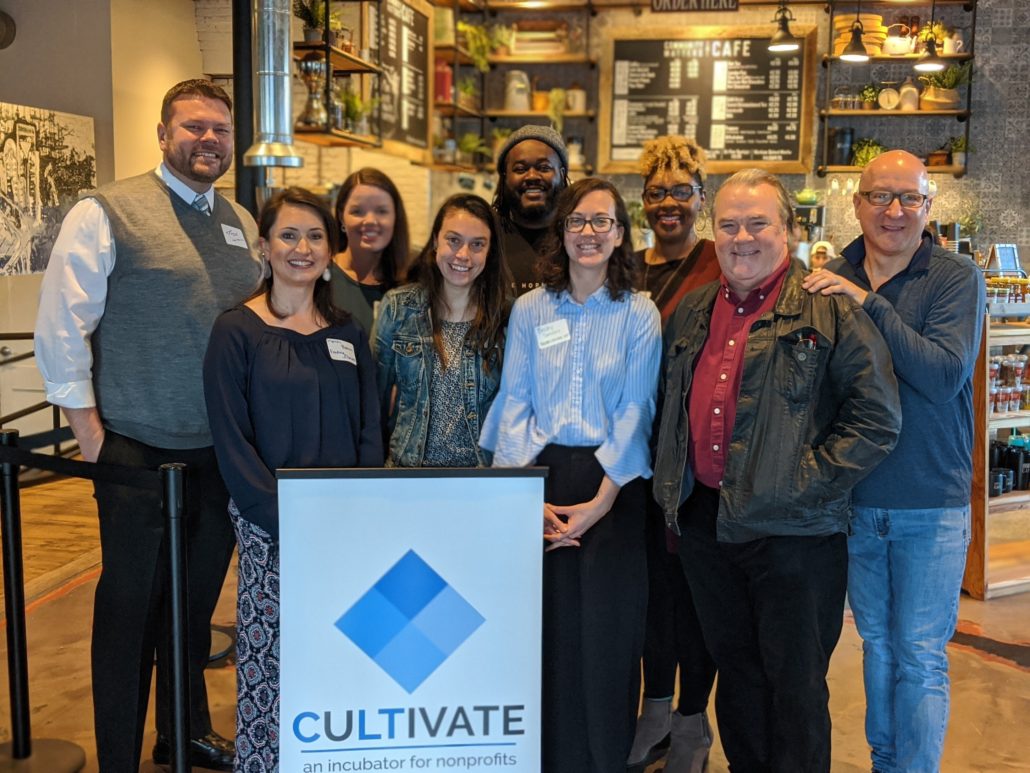
The 2020 Cohort and Charlie Elberson, Reemprise Fund, on March 12, 2020.

Last Friday at noon, dozens of leaders from the local social good community gathered together virtually to celebrate the graduates of the 2020 CULTIVATE cohort. One of our favorite events every year, the annual CULTIVATE graduation is an opportunity to honor and celebrate the six organizations who have completed our intensive year-long incubator for emerging nonprofits.

This year, CULTIVATE graduates include:

  • Ed Price – Chief Operating Officer, Charlotte Rescue Mission (Community Matters Cafe)
  • Mendy Godman – Co-Founder & Executive Director, Feeding Charlotte
  • Becky Santoro – Co-Founder & Executive Director, Foster Village Charlotte
  • Emmanuel & Adrienne Threatt – Co-Founders, Hope Vibes
  • Katie Phillips – Executive Director, Soccer Foundation of Charlotte
  • Charis Blackmon – Executive Director, West Side Community Land Trust

Friday’s event was as different from our 2019 Cohort Graduation as the year that preceded it. 2020 was both a challenge and a call to action for our participants — as Managing Director Josh Jacobson said in his opening words, “last year was a unique opportunity to demonstrate the power of community-embedded nonprofits, at a time when nimbleness and trust built with people experiencing crisis were the building blocks of Charlotte’s pandemic response.”

Leadership in the Face of Change

While the graduation is an opportunity to learn about each organization’s pathway forward, we also reflected on the many ways the 2020 Cohort rose to the challenges of the past year.

We saw Community Matters Cafe, shut down during the stay at home order, build new partnerships to keep students engaged and programming active. Hope Vibes launched not one but two new services — the Hope Tank and Solar Sinks — to increase access to important hygiene items and facilities for our neighbors experiencing homelessness. Foster Village leveraged its community to advocate — successfully — for the needs of foster children and families. Soccer Foundation of Charlotte created an entirely new program for children struggling with virtual learning. The West Side Community Land Trust made deep investments in permanent housing affordability. Feeding Charlotte developed dynamic new partnerships that helped keep catering companies afloat while providing meals to food access organizations.

What’s Next for the 2020 Cohort

What each graduate accomplished during the unprecedented events of 2020 is an inspiring reminder of the deep capacity of early-stage nonprofits, and many attendees resonated with the idea that “emerging” (as we call CULTIVATE cohort organizations) does not mean small impact.

As one attendee shared in the Zoom chat, “CULTIVATE — and each of these remarkable social innovators — is an antidote to anyone worried about our ability to creatively address and solve our toughest challenges.” We echo this sentiment, and encourage the Charlotte community to learn about what is next for the 2020 Cohort and get involved with our innovative graduates by clicking on the links below.

Community Matters Cafe

Website

Instagram

Feeding Charlotte

Website

Instagram

Foster Village Charlotte

Website

Instagram

Hope Vibes

Website

Instagram

Soccer Foundation of Charlotte

Website

Instagram

West Side Community Land Trust

Website

Instagram

Filed Under: Emerging Organizations

The Value Prop: A Mindset Shift for the Private Sector & Social Good

March 8, 2021 by nextstage Leave a Comment

Check out a past What’s Next? episode that explores the intersection of the private sector and social good. This episode features Blair Primas, Senior Vice President + Marketing & Talent Management of OrthoCarolina and John Searby, the Executive Director of Catawba Riverkeeper Foundation.  You can catch the full replay by clicking here to learn how social good is already showing up in companies across the region.

Blair Primis photo

“Give back to the community in which you do business and don’t just put it as a slogan on your website. You actually have to walk the walk and I think if you do that you find that consumers or in our case patients will think about your organization in a way where we become essential to the things that may not necessarily have anything to do with their muscles bones or joints. And that’s ultimately what we want to do and I oftentimes in fast I think I’ve said it before to both of you in the past. I sometimes think to myself like why doesn’t every company want to invest in the community that they’re apart of because doesn’t it make the community stronger, which means that people who move here stay here and those that want to move here actually do so which makes everything better. “– Blair Primas

P.S. Next Stage is launching a Social Good Report this spring. Sign up here to receive a copy when the report is launched.

The study will take a closer look at how the nonprofit and private sector can forge meaningful partnerships that create real community impact – and how next generation employees want to create impact through the workplace. Next Stage will build the report through research that includes:

  • Interviews with 50+ corporate and business leaders
  • Input from nonprofit leaders
  • A survey of 500+ local millennial and Gen-Z employees

Filed Under: Thought Leadership

  • « Go to Previous Page
  • Page 1
  • Interim pages omitted …
  • Page 5
  • Page 6
  • Page 7
  • Page 8
  • Page 9
  • Interim pages omitted …
  • Page 12
  • Go to Next Page »

Primary Sidebar

Footer

Subscribe to the Impact Insider

Your monthly roundup of social good news and trends

only_email

Who we are

What we do

Who we serve

resources

Newsletter

Careers

Let’s work together!

Contact Us

fb
in
ins

© 2026 Next Stage Consulting | All rights reserved | Privacy Policy